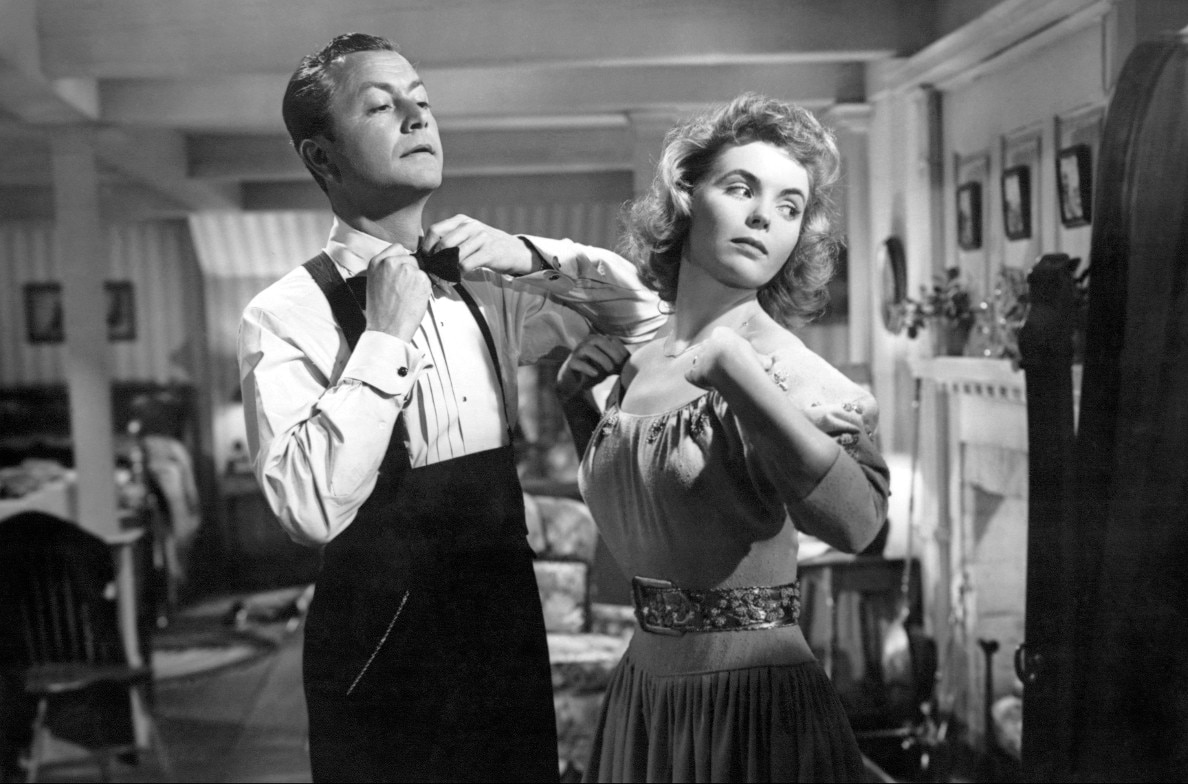
"Do you think marriage means the beginning and end of all human contact?" So asks David (Robert Young) of his wife Claudia (Dorothy McGuire) in Claudia and David (1946), a sequel to the hit movie Claudia (1943). In the first film, Claudia was an immature young bride adjusting to marriage. In the second, the couple continue to navigate their new life together as issues of motherhood and jealousy arise--especially after Claudia senses her husband spending a bit too much time with one Elizabeth Van Doren (Mary Astor). On the other hand, she's the recipient of a bit of extramarital attention herself, from dashing Phil Dexter (John Sutton).
Claudia had established Dorothy McGuire as a new screen star. It was her film debut, but she had already played the character to great acclaim on Broadway in a production that ran 722 performances from 1941-1943. That production had been a tremendous break: David O. Selznick bought the film rights to the play, signed McGuire to a movie contract and brought her to Hollywood. A few months later, he sold the property to Twentieth Century-Fox and also agreed to share McGuire's contract with that studio. After Claudia became a significant screen hit, Fox and Selznick were eager for a sequel, but McGuire refused, resulting in a suspension.
The suspension was short-lived, and McGuire soon starred in three more successful, now-classic films: The Enchanted Cottage (1945), A Tree Grows in Brooklyn (1945) and The Spiral Staircase (1946). The Enchanted Cottage also starred Robert Young as McGuire's husband. They made a good pair, and once again there was pressure for a Claudia sequel. But McGuire was still resistant: she badly wanted a part in RKO's Till the End of Time (1946) instead. Selznick agreed to loan her out for that role if she would finally make Claudia and David, and she agreed.
Claudia had originated as a series of short stories by Rose Franken about the trials and tribulations of a young married couple, published in Redbook and Good Housekeeping. In 1939, Franken published Claudia: The Story of a Marriage, the first of eight Claudia novels. A radio adaptation soon followed, as well as the Broadway play, which Franken herself wrote and directed. As the author's New York Times obituary put it, "Miss Franken's works displayed a steadfast conviction that marriage was a compound of gaiety and disaster, in which the partners matured as the result of shared experience. A woman, moreover, through fortitude understanding and perspective, could make marriage a happy estate. Although the notion of divorce might be entertained, it was not a viable alternative."
Claudia and David was directed by Walter Lang. Filming was briefly interrupted a week into production when Lang's mother died and he flew to Tennessee for her funeral -an extra-poignant occurrence since there are several references in the film to the death (in the first film) of Claudia's mother.
This was actor John Sutton's first film after two years in the Navy. Mary Astor makes an appearance on loan from MGM after having just played mothers in Thousands Cheer (1943) and Meet Me in St. Louis (1944), and she was happy for the change of pace. As she later wrote in her memoir A Life on Film: "I loved it. I wasn't anybody's mother and I looked lovely in beautiful clothes."
The film was not as big a phenomenon as the original Claudia, but it was well-received. The New York Times called it "a pleasant and touching picture in a strictly romantic vein... Walter Lang's capable direction has brought out the best in actors and script."
Variety pronounced it "one of those pictures that will have the women flocking to the box office. And gals' escorts won't have any special reason to complain... 78 minutes of solid entertainment... The picture has been given deluxe production throughout, with sets and technical details all of top quality."
According to an article of the day in The Hollywood Reporter, plans for a third Claudia film were squelched when it proved too difficult to fit into the schedules of both Dorothy McGuire and Robert Young.
By Jeremy Arnold
Claudia and David
by Jeremy Arnold | June 05, 2019
SIGN UP FOR OUR NEWSLETTERS

CONNECT WITH TCM