French master filmmaker Robert Bresson remains, for many
serious movieheads, the toughest nut to crack, the most
arduous tribulation of filmgoing. It's easy to understand
why: a Bresson film, like his timeless 1967 masterpiece
Mouchette, can seem as if it were conceived and
executed in active resistance against everything that
ordinarily makes movies blithely entertaining: spectacle,
expressiveness, drama, action, glamour, momentum,
sensuality, visual beauty. Cinema at its most popular has
been a rousing fulfillment of Richard Wagner's fabled
Gesamptkunstwerk the total art work, a massive
fugue of dramatic content, scale, sound, design,
composition, acting and theme. But Bresson's severe and
stiff-legged films are repudiations of that idea, and thus
require a measure of patience and attention we're not used
to bringing to movies.
His defiance in this regard is, of course, the key to his
brilliance. Like Mouchette, Bresson's films (or at
least his mature works, running from 1951's Diary of a
Country Priest to 1983's L'Argent) feel like
ghost stories experienced from the ghost's perspective
the unprofessional actors ("models," as he calls them)
never "act," but rather enact their gestured moments with a
stolid, ritualized lifelessness. The stories (more than
once derived from agrarian tragedian Georges Bernanos)
resemble Christian passions, and in fact Bresson has been
long pigeonholed as a "Catholic" filmmaker, although what
that may mean remains mysterious. He is totally focused on
the moral tragedy of human sin, to the exclusion of all
else, but calling a Bresson film "spiritual" is, it seems,
simply an escape hatch when you don't know what else to
call it.
Think of it this way: to reach the essential, moral truth
of his tales, Bresson simply lasers away everything he sees
as being false or prevaricating about movie storytelling.
Acting is pretending, so he insists his actors don't do it.
Fancy camera moves and pretty pictures are out. Bresson
knows every story is itself a contrivance, so he seeks to
make it obvious to a child's eye that he's presenting it
purely, without fabrication or filigree or masquerading as
"real." His camera moves, precisely, only to capture
details and gestures, which we are not supposed to
"believe" as anything except filmed details and gestures,
articulating a human dilemma. He doesn't try to "make" you
"feel" his protagonists' experience by virtue of being
alive and conscious, you should be sufficiently capable of
empathy and understanding on your own.
This is the same strategy of traditional Christian icons
and parables, for sure, but in terms of form it has less to
do with metaphysics than with ethical intent. The essence
is vital; the circumstances in which you receive it are
incidental, and shouldn't get in the way. Mouchette
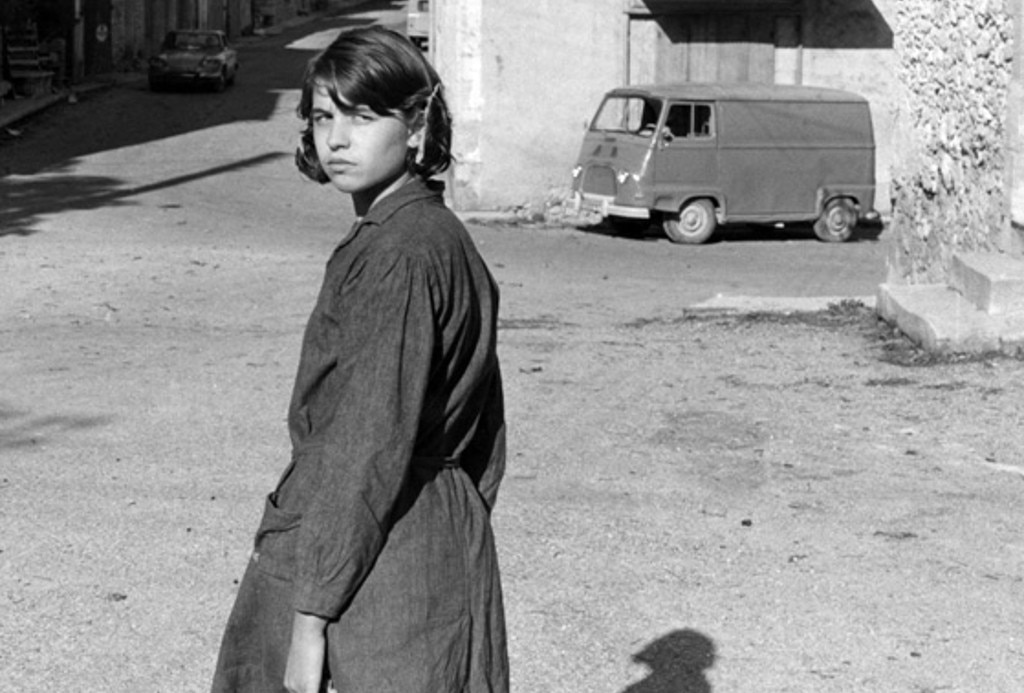
is a working paradigm this way it's a wounding, epochal
analysis of an abused teenage girl on her blank-faced way
to the grave. An inarticulate country waif with a dying
mother and an alcoholic father, Mouchette (Nadine Nortier)
is neglected, ritually humiliated, insulted and exploited
by everyone around her an all-too-common paradigm for
poverty-stricken, post-agricultural social settings, which
was surely Bernanos's point. Bresson is not shy about
metaphors: the opening involves the meticulous placing of
wire traps in the brush to snag innocent quail, and later
on the villagers indulge in a brutal hare shoot, both
sequences not so much representing Mouchette's victimhood
as demonstrating the cold-blooded dynamics of her world:
the violent will take, the weak will suffer. In Bresson's
no-nonsense hands, this grim fable becomes a pantomime
stations of the cross, completely focused on textural
minutiae a hand's movement, a dropped bottle, a look away
and implicit moral interrogation. Bad things happen
(including rape), but Bresson's cast is a remarkable tabula
rasa; we're faced with the cut-to-the-bone import of
violence or woe because the actors don't do the emotional
work for us.
Once you're onto Bresson's program, virtually every tightly
controlled shot and minimalist gesture in Mouchette
feels like a stab wound take one scene (as in, when the
recently raped girl allows her bed-ridden mother to guzzle
gin in bed and then wordlessly replaces the missing liquor
with tap water, as her mother begins to die in earnest
off-screen), and imagine another moviemaker managing it
with as much devastating precision. The effect is not a
comfortable display of angst or mournfulness in which we
could ostensibly admire the craft of the actors as we
simultaneously sniffle but an immediate sympathy,
emanating from the inside out. Bresson corners you into
intimacy, without making it easy or easily forgotten.
A notoriously ill-kept classic, Mouchette has
largely been seen in the last decades on bootleg VHS copies
and beat-up television prints. And so, perhaps more than
most of Criterion's recent titles, its restoration and
pristine presentation is a gift in a time of regrettable
cinematic illiteracy and slope-headed sensationalism. And,
as always, the disc comes lugging exegesis, including an
audio commentary by old-school scholar/critic Tony Rayns,
two TV docs about Bresson on the Mouchette set, an
essay by author Robert Polito, and the unmistakably
Godardian theatrical trailer, assembled by Jean-Luc
himself.
For more information about Mouchette, visit The Criterion Collection. To order
Mouchette, go to
TCM Shopping.
by Michael Atkinson
Mouchette - Robert Bresson's MOUCHETTE on DVD From The Criterion Collection
by Michael Atkinson | October 30, 2006
SIGN UP FOR OUR NEWSLETTERS

CONNECT WITH TCM