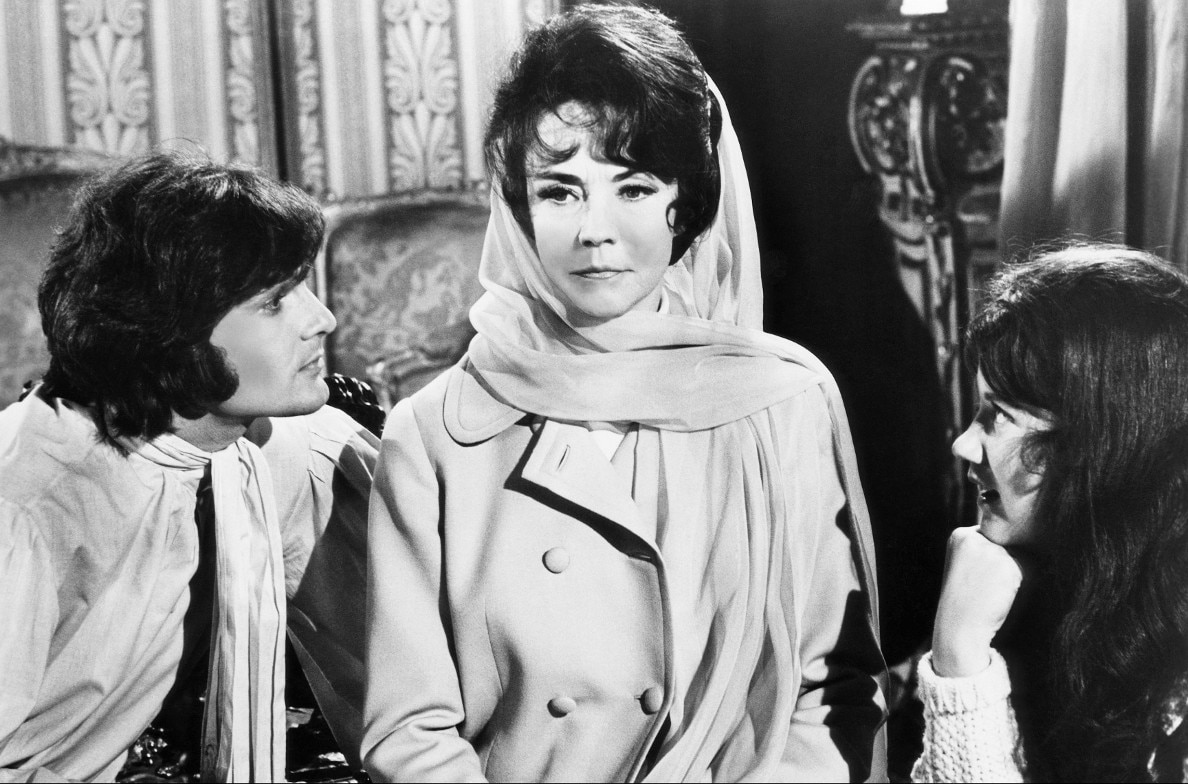
Jennifer Jones' personal and professional careers were in turmoil when she starred as a former stag movie actress in the AIP exploitation film Angel, Angel, Down We Go (1969). Fifty years later, it's still shocking to hear the beloved actress who earned her Best Actress Oscar for her saintly turn in The Song of Bernadette (1943) uttering such lines as "I made 30 stag films and never faked an orgasm" and "In my heart of hearts I'm a sexual tramp."
For over two decades, her mentor/husband, Oscar-winning producer David O. Selznick, had carefully controlled Jones' image and career. Besides the Oscar for The Song of Bernadette, Selznick guided her to Oscar nominations for Since You Went Away (1944), Love Letters (1945), Duel in the Sun (1946) and Love Is a Many-Splendored Thing (1955). Selznick's micro-management didn't always work according to Jones' son Robert Walker Jr. "They were awfully picky," he told the L.A. Times in 2010, a year after her death at the age of 90. "I am sure, he was getting a lot offers, but a lot of people didn't want to deal with Selznick. He interfered so much."
Before Angel, Angel, Down We Go, Jones only made two other films, both flops: Tender Is the Night (1962) and The Idol (1966). The latter she made after Selznick's death in 1965. The biggest headlines Jones received during the decade was for her highly publicized suicide attempt in 1967.
Angel, Angel, Down We Go casts Jones as Astrid Steele, a jewelry-obsessed narcissist living the high life in Beverly Hills with her wealthy husband (Charles Aidman), who loves taking showers with young men. Folk singer and social activist Holly Near plays their overweight, awkward teenager daughter Tara--Astrid named her after the house in Gone With the Wind--who also happens to be a pilot. Tara falls under the spell of rock singer Bogart Peter Stuyvesant (Jordan Christopher) and his gang, which include Roddy McDowall and Lou Rawls. After Tara introduces Bogart to her parents, the young man weaves his spell over Astrid leading to an embarrassing love scene between the two and a deathly parachute jump out of Tara's plane.
According to Edward Z. Epstein's biography Portrait of Jennifer, there were many theories as to why she took the role. "One is that Jennifer decided to shed her old image after the suicide attempt and present herself from a totally different and far less serious perspective," said Epstein. "Another theory was that Jennifer was trying to appeal to both a contemporary audience and contemporary filmmakers."
Angel, Angel, Down We Go was also a bit of a "prestige" picture for AIP. Aidman had starred in, written, directed and composed the music to the 1963 Broadway production of Spoon River Anthology and had appeared in several films and TV series, while Christopher had been the lead singer of The Wild Things and married Sybil Burton in 1966. The film also marked the directorial debut of screenwriter Robert Thom, who had penned Wild in the Streets (1968), the acclaimed counterculture political satire starring Christopher Jones. He never directed another film.
Jones, who turned 50 during the production, certainly looks fabulous thanks to the veteran hairstylist Sydney Guilaroff and make-up artist William Tuttle, and she attacks her role with vigor and conviction though hard times prevailed in her personal life. Epstein noted that production dragged on for months. "Sometime in May, Jennifer learned from her father that her mother had passed away. It was yet another piece of tragic news; but Jennifer swallowed her grief and carried on."
A month after production was completed, Angel, Angel, Down We Go was released in theaters on Aug 19, 1969 just 10 days after the Manson murders. The film was skewered by the critics with the New York Daily News pondering "Jennifer Jones - how did she ever get mixed up in such a weird production?" The L.A. Times declared the performances were wildly uneven "with Jennifer Jones perhaps fairing the best. (Her fear of aging rings with decided conviction.)" And The Hollywood Reporter noted, "Miss Jones's once mannered twitch has become an unpleasant snarl; in no way softened by the lines she is forced to mouth."
Even the Grindhouse and drive-in moviegoers didn't turn out for Angel, Angel, Down We Go. AIP wasn't willing to give up on the flop and re-released it in early 1971 as The Cult of the Damned. The name change didn't help. However, the movie has garnered some praise over the years as newer generations have revisited it, and it's worth watching because it is so bizarre. Thank goodness, it wasn't Jones's final film.
She married industrialist and art collector Norton Simon in 1971 and received a Golden Globe nomination for her last film, the disaster blockbuster The Towering Inferno (1974). After the suicide death of her only daughter, Mary Jennifer, in 1976, Jones and her husband created the Jennifer Jones Simon Foundation for Mental Health and Education, which she ran until 2003.
The last six years of her life she lived with Walker Jr. and his family in Malibu. "The children gave her such pleasure," he noted. "She gave the children so much. She looked beautiful up until the end. There was something that glowed about her."
By Susan King
Angel, Angel, Down We Go (aka Cult of the Damned)
by Susan King | May 21, 2019
SIGN UP FOR OUR NEWSLETTERS

CONNECT WITH TCM