Throughout production, Mark of the Vampire was known as Vampires of Prague.
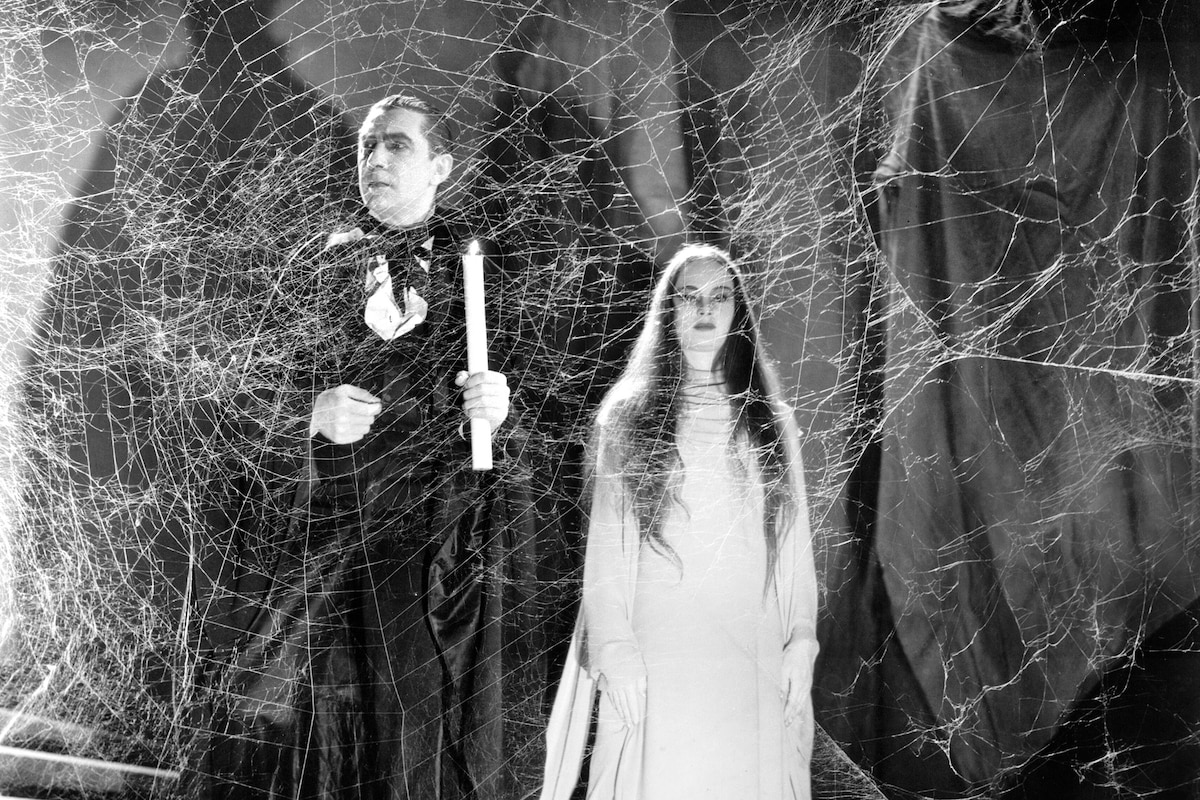
For the role of Luna, the flying vampire girl, MGM screen tested numerous starlets -- including a young Rita Hayworth -- before settling upon the otherworldly Carroll Borland.
For her flying scene, Borland was rigged with mechanical wings. She later recalled, "Large bat wings were attached to my back and I was supposed to flap them up and down...I had a bar that went from the back of my neck to my ankles. Sometimes they would lower the tail wires first and I'd end up landing on my nose. Sometimes they did well and I landed on my stomach...Then, when they had just about got it right, Mr. Browning decided that he wanted me to fly in a different direction. So we had to wait while the construction team tore out a wall and rehung the track."
We only see Luna flying in one brief scene of Mark of the Vampire, but the film's theatrical trailer includes additional footage of her flapping about the haunted castle.
Mark of the Vampire was photographed by legendary cinematographer James Wong Howe.
Browning filled the decrepit Borotyn manor with a variety of vermin. In addition to the usual bats, spiders and rats, he expanded the haunted-house menagerie to include cockroaches, opossums and a peculiar "shaggy, wolf-like beast" that haunts the cemetery (and can be briefly glimpsed in one scene). The original screenplay called for lizards, but none are evidenced in the finished film.
When asked about working with Browning, Borland replied, "He was a great big negative. 'Carroll, I want you to walk in front of Lugosi. You're going to be holding a candle, so look out for your hair.' 'What am I supposed to do?' 'Walk over and down the steps and walk out.' That was it. He simply expected Lugosi and me to be vampires. Everybody asks me, 'What was it like working with Tod Browning?' The answer is, I didn't work with Tod Browning. Tod Browning told me to go out and go down the steps!"
Browning reportedly withheld the final pages of the screenplay from the actors, so they would not know the details of the surprise ending until it was time to film.
DELETED SCENES:
After the "old crone" (Jessie Ralph) is spooked by a bat in the cemetery in the opening sequence, she returns to her "tumbledown, weather-beaten shack" in a state of superstitious hysteria. There, she harangues and abuses her "thin...albino daughter" for letting her cauldron of herbs burn too long. Although deleted from the final cut of the film, the albino waif would return in Browning's following film, The Devil-Doll (1936).
The bloody wound on Count Mora's (Bela Lugosi) temple is never explained in the film. The screenplay features a scene in which a villager tells the coroner that, 300 years previously, Count Mora strangled his own daughter (Luna) and then shot himself in the head.
In one deleted scene, Professor Zelin (Barrymore) examines a sleeping bat... that might be a vampire. "He straightens up and brings his head on a level with the bat -- stands there, studying it... Slowly the little beady eyes of the bat open -- and stare at the Professor... He stares back at the bat... its eyes blazing... The pupils of his eyes dilate -- then grow filmy. Slowly his head moves forward -- nearer the bat... The Professor's face draws slowly closer and closer -- as if drawn by some hypnotic power... Professor: 'I wish I knew! Could it be!'"
Sources:
The Films of Bela Lugosi by Richard Bojarski
The Immortal Count: The Life and Films of Bela Lugosi by Arthur Lennig
Lugosi: The Man Behind the Cape by Robert Cremer
Hollywood Cameramen by Charles Higham
The Barrymores: The Royal Family in Hollywood by James Kotsilibas-Davis
The Horror People by John Brosnan
Compiled by Bret Wood
Insider Info (Mark of the Vampire) - BEHIND THE SCENES
by Bret Wood | October 26, 2006
SIGN UP FOR OUR NEWSLETTERS

CONNECT WITH TCM