Browning's other "Old Dark House" films include The Eyes of Mystery (1918), London After Midnight (1927) -- neither of which survives today -- and his first sound film The Thirteenth Chair (1929).
Prior to shooting Mark of the Vampire, Browning was collaborating with William Faulkner on a drama entitled Ruby (aka Dance Hall Daisy) that takes place on the Louisiana bayou. Both were removed from the project, which eventually reached the screen as Lazy River (1934).
To insure the secrecy of the climax, MGM forbade theater ushers to seat anyone during the last fifteen minutes of the picture.
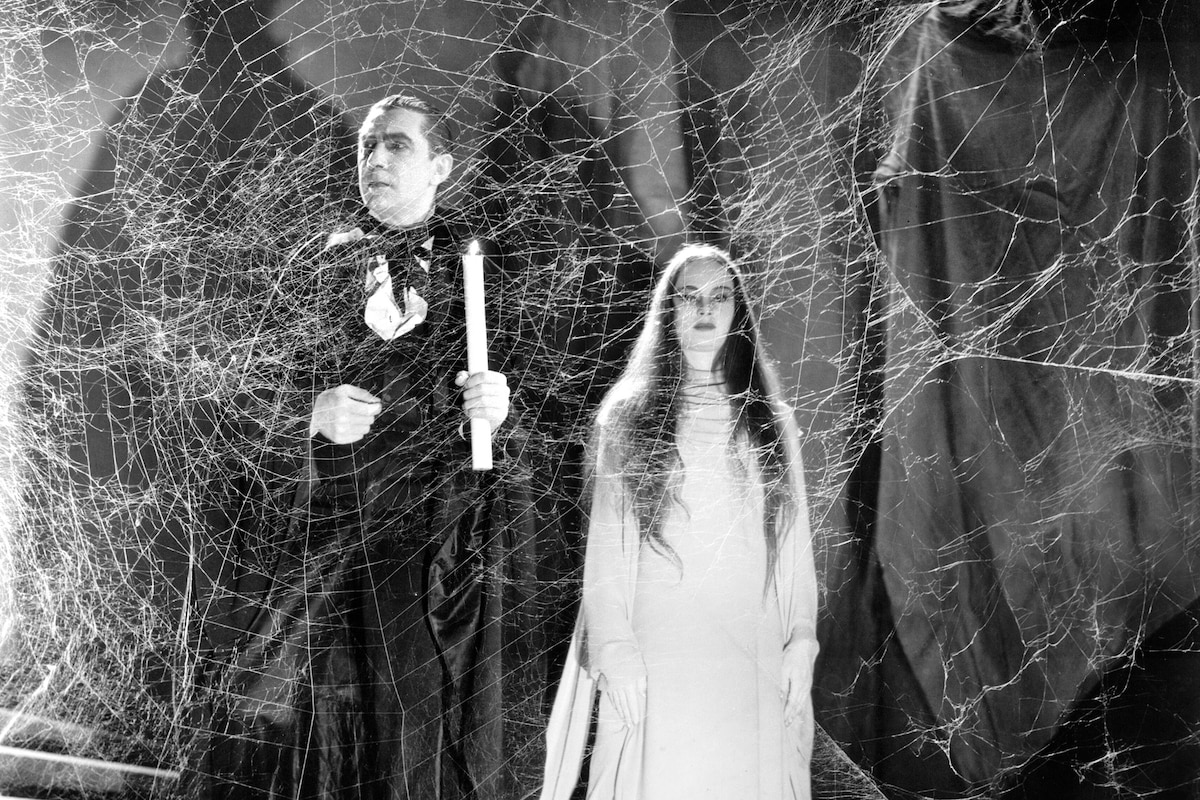
It took three actors to play the roles that had been played by only one in London After Midnight. In Mark of the Vampire, Lugosi portrayed the creeping vampire, Lionel Atwill played the investigating officer, and Lionel Barrymore is the specialist in hypnosis and the supernatural. In London After Midnight, they were all played by Lon Chaney.
Lionel Atwill, who stars as Inspector Neumann, was a popular leading man in horror films of the period, in Doctor X (1932), The Vampire Bat (1933), Mystery of the Wax Museum (1933), and Murders in the Zoo (1933). Atwill was embroiled in several Hollywood scandals over the course of his career. In his notoriously inflammatory book Hollywood Babylon II, Kenneth Anger devotes a remarkable eighteen pages to Atwill's proclivities and peccadilloes.
The innkeeper who discourages travelers from continuing their nocturnal journey was played by Michael Visaroff, who played virtually the same role in Dracula.
Jean Hersholt, who portrays the neighbor and guardian of the menaced Irene Borotyn (Allan), had a long career as a character actor (including Erich von Stroheim's Greed [1924]). He helped established the Motion Picture Relief Fund in 1939 (to benefit industry employees who had fallen on hard times). This eventually begat the Motion Picture Country House and Hospital (a retirement home for Hollywood professionals). He also served as president of the Academy of Motion Picture Arts and Sciences for several years. Today, Hersholt is best known for the honorary Academy Award that bears his name, given to an "individual in the motion picture industry whose humanitarian efforts have brought credit to the industry."
Upon the film's release, it was angrily attacked by a medical doctor: "There is a good deal of criticism of obscene and vulgar movies. Many of them are bad enough. But a dozen of the worst obscene pictures cannot equal the damage that is done by such films as The Mark of the Vampire [sic].
"I do not refer to the senselessness of the picture. I do not even refer to the effect in spreading and fostering the most obnoxious superstitions. I refer to the terrible effect that it has on the mental and nervous systems of not only unstable, but even normal men, women and children.
"I am not speaking in the abstract; I am basing myself on facts. Several people have come to my notice who, after seeing that horrible picture, suffered nervous shock, were attacked with insomnia, and those who did fall asleep were tortured by the most horrible nightmares.
"In my opinion, it is a crime to produce and to present such films. We must guard not only our people's morals -- we must be as careful with their physical and mental health." -- William J. Robinson, M.D., printed in The New York Times.
The Production Code Administration had few problems with Mark of the Vampire, but other censor boards required certain cuts, including: the scene in which Otto pulls at Sir Karell's neck in preparation for puncturing the skin with scissors (Pennsylvania); a shot of "vermin crawling over girl's robe -- and rats across path" (Alberta, Canada); the image of a "Roman Catholic cross on the spire of a church" (Austria); and footage of "methods showing how murder was committed" (England). Hungary, Poland and Italy rejected the film altogether, though Hungary later permitted the film to be shown, after the wholesale removal of "all the 'horror' shots [including] all screams throughout the picture... shots of bats and spiders, and the more gruesome shots of the vampire."
The hollow-eyed gypsy woman in the opening sequence was portrayed by Louise Emmons, a character actress who frequently appeared (without credit) as an old hag in Hollywood. She was a favorite of Browning's and can also be glimpsed in his films The Blackbird (1926), The Unknown (1927), West of Zanzibar (1928). Mark of the Vampire was her last screen appearance.
Sources:
The Films of Bela Lugosi by Richard Bojarski
The Immortal Count: The Life and Films of Bela Lugosi by Arthur Lennig
Lugosi: The Man Behind the Cape by Robert Cremer
Hollywood Cameramen by Charles Higham
The Barrymores: The Royal Family in Hollywood by James Kotsilibas-Davis
The Horror People by John Brosnan
Compiled by Bret Wood
In the Know (Mark of the Vampire) - TRIVIA
by Bret Wood | October 26, 2006
SIGN UP FOR OUR NEWSLETTERS

CONNECT WITH TCM