Freaks is based on the short story "Spurs," written by Clarence Aaron "Tod" Robbins, who was the author of The Unholy Three, also made into a film by Browning. "Spurs" was originally published in Munsey's Magazine in February 1923.
According to one source, Browning was introduced to the story by Cedric Gibbons, the head of the MGM Art Department. He was supposedly boyhood friends with Robbins and convinced the studio to purchase film rights for the sum of $8,000. Another source claims that the diminutive actor Harry Earles gave Browning a copy of the story during the production of The Unholy Three in 1925, in hopes that he could star in the adaptation.
Robbins's story has essentially the same plot but a radically different ending. In it, Jacques Courbé, "the Dwarf of Copo's Circus" avenges himself upon the beautiful bareback rider Jeanne Marie by riding her like a horse across Europe, goading her with sharp spurs attached to his ankles. The strong man, Simon Lafleur, is attacked by Courbé's wolf dog.
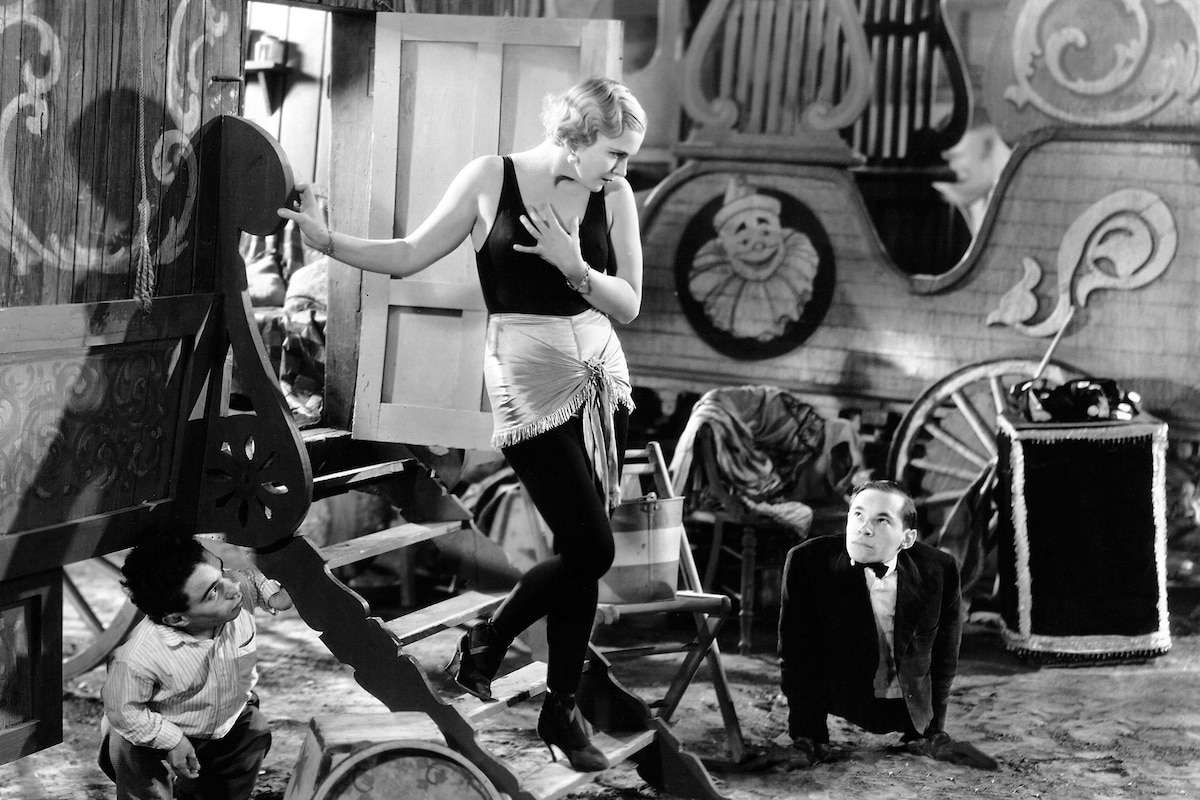
In order to populate the story with authentic sideshow performers, studio agents were dispatched with movie cameras across North America to photograph the most striking human curiosities they could find. During the filming, all the "freaks" and their managers were lodged in a boarding house in Culver City and carted to and from the studio each day.
Several complaints were filed by MGM personnel who objected to the presence of the "freaks" in the studio commissary. Samuel Marx, head of the Story Department, recalled with peculiar pride, "Suddenly we who were sitting in the commissary having lunch would find Zip the What-Is-It? sitting at the next table, or the Siamese twins, who were linked together. And half the studio would empty out when they would walk in because the appetites went out. And so, Harry Rapf, who was a great moral figure, got a bunch of us together and we went in and complained to Irving [Thalberg] about Freaks. And he laughed at that. He said, 'You know, we're making all kinds of movies. Forget it. I'm going to make the picture. Tod Browning's a fine director. He knows what he's doing.' And the picture was made." But the lunchroom protests didn't end. As a result, a makeshift table was constructed and the cast of Freaks (with the exception of Harry and Daisy Earles, Violet and Daisy Hilton, and the more "normal" cast-members) were forced to eat their meals outdoors. (see photo)
Born in Moscow in 1896, Olga Baclanova trained as a teenager at the Moscow Art Theatre. While the company was on tour on New York, she defected and moved to Hollywood. Her best known early role was as the femme fatale in Paul Leni's thriller The Man Who Laughs (1928). Usually billed simply as "Baclanova," the actress later recalled the day when she was first introduced to the supporting cast, "[Browning] shows me little by little and I could not look, I wanted to faint. I wanted to cry when I saw them. They have such nice faces... they are so poor, you know... [Browning] takes me and say, you know, 'Be brave, and don't faint like the first time I show you. You have to work with them.'... It was very, very difficult first time. Every night I felt that I am sick. Because I couldn't look at them. And then I was so sorry for them. That I just couldn't... it hurt me like a human being."
Film editor Basil Wrangell had a less sympathetic reaction to the sideshow performers, "It was bad enough to see them during the day when you'd go down on the set or have to go by their eating quarters, but when you had to look at it on the moviola for eighteen hours a day, it was enough to make you crawl up the walls."
Johnny Eck, the half-boy, remembered his screen test was taken by MGM's scouting unit while he was on tour in Canada, and he shared the screen with the world's largest rat. He recalled being treated well by the crew, "The technicians, the sound men, the electricians, and the prop department, and everybody... was my friend... We got along beautifully."
Browning recalled that it was often difficult to communicate with some of the sideshow performers who were mentally impaired, such as Schlitze Metz, Elvira Snow and Jenny Lee Snow, "They were not easy to work with...They are like little children, and sometimes took hours for them to understand what was wanted. When they weren't working they would retire to a corner of the set." In another interview, he stated, "They had to be humoured like children. Once in a while they became upset, angry, and would try to vent their rage in biting the person nearest to them. I was bitten once. But considering everything, we had little trouble."
The stress of working with untrained actors, however, proved difficult for Browning, "It got to the point where I had nightmares. I mean it. I scarcely could sleep at all. There was one terrible dream in which I was trying to shoot a difficult scene. Every time I started, Johnny Eck, the half-boy, and one of the pinheads would start bringing a cow in backwards through a door. I'd tell them to stop but the next take they'd do it all over again. Three times that night I got up and smoked a cigarette but when I went back to bed I'd pick up the dream again."
While Olga Roderick, the bearded lady, later regretted appearing in the film, most of the cast considered the making of Freaks a pleasurable experience. The cast presented Browning with a gift upon the completion of filming: a gold locket in the shape of a tiny book. On each of its golden pages were engraved the names of the sideshow performers who were about to be immortalized.
Freaks was produced on a 36-day shooting schedule beginning November 6, 1931, and was completed on a budget of $316,000.
DELETED SCENES:
According to the screenplay, the scene in which Madame Tetrallini introduces the wandering land-owner to the performers frolicking in the woods ran quite a bit longer. It included additional dialogue that endeavored to humanize the so-called freaks. She tells him they are "always in hot, stuffy tents -- strange eyes always staring at them -- never allowed to forget what they are." Duval responds sympathetically (clearly the stand-in for the viewing audience), "When I go to the circus again, Madame, I'll remember," to which she adds, "I know, M'sieu -- you will remember seeing them playing -- playing like children... Among all the thousands who come to stare -- to laugh -- to shudder -- you will be one who understands."
The film as it exists today does not make it clear, but the seemingly normal characters of Venus and Phroso have their own afflictions (and are, therefore "freaks" themselves). She is sex-starved and he is impotent (making them indeed an odd couple). In one scene she tells Phroso angrily, "Sleep isn't all a girl needs... I'm tired of sitting around like a sap. I'm going to look for a couple of sailors -- see the town -- and have some fun." This scene never made it past the script-censors. It was rewritten (without Browning's involvement) to have Venus dream of, "having good times -- going places, doing things... falling in love -- getting married -- having kids."
Much of the film's sexual humor was stripped away in the recut version. One scene showed Roscoe (who performed
in drag) removing the padding from his bra as he changes costumes. Another showed a trained seal amorously following the "Seal Woman" as she makes her way to her wagon. When Hans catches Cleo kissing Hercules, she cruelly says, "Don't worry, my little precious -- there's more than you can ever use."
Numerous other bits of dialogue were removed that depicted the "normal" humans as disgusting creatures and the "freaks" as gentle and sympathetic (destroying the social critique of intolerance Browning was attempting to construct). While the circus awaits word on Hans's declining health, one of the Rollo Brothers coldly remarks, "You'd think the world was coming to an end -- just because a mangy freak's got a hangover." In another scene, Madame Tetrallini responds to the Rollos' taunts by defending the humanity of her "children," "Augh, you cochons -- you beasts... They are better than you -- all of them -- you two dogs!"
After the "freaks" exact their vengeance upon Cleopatra and Hercules, the film showed Phroso and Venus, now married, visiting Tetrallini's Freaks and Music Hall (no longer a traveling circus) three years later. There, they learn that Hans and Frieda have moved to Australia, married and have had a child. While visiting their old friends, Phroso and Venus are surprised to learn that Cleopatra and Hercules now work for Mme. Tetrallini. The beautiful acrobat is now the Duck Woman, and Hercules is a soloist (singing in the high tenor of a castrato). The film was to end as Hercules begins a soft romantic song... and from across the building comes his lover's reply, "Quack quack."
The reunion of Hans and Frieda, seen at the end of most prints, was not part of Browning's original cut, but was added during the re-editing to give the film a happier ending.
Sources:
Cult MOvie Stars by Danny Peary
Cult Movies by Danny Peary
An Illustrated History of the Horror Film by Carlos Clarens
The Horror People by John Brosnan
Dark Carnival: The Secret World of Tod Browning by David J. Skal & Elias Savada
Magill's Survey of Cinema
Shock (ed. Stefan Jaworzyn)
The Monster Show: A Cultural History of Horror by David J. Skal
Midnight Movies by J. Hoberman & Jonathan Rosenbaum
Insider Info (Freaks) - BEHIND THE SCENES
by Bret Wood | October 26, 2006
SIGN UP FOR OUR NEWSLETTERS

CONNECT WITH TCM