Dwarf John George appeared in Browning's The Unknown [1927], The Road to Mandalay [1926] and both versions of Outside the Law [1920, 1930]. But -- for reasons unknown -- he does not appear in Freaks, even though a role was specifically written for him in the screenplay.
The role of Cleopatra, the femme fatale, was originally offered to Myrna Loy, while Jean Harlow was at one time slated to portray Venus, the beautiful animal trainer. Harlow had appeared in Browning's previous film, Iron Man (1931) at Universal.
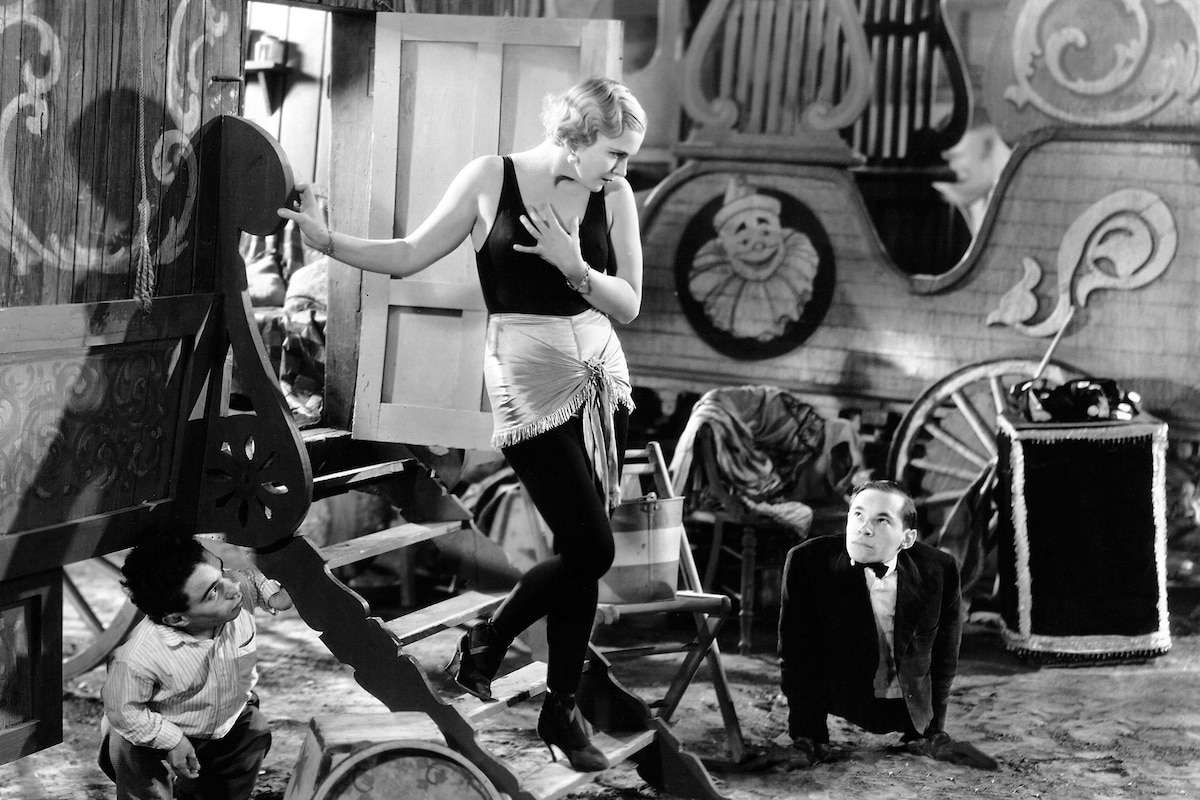
Harry and Daisy Earles (who play an engaged couple in Freaks) were actually brother and sister. Along with sisters Grace and Tiny, they performed as "The Doll family." Harry (whose real name was Kurt Schneider) emigrated to the U.S. from Germany circa 1915. They adopted the last name Earles because it was the name of a man for whom they worked shortly after their arrival in the U.S. After making Freaks, they performed in the Ringling Brothers Circus. They occasionally appeared in other films, such as The Wizard of Oz (1939) and The Greatest Show on Earth (1952). Harry died in 1985. Daisy (birth name - Hilda Schneider) died in 1980.
According to the screenplay, the correct spelling of the circus folk's ceremonial chant is "Gouble Gobble."
The first preview screening of Freaks was held in early January 1932. Audience response was overwhelmingly negative, and it was reported that one person ran screaming from the auditorium.
One woman, after seeing Freaks, wrote a letter to Browning at MGM, exclaiming that "You must have the mental equipment of a freak yourself to devise such a picture." Another viewer complained, "To put such creatures in a picture and before the public is unthinkable."
A Nashville, Tennessee, woman wrote a letter to Photoplay magazine, "I had a friend who threatened to sue the theater that showed Freaks for bringing such a picture to the place. For me, I thank the theater heartily, for it shows us that there are others who are much worse off than we."
Although Thalberg decided to recut the picture immediately after the disastrous test screening, he could not cancel the world premiere on January 28 at the 3,000-seat Fox Theatre in San Diego. This is the only venue at which the uncut Freaks is known to have played. Ironically, the unexpurgated Freaks was a major box-office success. Crowds lined up around the block to see the picture, which broke the theatre's house record. By the end of the run, word had spread that Freaks was about to be butchered, and the theatre advertised, "Your last opportunity to see Freaks in its uncensored form!"
Only a handful of reviews of the uncut Freaks survive. One calls it "rather gruesomely dramatized for the edification (or education) of those morbid persons who enjoy gazing upon unfortunate, misshapen, cruelly deformed humanity." Not all the reviews were negative. The San Diego Sun wrote, "'Freaks.' The word makes the ordinary type of people shocked. However, in this brand-new type of production, a new side of their lives is given...Without a doubt, this is a wonderful picture."
Once Thalberg decided to re-edit Freaks, the release date was pushed back from January 30 to February 20, 1932. Its running time was shortened from 90 minutes to 60.
Freaks was a pet project of Browning's. As early as 1927 there are newspaper reports of his enthusiasm for the property. By 1931, he had convinced production head Irving Thalberg that the film was going to be a smash. A studio newsletter sent to exhibitors observed, "Get the boss started on the subject of Tod Browning's Freaks and he'll keep it up for hours. We don't remember when he has been more enthusiastic about anything than he is right now about this one."
The "Duck Woman" costume seen at the end of the film was actually designed for Lon Chaney to wear in Browning's 1928 film West of Zanzibar. When that scene was cut from the film, the costume was stored in a prop warehouse for four years, until Browning could devise a new use for it.
The studio's advertising guides encouraged theatres to decorate their marquees and lobbies in the manner of carnival sideshows. They also splashed the theatre-fronts with banners that piqued the prurient curiosity of passers-by, with questions such as, "Do Siamese Twins make love? Can a full-grown woman truly love a midget? Do the pin-heads think? What sex is the half-woman half-man?"
The public response to Freaks was wildly varied. Some cities had sellout crowds (Minneapolis, Buffalo, Cleveland, Houston, St. Paul, Omaha), while others fell far below their weekly averages (New York, Los Angeles, Chicago).
Freaks did not play in New York until July 8, 1932 (at the Rialto Theatre), five months after its first commercial release.
Although there was no ratings system in America at the time, most theatres required that only viewers age 18 and older be allowed to view the film.
In Great Britain, Freaks was banned for 30 years.
Freaks sent shock waves through the MPPDA (the industry censor board that was quickly gaining power, and would eventually evolve into today's MPAA ratings board). Jason S. Joy wrote to the organizations figurehead, Will Hays, expressing concern about the blossoming horror movie genre, mentioning Freaks specifically. "Is this the beginning of a cycle which ought to be retarded or killed?" The MPPDA had managed to stop the growth of teenage gang films in April 1931 by imposing an informal ban upon them... and might have easily done the same thing to the horror film.
The industry watchdog publication Harrison's Reports devoted numerous articles to Freaks. One said, "Any one who considers this entertainment should be placed in the pathological ward in some hospital." Their official review of the film said, "It is not fit to be shown anywhere," yet the critic admittedly had not seen the film. Yet another article urged theatre-owners to use the film as a political weapon. "Book the picture on a Monday, or Tuesday, or any other slow week day. Announce that on that day your theatre will remain closed because you are unwilling to become an instrument of demoralization among the people of your community by showing such a picture. Show the picture on that night to invited guests consisting of the most prominent persons of your town -- ministers, priests, rabbis, the Chief of Police, Mayor, alderman, the heads of all civic and fraternal organizations. After they see the picture, make a speech to them, or have a good speaker make it for you, pointing out the kind of pictures they are producing at Hollywood and are forcing you to show."
Freaks was pulled from the theater in the middle of its Atlanta run, and replaced with a more innocuous depiction of sideshow life, Polly of the Circus (1932).
When MGM closed its books on Freaks after its initial theatrical run, it was tallied as a financial loss of $164,000.
The two-and-a-half minute title scroll that opens some prints of the film -- which provides historical information on "freaks" through the ages -- was not part of the original theatrical release. This text was added by exploitation film distributor Dwain Esper, who licensed the film from MGM in 1948. This device was typically employed by "exploiteers" to put an educational spin on their films and thereby justify the presence of sex, violence, drug use and other displays of vice typically absent from the screen. Esper rereleased the film at independent theatres, promoting it with sensational ad campaigns. To get extra mileage from the film, he also released it under the titles, Nature's Mistakes and Forbidden Love.
After Dwain Esper exhibited Freaks on the grind-house circuit, the film fell into obscurity. It was resurrected for the 1962 Cannes Film Festival, where it was suddenly proclaimed a neglected classic. Film archivist and repertory programmer Raymond Rohauer obtained the rights and marketed it as a cult film.
When Freaks was made, Siamese twins Daisy and Violet Hilton had already survived severe child abuse and established themselves as highly-publicized and -paid entertainers. In 1951 they starred in their own murder mystery film Chained for Life. In the 1940s and '50s, their business ventures met with little success. Their careers as professional entertainers ended when a shady promoter brought them to a Charlotte, North Carolina, drive-in in 1962, then abandoned them after the show. Daisy and Violet found jobs at a local supermarket and worked there until their deaths by natural causes at age 60.
Schlitzie Metz (credited in the film as Schlitze) was reputed to be the sole surviving descendent of the Aztec race, but she was, in fact, a he. According to Daniel Mannix's book Freaks: We Who Are Not As Others, he wore a dress "because it was easier to take care of his toilet needs if he wore skirts... Schlitzie was in show business for thirty years and then his manager -- or to be more explicit about it, his owner -- died. The side show wanted to keep Schlitzie, but the state insisted on putting him in an institution... [sideshow operator] Sam Alexander... went to see him and found poor Schlitzie literally dying of loneliness. The attendees in the mental institution were far too busy to pay any attention to him and Schlitzie was pining away. Alexander managed to persuade the authorities to release Schlitzie to him, and once again Schlitzie was happily on the road. He lived to be eighty, dying in California."
In 1971, a 68-year-old tattooed dwarf named Colonel Montague Addison wrote a letter to Films in Review condemning Freaks: "Our reaction to Tod Browning's exploitation of us is every bit as indignant over stereotyping as that of the blacks today. I avoided seeing Freaks for years on the advice of my freak friends. When I finally did see it my worst fears were realized. While pretending sympathy and understanding for a defenseless minority group, Freaks actually exploits and degrades us, in a manner that is hokey as well as offensive."
Olga Baclanova (Cleopatra) recalled an experience that, years later, reminded her of the project. "I went with my husband to the circus when the circus was here much later, and they say, 'the midgets are downstairs,' and I go down and they shout 'Baclanova! Baclanova!' And they were just the same as when I make the picture."
The story of Johnny Eck, the half-boy, has a less satisfying conclusion. He was invited to appear in Browning's 1936 film The Devil-Doll, but Eck and his manager argued over the terms. Their partnership ended and Eck did not appear in the film. He later wrote in his unpublished autobiography, "Many nights I would cry, lying awake in the dark, thinking of how really wonderful and exciting [it would be] to be working in front of the cameras on all the different giant sound stages. I got to know each member of the film crew. I was accepted not as a Monster Freak -- but as one of them -- not twenty inches tall, but a miniature super-man! Best of all, I was special to director Tod Browning and his assistant Errol Taggart. I would ride many times along side of these great men on a big camera dolly while they were shooting scenes. Now it was all over." Eck withdrew from the public eye after he was savagely beaten by burglars who invaded his home in the early 1980s. He died a recluse in 1991.
Sources:
Cult MOvie Stars by Danny Peary
Cult Movies by Danny Peary
An Illustrated History of the Horror Film by Carlos Clarens
The Horror People by John Brosnan
Dark Carnival: The Secret World of Tod Browning by David J. Skal & Elias Savada
Magill's Survey of Cinema
Shock (ed. Stefan Jaworzyn)
The Monster Show: A Cultural History of Horror by David J. Skal
Midnight Movies by J. Hoberman & Jonathan Rosenbaum
Compiled by Bret Wood
In the Know (Freaks) - TRIVIA
by Bret Wood | October 26, 2006
SIGN UP FOR OUR NEWSLETTERS

CONNECT WITH TCM