The full impact of Alfred Hitchcock's Psycho (1960) on American movies will likely never be fully known - more movies and segments of movies are indebted to its game-changing grisliness than can be counted. However, where other movies are discussed in terms of homage or influence, The Couch (1962) is one of the closest things we have to a direct offspring of Hitchcock's horror classic. It shares with Psycho the contributions of writer Robert Bloch, a crew largely comprised of TV veterans and a psychoanalytical look at an all-American killer. What it most conspicuously does not share with Psycho is a reputation of any real durability. It is due for another look.
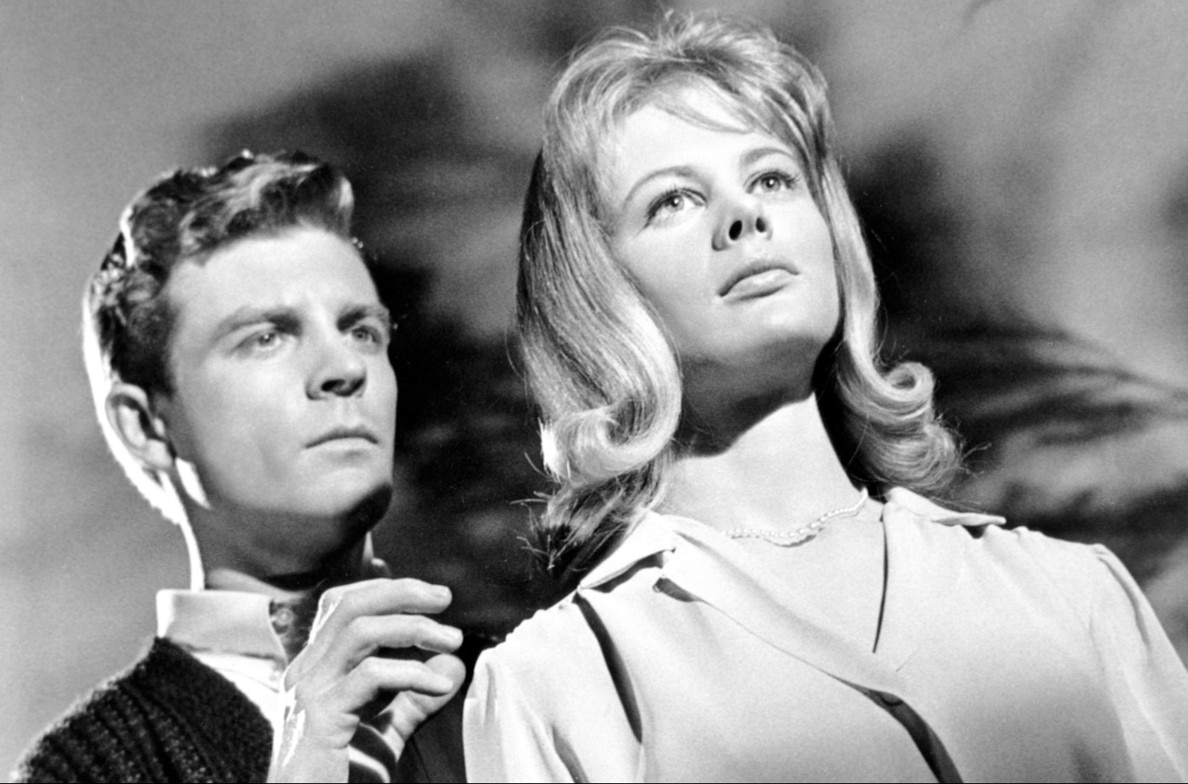
Grant Williams plays Charles Campbell, a deeply disturbed man out on parole after a two-year rape sentence, whose fitness for readmission into society is to be determined by a series of psychiatric consultations. His therapist is played by Onslow Stevens, at the end of a prolific career as a character actor in a wide variety of programmers, and his receptionist is played by television mainstay Shirley Knight. As Campbell enacts a series of random killings - each one committed just before his scheduled therapy appointment and thus ensuring him an alibi - he also begins to court the receptionist, whom he successfully attracts with a combination of charm and good looks that throws off all suspicion of his fundamentally violent nature.
Williams is best known today for his eponymous role in The Incredible Shrinking Man (1957), and while never breaking out of the TV and B movie circuit, he was always a capable performer. After Anthony Perkins, he was the next to take a stab at the burgeoning 'handsome all-American serial killer' movie archetype. While The Couch makes no mystery of the fact that Campbell is the killer at large, it gives his underlying motives an ambiguous treatment. The allure of the film for audiences of the '60s lay in the steady piecing together of a deranged mind over the course of various psychiatric consultations. And while, from today's vantage point, the film's psychoanalyzing seems pat and all too dated, there was endless fascination for audiences of the day in the notion that the mysteries of humanity's murderous impulses could be illuminated over the course of a little time on the therapist's couch (the title of the film, indeed, imputes to the chaise lounge which has colossal symbolical significance).
The Couch came from an idea by director Blake Edwards (who was at that time hard at work on his own foray into the horror-suspense thriller, the atypical Experiment in Terror, 1962), but it was Robert Bloch who gave it form as a screenplay. Whereas Bloch only wrote Psycho as a novel, leaving it to Joseph Stefano to adapt the script, the screenplay for The Couch was all his. In fact, he would later be commissioned to novelize the film, adding in a number of subjective, psychological hallucinations that had been trimmed from the film's shooting script, and, as a result, made the psychosexual undercurrents of Campbell's condition more explicit. The novel has been cited by no less than Stephen King as one of Bloch's essential books, in which he managed to "rediscover the suspense novel and reinvent the anti-hero...."
The movie, alas, is lacking for such praise, and has largely languished in obscurity until its reissue on DVD by the Warner Archive Collection. While it boasts many of Psycho's merits, including a stripped-down television aesthetic and ample location shooting, it was missing a directorial force like Hitchcock to mold the material into something truly original. Owen Crump, who had a prolific screenwriting background wound up directing The Couch. Crump's directorial experience had been in documentary shorts and television mostly. And while his straight-ahead, economic style worked for the material, he was never to direct another film (although his producer credits would continue to amass, finally culminating in the financial catastrophe of the Blake Edwards-directed Darling Lili, 1970). Crump remains an obscure figure in Hollywood history, a man with a great number of familial ties to Hollywood royalty but whose biography is slim pickings. That he was one of the first filmmakers of the '60s to follow Hitchcock's lead and exploit the possibilities of the psychological horror film should not be overlooked.
By Stuart Collier
The Couch
by Stuart Collier | May 03, 2019
SIGN UP FOR OUR NEWSLETTERS

CONNECT WITH TCM