In 1954, a 14-year old George Romero was arrested for throwing a burning mannequin off the roof of his Bronx apartment building while shooting an 8mm film titled The Man from the Meteor.
At the age of 19, Romero spent a summer as a grip on the New York location of Alfred Hitchcock's North by Northwest (1959), alongside future fellow filmmaker Larry Cohen.
Romero attended the Carnegie Institute of Technology (now the Carnegie-Mellon Institute) in Pittsburgh, Pennsylvania, where he met many of his future Night of the Living Dead collaborators.
Failing to secure financing to make his own feature film, Romero co-founded The Latent Image, Inc., an independent production house servicing Pittsburgh businesses and advertising agencies. With the earnings from their first jobs photographing weddings, Romero and his partners bought a toy hockey game and a pet monkey for their $50-a-month South Side office.
Hardman and onscreen wife Marilyn Eastman were at the time of filming partners in Hardman-Eastman Studios, a commercial production company based in Pittsburgh. They later married in real life.
George Romero appears in a cameo as a news reporter in a brief segment filmed in Washington, D.C.
Latent Image had attempted to license the musical score from Robert S. Baker and Monty Berman's Jack the Ripper (1959) but instead settled on selections from the Capital Hi-Q library. Some of the cues heard in the film can also be found in The Killer Shrews (1959).
In the shooting script, Barbara was the film's sole survivor.
Columbia Pictures was the only major studio to show interest in Night of the Living Dead, but ultimately balked at distributing the film because it was shot in black-and-white. Independent distributors American International Pictures passed on the project due to its downbeat ending.
By the time Monster Flick was in the can, the title had been changed to Night of the Flesheaters. Although early publicity materials bore this retitling, the threat of litigation from the producers of The Flesh Eaters (1964) necessitated the choice of a new tag. While the filmmakers favored Night of Anubis, a reference to the Egyptian god of death, Night of the Living Dead was selected by the film's exhibitor, Continental Distributing.
As part of its publicity campaign, Continental issued Lloyd's of London life insurance policies to Night of the Living Dead attendees, offering $50,000 to the survivors of any audience member frightened to death while watching the film.
In an angry editorial published in The Chicago Sun Times, film critic Roger Ebert condemned the film's exhibition as a kiddie matinee: "I don't think the younger kids really knew what hit them. They were used to going to movies, sure, and they'd seen some horror movies before, sure, but this was something else. This was ghouls eating people up...This was little girls killing their mothers."
In the spring of 1971, Night of the Living Dead played for twenty-five weeks in revival at the Walter Reade Theater in New York's Greenwich Village. That summer, the film began a two-year stay at the Plaza Theater in Brookline, Massachusetts.
Because theatrical prints of Night of the Living Dead did not contain a copyright notice, the film ultimately fell into the public domain and none of the original investors ever profited directly from its theatrical distribution.
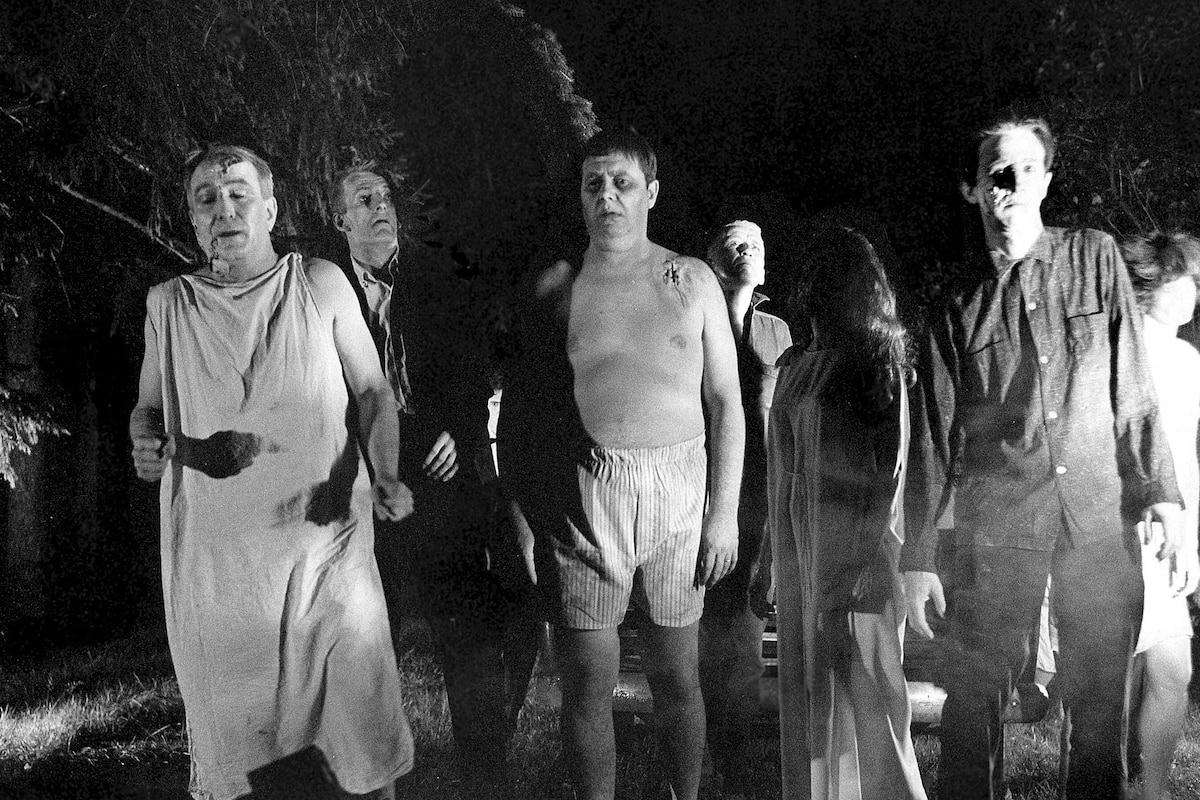
Although Night of the Living Dead sparked the zombie subgenre, whose number includes Jorge Grau's Let Sleeping Corpses Lie (1974), Lucio Fulci's Zombie (1979), Dan O'Bannon's The Return of the Living Dead (1985), the video game-derived Resident Evil (2002) and the comic homage Shaun of the Dead (2004), the Z-word is never once uttered in the script credited to George Romero and John A. Russo. Romero preferred to call the walking dead "ghouls."
Night of the Living Dead lead actor Duane Jones later appeared in the vampire films Ganja and Hess (1973) and To Die For (1989) before his untimely death from cardiopulmonary arrest in 1988.
Judith O'Dea runs her own communications and public speaking consulting company in Long Beach, California. She recently completed a role in the independent horror film The Ocean (2006).
Supporting player Keith Wayne took his own life in 1995.
George Romero has directed three sequels to Night of the Living Dead: Dawn of the Dead (1978), Day of the Dead (1985) and Land of the Dead (2005). Romero provided the script for Tom Savini's remake of Night of the Living Dead in 1990.
Night of the Living Dead was inducted into the National Film Registry of the Library of Congress in 1999.
In 2001, Night of the Living Dead was included in the American Film Institute's listing of 100 most thrilling horror films.
Sources:
Cult Movies by Danny Peary
Dark Visions: Conversations with the Masters of the Horror Film by Stanley Wiater
The Monster Show: A Cultural History of Horror by David J. Skal
Midnight Movies by J. Hoberman & Jonathan Rosenbaum
The Cinema of George Romero: Knight of the Living Dead by Tony Williams
movies.about.com
www.thefilmjournal.com
DVD Times
iconsofright.com
"Anatomy of a Horror Film", Interview by Gary Anthony Surmacz, Cinefantastique
"Romero," Interview by Tony Scott, Cinefantastique
Compiled by Richard Harland Smith
In the Know (Night of the Living Dead) - TRIVIA
by Richard Harland Smith | October 18, 2006
SIGN UP FOR OUR NEWSLETTERS

CONNECT WITH TCM