"The silken hair, the flashing eyes, the taunting lips...every inch of her is murder!" proclaimed the poster for A Blueprint for Murder (1953), written and directed by Andrew L. Stone, who had come up with the idea for the film after two years of deep research into murders committed with poison. In the course of his research, Stone was stunned to learn just how few poisoning murders were detected or led to convictions.
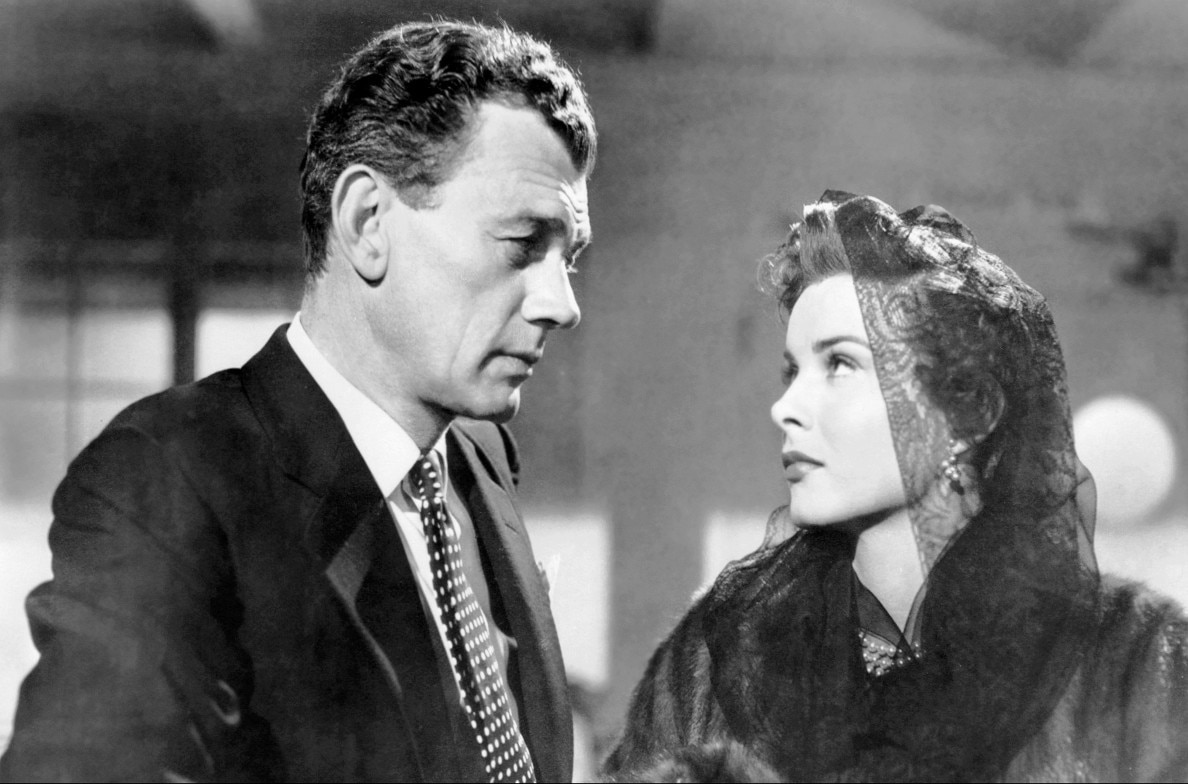
Whitney "Cam" Cameron (Joseph Cotten) hurries to be with his late brother's family when his niece, Polly (whose face is never seen on camera), is rushed to the hospital with seizures. Polly's younger brother, Doug (Fred Ridgeway), tells Cam that the seizures are just like the ones his father had when he died. Polly is expected to survive, but then has a mysterious relapse and dies. Upset, Cam visits some friends, including reporter Maggie Sargent (Catherine McLeod), who tells him that his description of Polly's symptoms sound like poisoning. No one believes Maggie at first, not even Dr. Stevenson (Jonathan Hole). Cam begins to be suspicious when Polly's stepmother, Lynn (Jean Peters), refuses to allow her to be autopsied, and Maggie's husband, Fred (Gary Merrill), tells Cam that his brother's will leaves everything to Lynn only if the children die first. Actors Jack Kruschen, Barney Phillips and former silent film star Mae Marsh as Lynn's housekeeper, Anna Swenson, round out the cast.
A Blueprint for Murder had a short production, with filming lasting only from February 12 - March 6, 1953 at the 20th Century-Fox studios in West Los Angeles, as well as the (then) new wing of Cedars of Lebanon Hospital, the Los Angeles Hall of Justice in downtown L.A. and locations in the beach community of Santa Monica, where scenes of Lynn's home were filmed at a mansion that had once belonged to actress Marion Davies. Shooting on location inside real buildings proved to be a challenge for cinematographer and Fox veteran Leo Tover. In the 1950s, cameras were still very large and very heavy, and maneuvering them into small spaces was difficult. Tover created a system using a small dolly for the camera that did not require a track. This allowed him to move the camera through a regular doorway without having to cut away.
When A Blueprint for Murder premiered in New York on July 24, 1953, with the Los Angeles opening on August 28th, the critics were mixed. The New York Times unnamed critic "H.H.T." wrote that although the film was "supposedly based on fact, the rhetorical contrivances [...] defeat a trim little cast. [...] Indeed, it loses conviction altogether before the climax, when [Cotten] traps the culprit aboard an ocean liner, squiring her intended victim and enough strychnine--as Mr. Cotten accuses her, twice--to choke a horse. 'This farce,' replies the understandably surly Miss Peters, 'has gone on long enough.'"
SOURCES:
A Blueprint for Murder (1953). (1953, November 23). Retrieved from https://www.imdb.com/title/tt0045566/
AFI|Catalog. (n.d.). Retrieved from https://catalog.afi.com/Film/50769-A-BLUEPRINT-FOR-MURDER?sid=dea73284-09d1-4cb3-aab8-a0ad330d3e85&sr=4.4063144&cp=1&pos=0
Keaney, M. F. (2015). Film Noir Guide: 745 Films of the Classic Era, 1940-1959. Jefferson, NC: McFarland.
New Suspense Film Opens at Palace. (1953, July 25). Retrieved from https://www.nytimes.com/1953/07/25/archives/new-suspense-film-opens-at-palace.html
By Lorraine LoBianco
A Blueprint for Murder
by Lorraine LoBianco | April 08, 2019
SIGN UP FOR OUR NEWSLETTERS

CONNECT WITH TCM