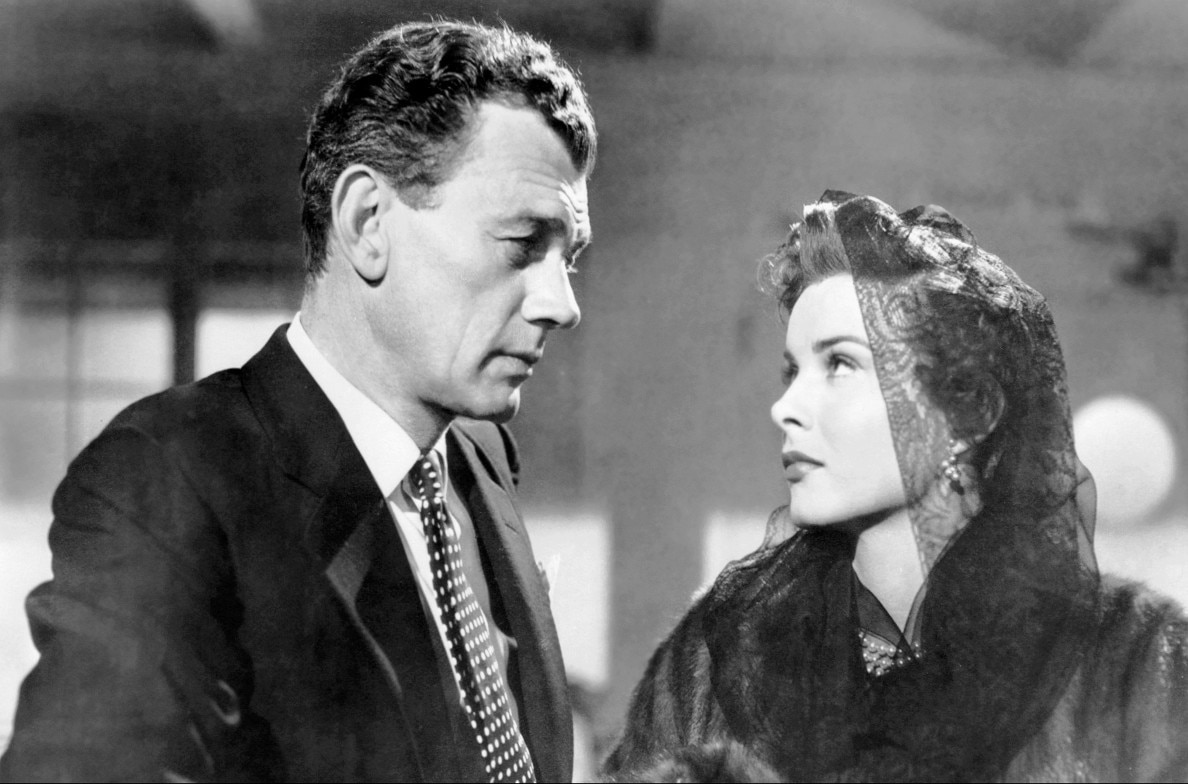
After Joseph Cotten's niece dies early in A Blueprint for Murder (1953), he gradually comes to suspect her stepmother (Jean Peters) of murdering her with poison; Peters had been married to Cotten's late brother and stands to inherit his vast estate. Cotten concocts a wild scheme to prove his suspicions before his nephew suffers a similar demise, leading to a battle of wits that culminates on an ocean liner.
This suspense thriller was written and directed by Andrew L. Stone and produced by his own production company, with distribution from 20th Century-Fox. Stone took great pride in his insistence on stark realism in virtually every picture he directed. Studio publicity notes indicate that Stone spent two years researching medical and police records dealing with poison before writing the Blueprint for Murder script. Among other facts, state the notes, "he uncovered startling evidence that the average poisoner gets away with nearly six murders before being found out... Stone points out that although all the material in the melodrama is based on fact, the story itself is a fabricated one, unbased on any actual incident."
Stone applied his penchant for authenticity to location shooting as well, eschewing soundstages where possible. He shot this film mostly in downtown Los Angeles, including Union Station and the Hall of Justice, with the former residence of Marion Davies, on the Santa Monica coast, filling in for the home of Jean Peters's character. For one shot, Stone placed the camera in the rear of a taxi to capture a cab ride from a train station to a courthouse in one uninterrupted four-minute shot.
Stone enjoyed a successful and quite independent career that stretched back to 1928, when he directed his first film. Early on, he concentrated on comedies and musicals, and in 1943 he directed the famous all-black musical Stormy Weather, a breakthrough for him. The same year, he formed his own production company, with distribution deals from various studios in the years to come. In the 1950s he shifted gears to suspense thrillers and mysteries, including Highway 301 (1950), The Steel Trap (1952, also starring Cotten), Julie (1956), and Cry Terror! (1958). Starting in the late 1950s, his wife Virginia co-produced and edited his films, often in a makeshift cutting room in their backyard.
A Blueprint for Murder opened on a double bill with Fox's Sailor of the King (1953) to mixed reviews, with The Hollywood Reporter finding it "thrilling" and The New York Times declaring that it "misses by a good mile." Jean Peters, reunited with Joseph Cotten after Niagara (1953), received especially high marks all around.
By Jeremy Arnold
A Blueprint for Murder
by Jeremy Arnold | April 08, 2019
SIGN UP FOR OUR NEWSLETTERS

CONNECT WITH TCM