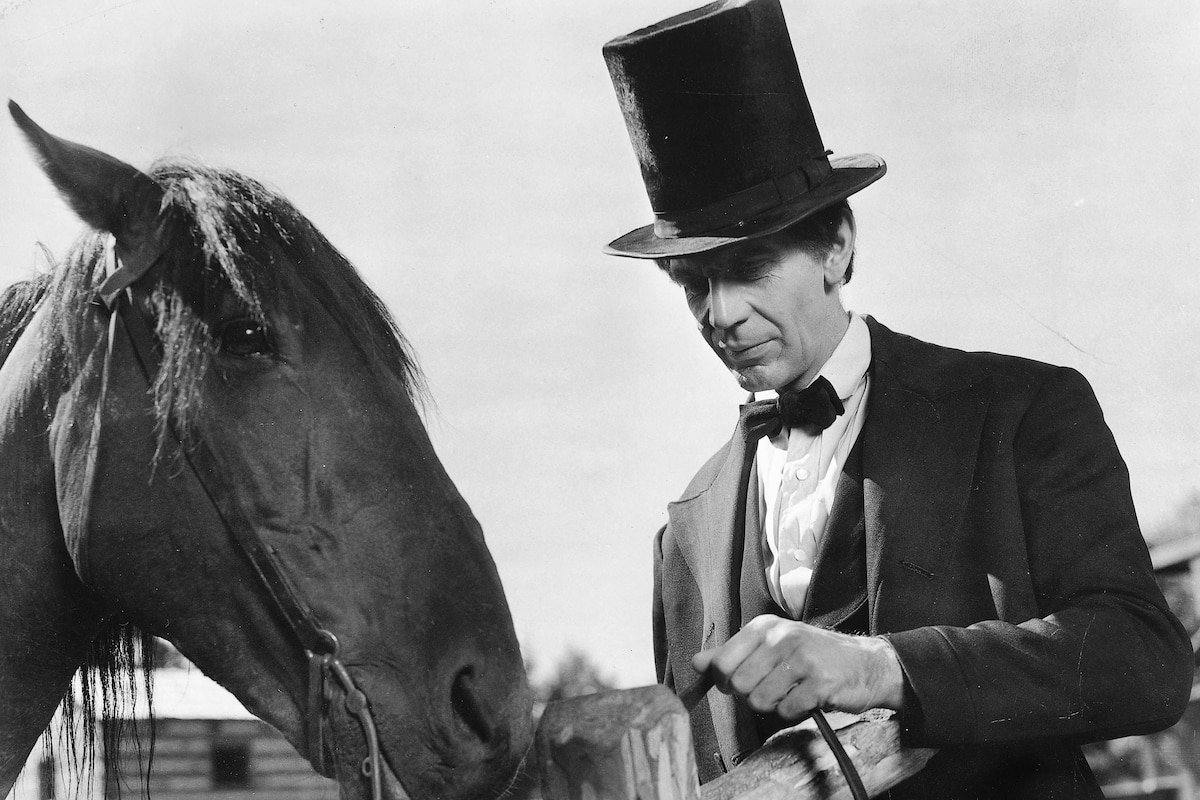
Cinematographer James Wong Howe garnered the second of ten Academy Award nominations for his evocative cinematography in Abe Lincoln in Illinois (1940), directed by John Cromwell. Raymond Massey stars as Lincoln in this episodic film biography that traces the life and times of America's 16th president from his humble beginnings to his first sweetheart and early law practice through his final years in the White House.
The film was based on the popular Pulitzer-Prize-winning stage play of the same name by Robert E. Sherwood. While Sherwood was still writing the play, he didn't have any specific actor in mind for the part of Lincoln. However, one night in 1936, Sherwood's friend actress Ruth Gordon gave him opening night tickets to the Broadway play Ethan Frome in which she was starring opposite Raymond Massey. Sherwood immediately recognized Massey's talent and striking physical resemblance to the gangly Lincoln. According to Gordon's 1976 memoir My Side, Sherwood excitedly phoned her after the play saying, "You've found my Abe Lincoln for me! Ray's a friend, but I never thought of him."
When the stage version became a success in New York during the fall of 1938, offers to buy the movie rights began pouring in from all the major studios. However, Massey held little hope of being asked to reprise his role on the big screen since Hollywood usually preferred to use big name movie stars. When producer Max Gordon offered him the film role, he was elated. Massey kept his approach to playing Lincoln simple. "I had done no research beyond reading Carl Sandburg's The Prairie Years," Massey recounted in his 1979 autobiography, A Hundred Different Lives, "and the Lincoln books that everyone reads." Instead, he based his characterization primarily on Sherwood's screenplay.
The first three weeks of shooting took place on location in Oregon. It was slow going, according to Massey, due to a lack of cooperation from the various animals being used in the early farm life scenes. The filming of the first scene was disrupted by renegade chipmunks that were "liberated" at the word 'Action!' and bit the property master on the set. And it took two days to shoot a scene in which fifty pigs on Lincoln's raft careen over a short waterfall--a scene that ended up lasting roughly one minute on film. According to Massey in his autobiography, the Oregon production crew ended up with only "an astonishing small amount of finished footage, about 8 percent of the total picture. But once back in the studio we really made progress. In only one night on the RKO back lot, in a stifling temperature of 101, we shot the Lincoln-Douglas debate scene. That was about thirteen minutes of finished film." More than anything, Massey enjoyed working with his fellow actors Gene Lockhart (as Stephen Douglas) and former Ethan Frome co-star Ruth Gordon (as wife Mary Todd Lincoln).
All in all, Massey was pleased with his work on Abe Lincoln in Illinois but when he saw a preview of the film during the editing phase, he noticed something was missing: "I realized that an entire scene had been cut, the prairie scene with the beautiful prayer for the sick boy! The fulcrum of the stage play...the scene which explained Abe Lincoln's recognition of his destiny - that scene had been excised from the picture!" He pleaded his case to the director but finally let the matter drop when producer Max Gordon shouted at him, "You've been paid, mind your own business!"
When Abe Lincoln in Illinois was completed and ready for release, Washington D.C. was chosen as the logical place for the film's world premiere. At first RKO, who was releasing the film, had wanted Massey to arrive by train in full Abraham Lincoln costume and makeup. Producer Max Gordon vehemently rejected the idea, and it subsequently didn't happen. Instead, Massey escorted First Lady Eleanor Roosevelt to the Keith's Theater as his guest for the preview. Her husband, President Franklin D. Roosevelt, had watched the film the night before at a private White House screening and, according to Massey, Roosevelt seemed to enjoy it. "He wrote those speeches himself!" Roosevelt reportedly muttered in admiration during the movie.
The 16th president was a source of popular interest when Abe Lincoln in Illinois was released in 1940. Less than a year before, John Ford's Young Mr. Lincoln (1939) had come out covering much of the same material and starring Henry Fonda in the title role. The positive values that Lincoln represented lent optimism to Americans, as the threats of Hitler and Totalitarianism were very much in the public consciousness. In addition to James Wong Howe's nomination for cinematography, Abe Lincoln in Illinois also received an Academy Award nomination for Raymond Massey as Best Actor. Though he went on to star in many other films, Massey always remained best known for this performance.
Producer: Max Gordon
Director: John Cromwell
Screenplay: Robert E. Sherwood, Grover Jones
Art Direction: Van Nest Polglase, Carroll Clark
Cinematography: James Wong Howe
Editing: George Hively
Music: Roy Webb
Cast: Raymond Massey (Abraham Lincoln), Ruth Gordon (Mary Todd Lincoln), Gene Lockhart (Stephen Douglas), Mary Howard (Ann Rutledge), Dorothy Tree (Elizabeth Edwards).
BW-110 min.
by Andrea Passafiume
Abe Lincoln in Illinois
by Andrea Passafiume | October 12, 2006
SIGN UP FOR OUR NEWSLETTERS

CONNECT WITH TCM