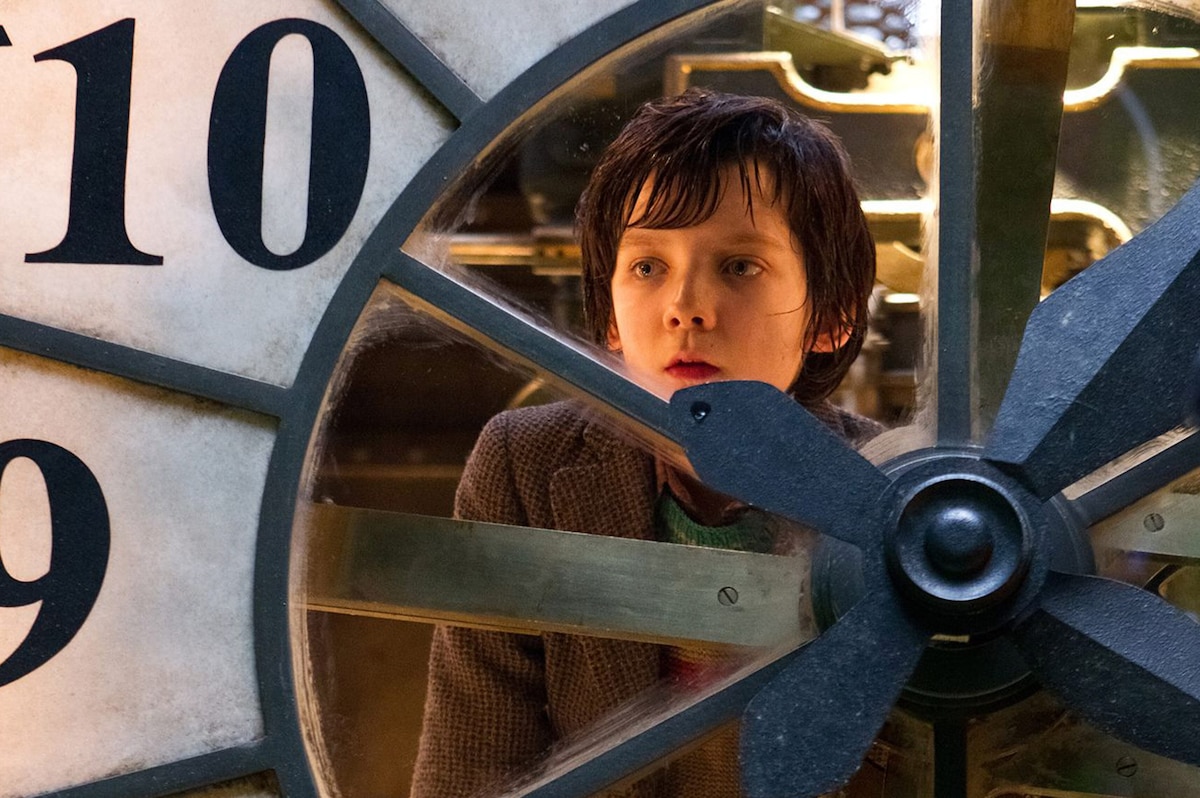
Martin Scorsese has always been a student of the cinema. He cherishes its history, educates on and illuminates it whenever he can, and fights to preserve it as much as any preservation society can boast. It was, thus, natural that Scorsese would want to adapt Brian Selznick's beautifully illustrated and richly detailed novel, The Invention of Hugo Cabret, for the screen when he directed Hugo in 2011. The story of a small boy maintaining the clocks in the Gare Montparnasse railway station in Paris in 1931, finds its way into film history and art, and the importance of preservation, and how a young person's discovery of the past can have a profound influence on the direction of their life.
The story of Hugo begins with Hugo Cabret (Asa Butterfield) in the railway station maintaining the clocks. We quickly find out that Hugo's father, played by Jude Law, was a clockmaker himself and excitedly taught Hugo how to fix clocks, automatons, and other mechanical curiosities of the day. When Hugo's father died, he was put into the care of his Uncle Claude (Ray Winstone), the actual person tasked with the clock maintenance in the station. When Claude disappears, Hugo maintains the clocks in secret, fearing if the authorities find out his uncle is gone, he will be sent away as an orphan. How all of this relates to the archives of Georges Méliès is a part of the joy in watching the movie and following the story. Scorsese films the montage of Méliès' flickering cinematic miracles with all the love of an archivist and teacher whose dual purpose is to enlighten and inspire.
The cast of Hugo included two child actors, Butterfield and Chloë Grace Moretz, already old hands at showbiz by their early teens. Butterfield had made four movies prior and Moretz had achieved fame in the controversial role of Hit Girl in Kick-Ass (2010). But with Hugo they moved into a new dimension, playing two lost souls who bond over the discovery of a rich, hidden past. And while the film has an array of talented stars filling its cast, from Ben Kingsley and Jude Law to Christopher Lee and Sacha Baron Cohen, it is Butterfield and Moretz that hold the story together and carry the movie effortlessly on their shoulders.
Once released, the movie did not have immediate success. The critics loved it, and when awards season rolled around, it was greeted with multiple accolades, including eleven Academy Award nominations. But the box office just wasn't there. Oh, it wasn't bad, totaling almost 200 million worldwide, but with a production and marketing budget that combined for close to 300 million, that wasn't nearly enough to save it from being labeled a flop. Interestingly, a part of the financial problems came with the filming techniques used, specifically 3-D. It was Scorsese's first foray into the trendy process which ended up slowing down production while at the same time inflating ticket prices that kept audiences away. Despite 3-D being touted as a mainstay, every 30 years or so when it comes back around, it never seems worth it. And it never seems to become a mainstay. By the end of the second decade of the 21st century, it was already, once again, left for dead.
But Hugo is not. Despite its box office failure, it's a movie with tremendous staying power and one of the best of Scorsese's recent films career. Scorsese has always loved the cinema and this movie is, in no small part, a love letter to the movies that have defined his life.
Directed by Martin Scorsese
Written by John Logan
Produced by David Crockett, Barbara De Fina, Christi Dembrowski, Johnny Depp , Tim Headington, Georgia Kacandes
Cast: Ben Kingsley (Georges Méliès), Sacha Baron Cohen (Station Inspector), Asa Butterfield (Hugo Cabret), Chloë Grace Moretz (Isabelle), Ray Winstone (Uncle Claude), Emily Mortimer (Lisette), Christopher Lee (Monsieur Labisse), Helen McCrory (Mama Jeanne), Michael Stuhlbarg (Rene Tabard), Frances de la Tour (Madame Emilie), Richard Griffiths (Monsieur Frick), Jude Law (Hugo's Father)
Music by Howard Shore
Cinematography by Robert Richardson
Film Editing by Thelma Schoonmaker
Casting by Ellen Lewis
Production Design by Dante Ferretti
Art Direction by Martin Foley, Christian Huband, Rod McLean, Stuart Rose, Luca Tranchino, David Warren
Set Decoration by Francesca Lo Schiavo
Costume Design by Sandy Powell
By Greg Ferrara
Hugo
by Greg Ferrara | March 08, 2019
SIGN UP FOR OUR NEWSLETTERS

CONNECT WITH TCM