All the King's Men takes its title from the
nursery rhyme about Humpty Dumpty, the poor guy who had a
great fall and couldn't be put together again. But that's
the movie's only childlike touch. Directed by Robert
Rossen in 1949 and released on DVD by Sony Pictures Home
Entertainment, this critically acclaimed melodrama stands
with the most hard-boiled stories ever told about American
politics.
Based on Robert Penn Warren's novel, which won the
Pulitzer Prize for literature in 1947, All the King's
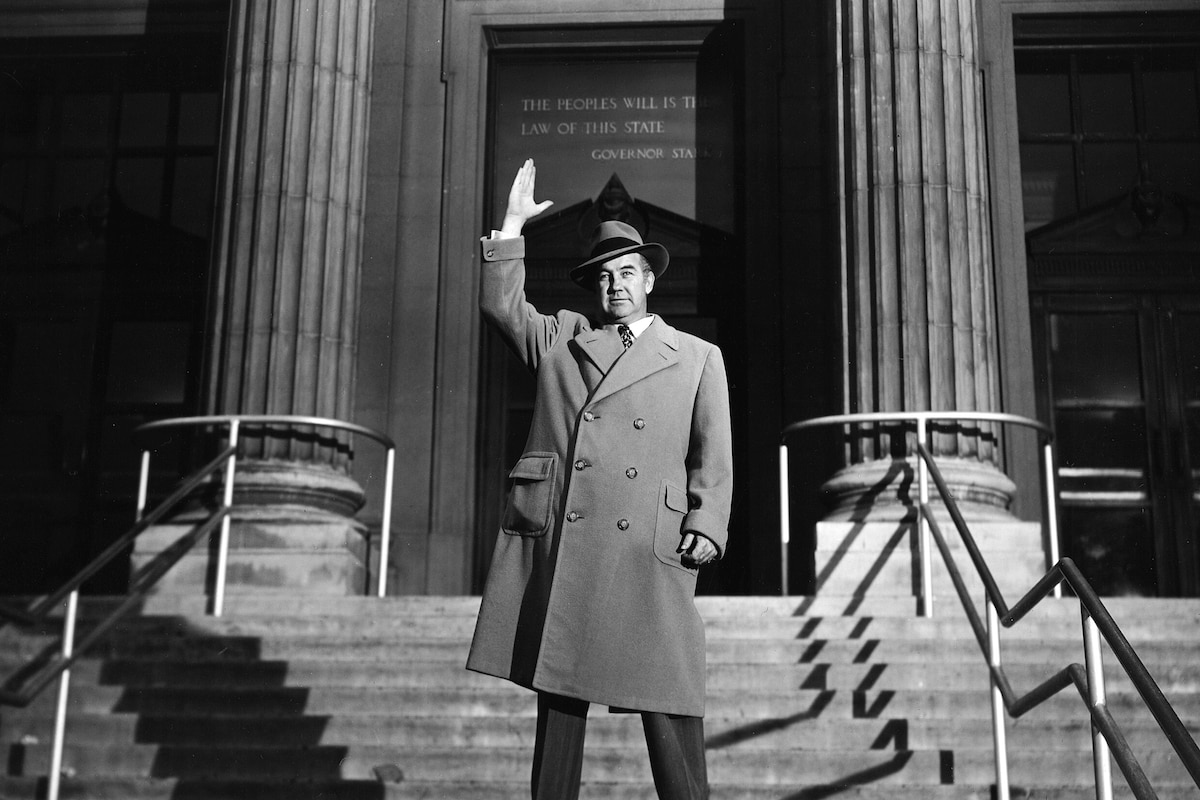
Men has two main characters. One is Willie Stark,
modeled on Huey Long, a real-life Louisiana governor and
senator who was assassinated in the state capitol in 1935.
The other, more central to the novel than the movie, is
Jack Burden, a journalist who goes to work for Willie
without realizing the moral and emotional consequences
this will bring.
At the start Willie is an ordinary rural Southerner
who'd like to win public office and help people, but has
little education and no talent for getting votes. He loses
his first election, to nobody's surprise, and settles in
to study law with help from his loyal wife. Soon he's an
attorney, finally helping people and making more money
than a small-time government post could offer.
The state's political machine has other ideas, though.
Their candidate for governor is doing poorly, and they
need someone who can split the "hick vote" so he can win.
Willie is just the ticket, since he'd like to be in
politics and is too unsophisticated to know he's being
used. He accepts the machine's backing and travels around
the state giving incredibly boring speeches that he thinks
are excellent because his hypocritical handlers tell him
so. Learning the awful truth from Jack, he gets drunk and
throws away his speech, talking from the heart instead. He
reminds the crowd that his warnings about construction
graft were prophetic-several kids were later killed when a
schoolhouse fire escape collapsed-and proclaims that he's
a hick who'll stand up for other hicks. This time he
wins.
As governor, Willie takes no orders from the machine or
anyone else. While he rules with an iron hand, he also
builds schools and highways that make him hugely popular.
Depending on your point of view, he's a "messiah or
dictator," as a Citizen Kane-type newsreel puts it.
Either way, complications start multiplying: His attorney
general quits; his assistant Sadie gets jealous of his
love for another woman; his adopted son has a fatal
drunk-driving accident; and eventually his enemies try to
impeach him. Jack isn't doing too well, either. Willie has
stolen his fiancée, ordered him to dig up dirt on an
admired friend, and gotten him deeply involved in the
political duplicity he used to think Willie hated. Jack
survives in the end, while Willie suffers the same
fate-shot by a physician whose family he'd injured-that
finished Long off in real life.
All the King's Men was one of many "social
consciousness" pictures made in Hollywood soon after World
War II, when returning veterans had trouble finding jobs,
corruption thrived in government and big business, and
inequalities along class and racial lines-which had seemed
less important during the war itself-reasserted themselves
with a vengeance. At a time when movies were taking on
many sensitive themes, such as soulless capitalism in
Force of Evil (1948) and anti-Semitism in
Crossfire (1947), the corrosive view of politics in
Warren's novel cried out for film treatment.
Rossen bought the rights, wrote his own screenplay, and
got Columbia Pictures to finance it. He reportedly offered
the Willie Stark role to John Wayne, a famous right-winger
who was outraged by the script's negative portrait of
American politics. The part went to Broderick Crawford,
boosting him out of the B-movie world he'd been stuck in
for years. Hoping to capture Long's personality as
realistically as possible, Crawford studied his voice and
gestures by watching newsreel footage. Rossen shot as much
as he could on location, using local residents as
extras.
All the King's Men was timely in 1949 and
remains so today. But it would pack a stronger punch if
Rossen's directing weren't so solemn and stilted. And
while the film's setting isn't specified, the story
certainly has Southern roots, so you have to wonder why
almost nobody has a Southern accent, and why no
African-American faces are visible, even in the
background. In the 2006 remake, writer-director Steven
Zaillian corrects this, giving Southern atmosphere to
spare. (The only extras on the DVD are two previews of
Zaillian's version, starring Sean Penn as Willie and Jude
Law as Jack.)
The acting in Rossen's film is also uneven. While it's
hard to imagine a more ideal role for Crawford, the studio
apparently decided to smooth out the raspy voice that was
one of his trademarks, diluting his performance. Mercedes
McCambridge gives great energy to Sadie and Joanna Dru has
good moments as Anne, but John Ireland is wooden as Jack
and Shepperd Strudwick even more so as Anne's idealistic
brother.
None of this stopped the movie in the Academy Awards
race, though-Crawford and McCambridge won as best actor
and best supporting actress, Ireland was nominated for
best supporting actor, and Rossen was nominated for his
directing. In all, the film got seven nominations and
three wins, including best picture.
In a review of All the King's Men written years
after its premiere, Pauline Kael said watching Willie
Stark for a couple of hours "might just make you feel
better about the President you've got." Some viewers might
feel that way in any era, which testifies to the story's
lasting relevance. Rossen's adaptation isn't a great
movie, but it raises issues still worth pondering.
For more information about All the King's Men,
visit Sony Home
Entertainment. To order All the King's Men, go
to
TCM
Shopping.
by Mikita Brottman and David Sterritt
All the King's Men - The Oscar®-winning 1950 Version on DVD
by Mikita Brottman and David Sterritt | September 21, 2006
SIGN UP FOR OUR NEWSLETTERS

CONNECT WITH TCM