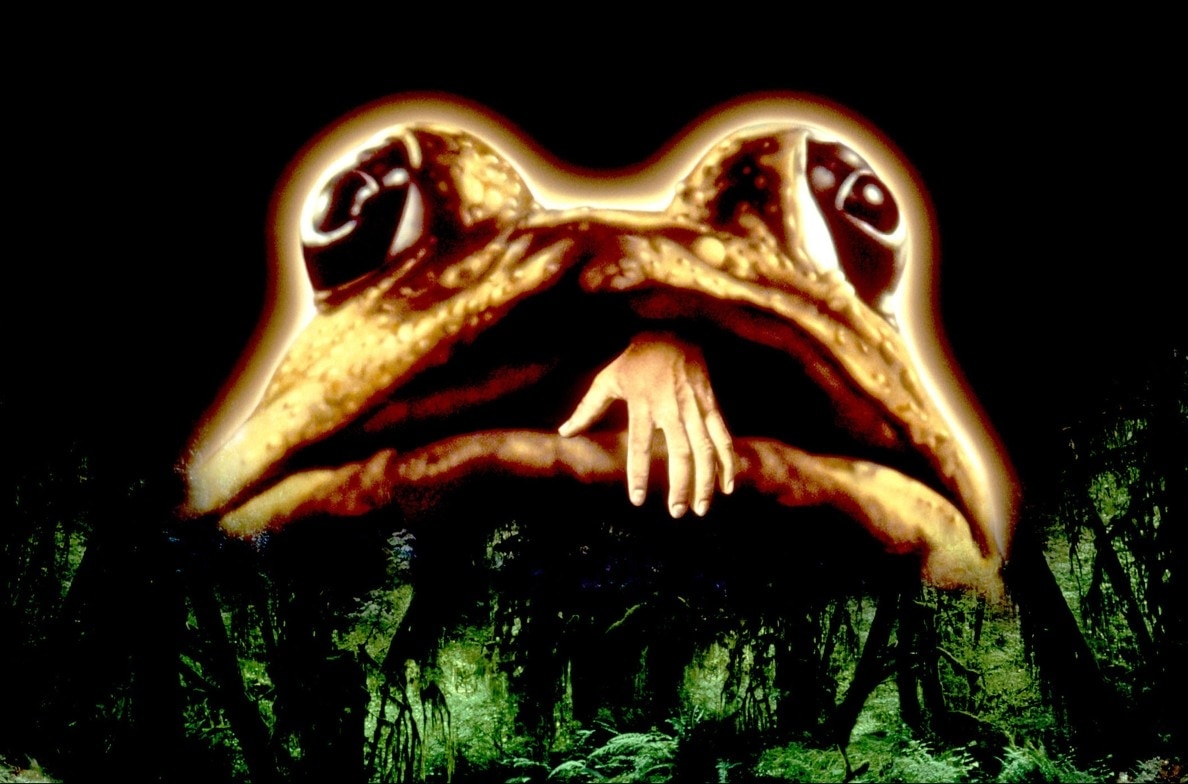
Animals on the attack has been an elemental part of American science fiction and horror since King Kong (1933). It became its own distinctive subgenre in the atomic 1950s, when radiation and other modern threats supersized ordinary creatures into giant rampaging monsters and evolved into the "revenge of nature" movies that Alfred Hitchcock inaugurated with The Birds (1963). Frogs (1972) came out after the success of Willard (1971), which turned ordinary rats into a rodent army targeting humans, but it has more in common with Hitchcock's The Birds while embracing an ecological awareness that replaced nuclear fears in the horror and science fiction of the 1970s.
Set on an island estate of a tyrannical millionaire industrialist in the Florida Everglades, Frogs opens with scenes of natural beauty and serenity intercut with shots of pollution poisoning the ecosystem. Sam Elliott plays a photojournalist canoeing through the swamp and documenting the pollution of this natural world. As he paddles through the waterways, the frogs follow, ultimately converging on the mansion in the center of this poisoned paradise. Ray Milland plays the patriarch who rules his extended family like a dictator and treats the ecosystem around him as an unruly private garden to be tamed by pesticides and other toxic chemicals.
Unlike the giant monster movies of the 1950s and 1960s or the disaster epics of the 1970s, the film eschews elaborate special effects and instead relies on the nature photography of Mario Tosi, who shot the film on location in Eden Gardens State Park on the Emerald Coast of Florida. He captures the beauty of the Everglades and the natural inhabitants of the eco-culture, both in dramatic close-ups and in action shots, which director George McCowan edits to create the impression of animals working in concert like a strike force to attack the humans poisoning their home. While frogs are indeed prominent throughout the film, the title is somewhat misleading as the entire eco-culture of the Florida Everglades is in on the attack: spiders, scorpions, snakes, alligators, snapping turtles, even Spanish Moss. Along with the ecological message is an undercurrent of social commentary involving a grandson of the millionaire, a fashion photographer played by Nicholas Cortland, and his date to the family gathering, an African-American model played by Mae Mercer. The strains of class, money, and power are also felt throughout the film as the patriarch wields his fortune like a bribe to coerce his family to follow his directives.
Ray Milland was no stranger to this kind of role or to the genre. Once a suave leading man, he became adept at darkly charismatic villains and tragic antiheroes, and as a director he made the memorable end-of-civilization thriller Panic in the Year Zero (1962), in which he also starred as a father doing what it takes to protect his family in the lawless world after a nuclear attack. Young Sam Elliott had graduated from bit parts to a recurring role on the TV series Mission: Impossible but this was his first starring role and he played it clean shaven. He is not immediately recognizable to contemporary audiences without his trademark mustache, but that bass growl of his is unmistakable.
Stage actress Joan Van Ark made her feature debut in the film and went on to success on the small screen in the nighttime soap operas Dallas and Knots Landing. It's also the feature directorial debut of TV veteran George McCowan. He went on to make The Magnificent Seven Ride! (1972) and The Shape of Things to Come (1979) for the big screen but found greater success directing episodes of such hit TV shows as Starsky and Hutch, Charlie's Angels and Fantasy Island.
The film was praised by some film critics for its ecological themes and often lovely nature photography and film historian Phil Hardy called it "one of the best of the revenge-of-nature cycle of films that erupted in the seventies in the wake of renewed interest in ecology." The theme was further explored in such films as Day of the Animals (1977), Long Weekend (1978) and Prophecy (1979).
Sources:
Wide-Eyed in Babylon, Ray Milland. William Morrow & Co., 1984.
The Encyclopedia of Science Fiction, Phil Hardy. Woodbury Press, 1974.
AFI Catalog of Feature Films
IMDb
By Sean Axmaker
Frogs
by Sean Axmaker | December 13, 2018
SIGN UP FOR OUR NEWSLETTERS

CONNECT WITH TCM