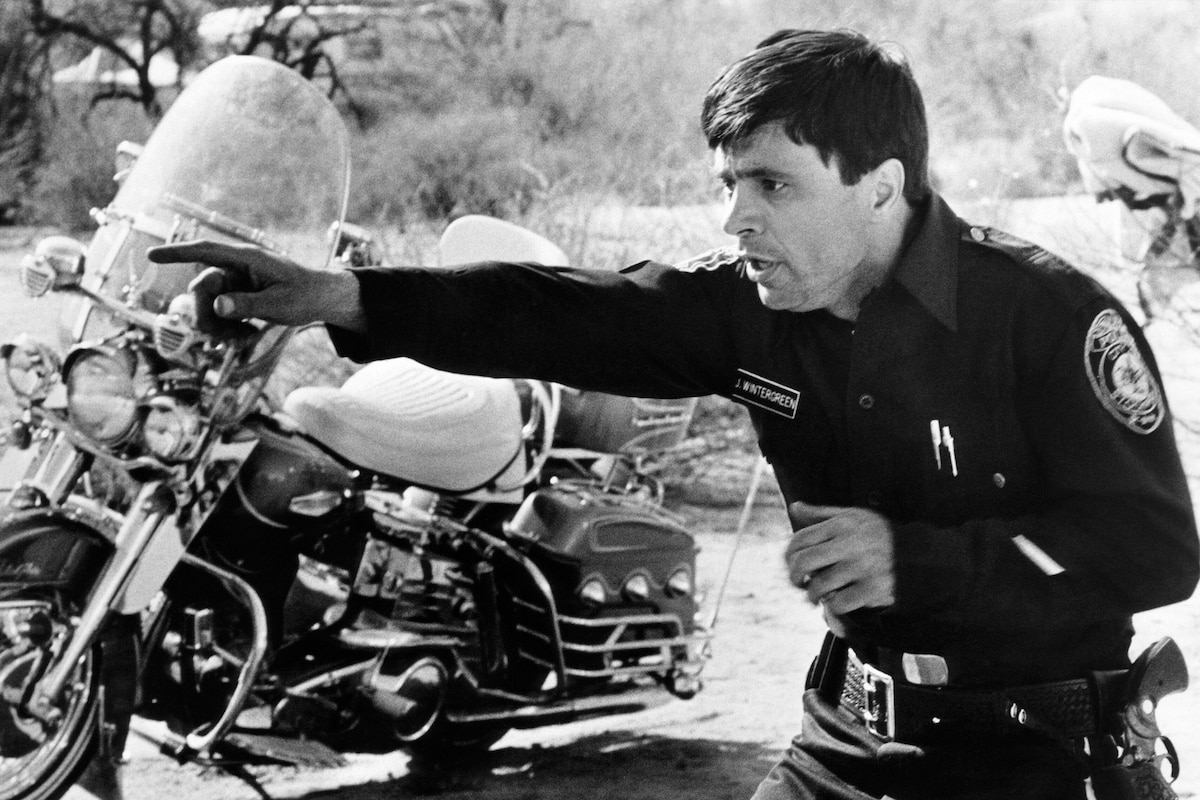
Not all lost movies are literally lost...some languish in studio vaults, victims less of time and tide than corporate neglect. Over the last thirty years, there has been precious little ink spilled over Electra Glide in Blue (1973), the only feature film directed by James William Guercio, and its quiet return to the world on DVD is cause for reevaluation. Starring a post-In Cold Blood (1967), pre-Baretta Robert Blake, Electra Glide in Blue is equal parts modern western, biker flick, policier and existential journey-to-self, complete with the then-requisite downer ending that, however it may echo Easy Rider's (1969) sting in the tale, still packs a punch.
Set in a dusty desert community of trailer parks, titty bars and tumbleweed ennui, Electra Glide in Blue plays like an unpublished Jim Thompson novel, with Blake's ambitious chopper cop making good at a crime scene and earning a detective grade promotion that introduces him to a new world of pain. Guercio corralled a stellar cast with supporting parts played by Mitch Ryan, Elisha Cook, Jr., Royal Dano and Billy "Green" Bush but the film's best performance comes from Jeannine Riley, former star of TV's Petticoat Junction. As a washed-up Rockette reduced to roadhouse waitressing, Riley delivers an impressive drunken monologue late in the film, turning the disappointments of her life into an interpretive dance while humiliating both Blake and Ryan. It's a tour-de-force moment, one of many in a film that has lingered too long in the shadows.
The police department of Scottsdale, Arizona disapproved of the script by Robert Boris and Rupert Hitzig and refused all participation, forcing the crew out into the desert to make Electra Glide in Blue. In addition, Guercio could not afford veteran cinematographer Conrad Hall, and so augmented Hall's salary with his own. According to Guercio, he made one dollar for directing Electra Glide in Blue. Because Guercio had little money for casting, many of the relatives of the cast and crew appear in bit roles, including Guercio's wife Lucy and Conrad Hall's daughter Kate. And many of the hippies in the commune scene are played by Chicago's roadies, including Bob Zemko, who died the following year.
The critical response to Electra Glide in Blue was generally mixed with most mainstream reviewers reflecting the opinion of Roger Greenspan of The New York Times: "Under different intentions, it might have made a decent grade-C Roger Corman bike movie-- though Corman has generally used more interesting directors than Guercio. It is in fact a murder mystery, in which a higher-principled Arizona motorcycle cop discovers the death of an old recluse and, against all odds, finds out who killed the man and why. Upon this slender plot is grafted lots of excess cinema, and a really unfair share of meaning." But a few critics recognized the movie's unique and original vision such as Michael Atkinson of The Village Voice who wrote, "A forgotten gout amid the spume of the American new wave, James William Guercio's 1973 Midwestern policier is a grim, ambivalent rejoinder to the generational agitprop of Easy Rider...it's a living flashback, all desert dust, arty compositions, working-class despair, and a potent sense of outlaw critical mass. The ending, echoing and overshadowing Rider's, is a masterfully appalling moment in an era chockablock with convulsions."
Producer: James William Guercio, Rupert Hitzig
Director: James William Guercio
Screenplay: Robert Boris, Rupert Hitzig
Cinematography: Conrad Hall
Film Editing: Jim Benson, Gerald B. Greenberg, John Link
Art Direction:
Music: James William Guercio
Cast: Robert Blake (Officer Wintergreen), Billy Green (Officer Davis), Mitch Ryan (Detective Harve Poole), Jeannine Riley (Jolene), Elisha Cook (Crazy Willie), Royal Dano (Coroner).
C-114m. Letterboxed.
by Richard Harland Smith
Electra Glide in Blue
by Richard Harland Smith | September 15, 2006
SIGN UP FOR OUR NEWSLETTERS

CONNECT WITH TCM