The maverick filmmaker Robert Aldrich combined a liberal outlook with a disciplined feel for organization stemming from years as a top Hollywood assistant director. Definitely not a credit hog, he worked with many of the same people for over 20 years and put them first in the name of his production company, Associates and Aldrich. His record as a director had its ups and downs, but the blockbuster war movie The Dirty Dozen (1967) was such a success that he was able to launch his own studio. By 1974, Aldrich was once again in career trouble. His Emperor of the North (1973) failed, and Robert Mitchum turned him down to direct a film to be shot in Japan, The Yakuza (1974). Aldrich regrouped with The Longest Yard (1974), a gritty but funny prison drama about a brutal football game between guards and inmates. Its star Burt Reynolds had spent years as a stuntman and action player before attracting acting honors in John Boorman's Deliverance (1972). Reynolds also knew football, in college he had been a halfback for Florida State.
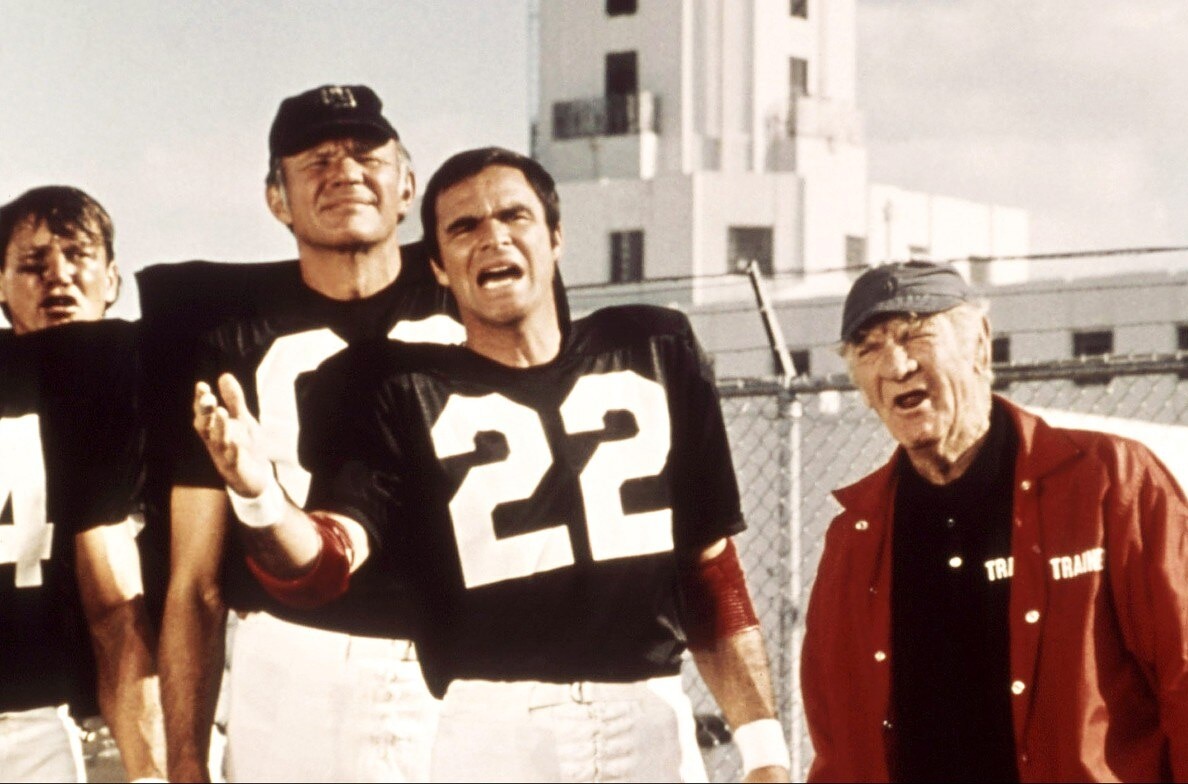
Tracy Keenan Wynn's screenplay was written to appeal to what Variety termed the male action crowd. Ex-NFL player Paul Crewe (Burt Reynolds) lost his career for shaving points and is now little more than a gigolo for rich women. When his latest meal ticket (Anitra Ford) points this out, he beats her up and steals her priceless European sports car for a reckless joyride. The new home for Crewe's personal war against authority is Florida's segregated Citrus State Prison. The institution is corrupt from the top down. Warden Hazen (Eddie Albert) believes in a personal power theory: "I want everyone in this prison to know what power is and who controls it." Hazen has authorized Captain Knauer (Ed Lauter) to act as an extralegal enforcer in this reign of terror. Because he wants his all-guard football team to win a championship, the warden tells Crewe to form a makeshift prisoner team for the guards to win against. When the uncooperative Crewe lands in solitary confinement, the entire prison is made aware of his active resistance. A snitch (Charles Tyner) flubs a murder attempt, accidentally burning another inmate to death, and Hazen threatens to call it murder and frame Crewe if he doesn't play ball. Crewe negotiates a truce: he'll organize and train a 'losing' team if Hazen goes easy on the prisoners. In the marathon game that follows, Hazen reneges on his promise and all bets are off.
As Robert Aldrich openly admitted, "I'm a football nut. I would have done the picture for nothing. Fortunately, they didn't know that at Paramount." He had played football at the University of Virginia and was dedicated to principles of fair play and teamwork. His first movie Big Leaguer (1953) is an impressive look at baseball, and many of his pictures involve groups of men that must work as a team to achieve a goal: the warring mercenaries of Vera Cruz (1954), the bomb removal experts of Ten Seconds to Hell (1959), the plane crash survivors of The Flight of the Phoenix (1965) and of course the prisoners-turned commandos in The Dirty Dozen. The director's daughter, Adell Aldrich, said that he loved making The Longest Yard because he got to be 'the coach.'
The director wanted to film at a real prison, as Don Siegel had done years before in the acclaimed Riot in Cell Block 11 (1954). Aldrich first chose an Oklahoma facility, but a riot at the prison burned several buildings, including the football stadium. As a fallback option, then-Governor Jimmy Carter of Georgia helped Aldrich secure permission to film at the maximum-security prison at Reidsville. Although some crew members didn't like working around potentially violent prisoners, all was harmonious on the shoot. Aldrich's macho cast-- Burt Reynolds, Mike Henry, Michael Conrad, and Richard Kiel-- got along famously with the prison population. Aldrich found jobs for prisoners, and even recruited a group of prisoners to play the team's cheerleaders. Reidsville had no football facilities, so Aldrich and producer Albert S. Ruddy built a real stadium as part of the deal.
Paul Crewe's all-convict football team is called 'the Mean Machine,' a name that became the film's title in the United Kingdom. Much of The Longest Yard is played as a comedy, a form that never gave Aldrich much success--his considerably worst films might be the Rat Pack comedy 4 for Texas (1963) and the feeble Western, The Frisco Kid (1979). But this show continues the mordant, profane tone of Robert Altman's MASH (1970), which also paid off in a brutal but funny football game. With Burt Reynolds' carefree bruiser accepting casual violence with a smile, emphasis is placed on dirty tricks and pranks between the prisoners and the guards. The difference is that the guard's ambushes and traps are unfunny and cruel, while the prisoners' clever tricks are often hilarious.
Burt Reynolds' Paul Crewe is yet another amoral Robert Aldrich hero, a loser struggling to reestablish his self-esteem. Aldrich said more than once that this theme was the perfect instrument for securing audience identification. He learned it from writer-director Abraham Polonsky, for whom Aldrich served as assistant director on the film noir classics Body and Soul (1947) and Force of Evil (1948).
Crewe's irreverent redemption comes with the discovery that he can rally the prison population against their crooked, racist jailers. When Warden Hazen pairs him with a black prisoner as a punishment, Crewe creates inmate unity by starting an open friendship with his new cellmate. There may be no honor among criminals, but loyalty and heroism are possible.
Eddie Albert was a veteran of Broadway musical comedy and many comic roles in movies, most notably as the beloved sidekick of Gregory Peck in William Wyler's Roman Holiday (1953). But the actor broke free of that pattern when he played a cowardly, villainous army officer in Aldrich's blistering anti-authoritarian war movie Attack (1956). Albert makes his villainous warden in The Longest Yard particularly despicable.
Aldrich said that he purposely modeled Warden Hazen after President Richard Nixon and the Watergate scandal. Warden is so proud of his sick ideas about power and control that he has his secretary audiotape his speeches to the prisoners, for posterity. Bernadette Peters in a beehive hairdo, is modeled after Nixon's secretary, Rose Mary Woods. Peters even imitates the notorious 'Rose Mary Stretch,' by which the President's secretary said she accidentally erased eighteen minutes of critical White House recordings. Some crew members worried that the Nixon parallel was inappropriate, but Aldrich was only disappointed that nobody noticed his ploy -- he did everything but give Hazen a wife named Pat.
The big football game between the guards and the prisoners is a full 45 minutes long; it required six cameras and 61 days to film. Aldrich's longtime editor Michael Luciano makes more use of split-screen visuals, which he had tried out on his previous Emperor of the North (1973). Aldrich would use multi-screen even more extensively on his later thriller Twilight's Last Gleaming (1977).
At the conclusion, the Mean Machine and the rebellious Crewe battle Warden Hazen to a standstill. Aldrich acknowledged that his rewritten ending lifted parts of Body and Soul by his mentor Abraham Polonsky. Paul Crewe doesn't counter Hazen's threat with John Garfield's famous line, "Everybody dies," but the effect is the same. As with Aldrich's more successful heroes, Crewe's future is hazy but his self-esteem has been restored.
The Longest Yard became Robert Aldrich's biggest success since The Dirty Dozen. It led directly to a partnership with Reynolds, which produced his last profitable picture, Hustle (1975). The feisty director continued to develop projects while battling studios for his artistic independence. Although none of his last four pictures was a hit, he remained active and vital right until his death in 1983.
By Glenn Erickson
The Longest Yard
by Glenn Erickson | November 28, 2018
SIGN UP FOR OUR NEWSLETTERS

CONNECT WITH TCM