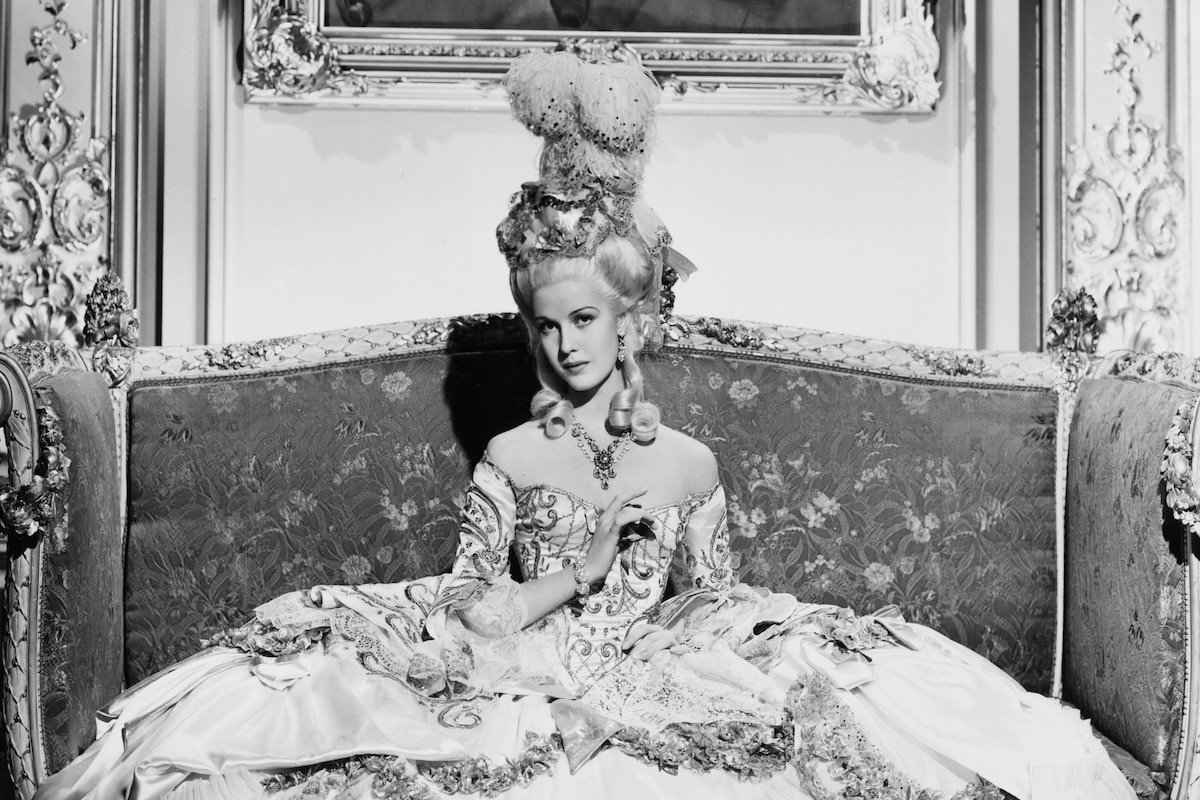
The bright light of Metro-Goldwyn-Mayer, Norma Shearer is the famous young queen of France in the lavish Hollywood epic Marie Antoinette (1938).
When the film opens Marie Antoinette is offered in an arranged marriage to Louis Auguste, the Dauphin of France (Robert Morley), and heir to the French throne. But Louis Auguste is a physically repellant and intellectually crippled mate who proves an unwilling husband as well. Marie finds her problems added to by Madame Du Barry (Gladys George), King Louis XV's (John Barrymore) scheming, devious mistress who finds special sport in Marie and Louis Auguste's inability to produce a child and heir to the throne. Though Marie initially seems to enjoy the support of the Duke d'Orleans (Joseph Schildkraut), he later reveals himself to be a duplicitous and unreliable confidante, more concerned with gaining power than aligning himself with an unpopular royal.
Soon driven away from the court of Versailles, Marie exacts her revenge by becoming the party girl of the realm and spending her fortune with reckless abandon. She also begins a dalliance with the handsome Swedish nobleman Count Axel de Fersen (Tyrone Power). But when the King dies and Louis Auguste becomes the new King, Count de Fersen is unwilling to continue their affair.
Committing herself to France and her husband, Marie bears two children but her restoration to a position of power and status proves her undoing. Marie and Louise Auguste are eventually imprisoned by rebels attempting to overthrow the monarchy during the French Revolution. And despite Count de Fersen's efforts to rescue her, she eventually meets her fate, along with her husband, beneath the blade of a guillotine.
As far back as 1933 Shearer's husband and MGM's head of production Irving Thalberg began plans to one day have his wife play the doomed French queen. But after Thalberg's death in 1936, Shearer took a sabbatical from acting.
Nevertheless, Shearer seemed fated to play Marie Antoinette and the film was her heralded return to film after her husband's death. Returning to MGM, however, was not without its difficulties. After Thalberg's death, tensions between Shearer and MGM head Louis B. Mayer grew considerably. Shearer's lawyers demanded that she and her children were due part of MGM's profits under Thalberg's contract, but it was an idea that infuriated Mayer.
In response to Shearer's demands, Mayer did his part to sabotage the Marie Antoinette production. His most significant strike was in replacing Shearer's preferred director, Sidney Franklin, with W.S. Van Dyke who some have suggested knew nothing of French history.
Dubbed "One-Take Woody," Van Dyke was also known never to make more than two takes for any scene, thus saving Mayer a considerable amount of money. Shearer was angered by Van Dyke's refusal to be deferential, or allow her more than two takes though Shearer's biographer Gavin Lambert notes that the pair eventually grew to appreciate each other's working methods.
Tensions weren't restricted to the feud between Shearer and Mayer. Shearer's costar Robert Morley reportedly so disliked the production he dubbed it "Marie and Toilette." Twentieth Century-Fox head Darryl Zanuck had some issues with the Marie Antoinette production too. He was infuriated that a star of Tyrone Power's magnitude, who played Marie Antoinette's lover in the film, was virtually a supporting player. Zanuck vowed forever after to severely restrict loaning out his top box-office stars.
Marie Antoinette received multiple Academy Award nominations for Best Interior Decoration and Best Score among others. And Shearer received her forth Oscar nomination for the film, though she lost to Bette Davis in Jezebel (1938). Morley also lost his Best Supporting Actor nomination to Walter Brennan in Kentucky (1938).
Production designer Cedric Gibbons went to great effort to put Marie Antoinette's enormous budget to good use. Determined that the sets look authentic, enormous amounts of preproduction research traced the fashion, customs and decor of the French court. Gibbons ensured the film's opulent tone by purchasing set dressing from actual Paris antique stores. And in order to manufacture the elaborate hats for the film, costume designer Adrian had a milliner from Paris brought to Hollywood.
Not that Hollywood couldn't also improvise when needed. To re-create the Palace of Versailles the filmmakers took a novel approach. They decorated the facade of the Hollywood Park Racetrack in Inglewood, California to look like Versailles then edited in background film of the actual French palace. It was the first time the French government had allowed a motion picture to shoot Versailles.
Marie Antoinette was based upon the book by Stefan Zweig whose biography uncovered vital new information found at the state archives in Vienna. According to Norma Shearer biographer Gavin Lambert, Zweig discovered that Louis XVI's impotence was traceable to phimosis, an irregularity in the foreskin later corrected through circumcision. The archives also provided evidence of Marie's affair with the Swedish nobleman Count Axel de Fersen, though the Hollywood Production Code restricted the script from stating any of these facts outright.
Marie Antoinette was a film made, according to Mayer's strictures, on the cheap. Finished in just ten weeks for less than two million dollars, its modest budget was an amazing sum for a production of that size.
A solid though not astounding success, Marie Antoinette did manage to gross almost $3 million, a sum greater than any previous MGM film. Variety said the film "approaches real greatness" though the reviewer admitted that the final decapitation of its heroine was "depressing," and "the exit is on the emotional downbeat."
Director: W.S. Van Dyke II (Julien Duvivier, uncredited)
Producer: Hunt Stromberg
Screenplay: Claudine West, Donald Ogden Steward, Ernest Vajda, F.
Scott Fitzgerald, based on a book by Stefan Zweig
Cinematography: William Daniels
Production Design: Cedric Gibbons, William A. Horning
Music: Herbert Stothart
Cast: Norma Shearer (Marie Antoinette), Tyrone Power (Count Axel de Fersen), John Barrymore (King Louis XV), Gladys George (Mme. Du Barry), Robert Morley (King Louis XVI), Anita Louise (Princess DeLamballe), Joseph Schildkraut (Duke of Orleans), Henry Stephenson (Count Mercey), Reginald Gardiner (Artois).
BW-150m. Closed captioning.
by Felicia Feaster
Marie Antoinette (1938)
by Felicia Feaster | September 08, 2006
SIGN UP FOR OUR NEWSLETTERS

CONNECT WITH TCM