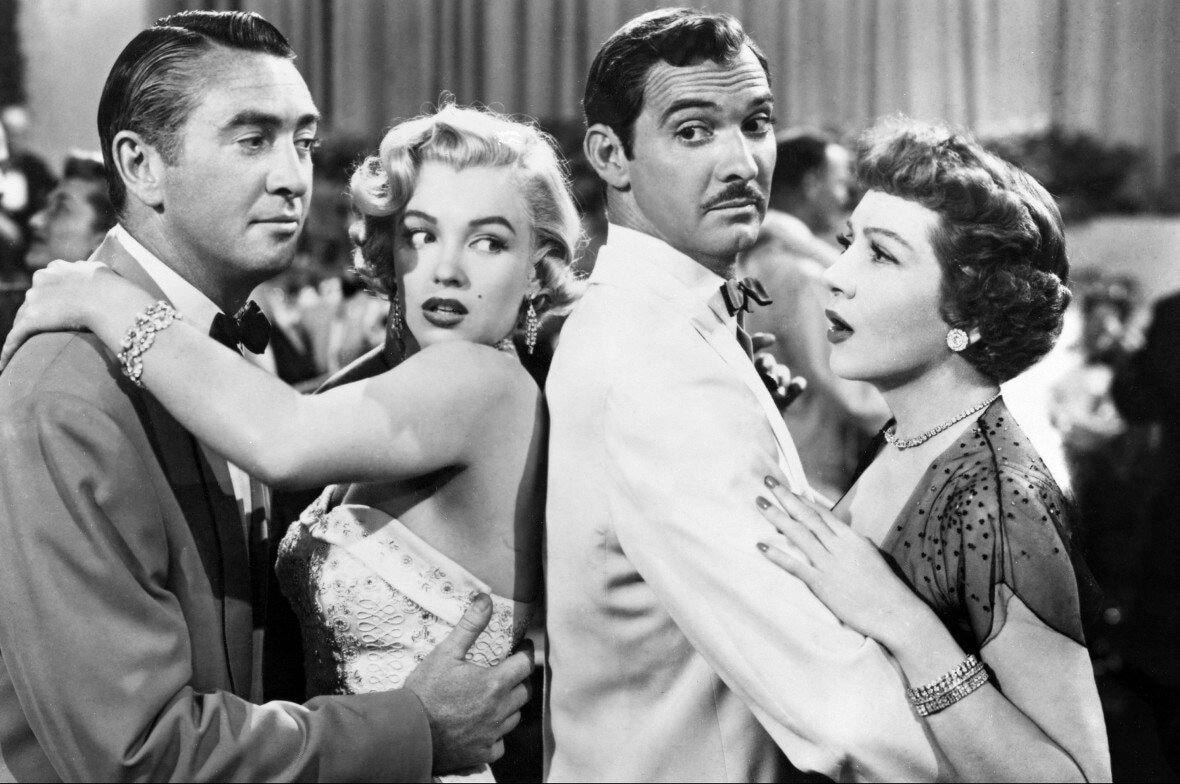
Claudette Colbert was one of the great stars of the 1930s and '40s, but by the 1950s she grew tired of working on film. That, and a tax problem that led her to move to Europe, slowed her film work to a halt. She would work on the stage, and later television, but by 1951 when she made Let's Make It Legal, she was on her way out of the movies. At the same time, two other people working on the film, writer I.A.L. Diamond and actress Marilyn Monroe, were on their way in and in a major way. It wouldn't be long before Monroe was a top box-office draw, and Diamond was only a few years away from becoming one of the most celebrated writers in the movies, working on such Hollywood classics as Some Like It Hot (1959) and The Apartment (1960) with Billy Wilder. As such, Let's Make It Legal, marks a nice transition from old Hollywood to new Hollywood, with the sophisticated yet farcical comedy stylings of Diamond already well in place.
Let's Make It Legal revolves around Colbert and Macdonald Carey as a married couple of 20 years headed for divorce. She wants to divorce him because of his gambling and she's already left, living with her daughter (Barbara Bates) and son-in-law (Robert Wagner). Carey works at a hotel where he's Wagner's boss and both of them are trying to appease a millionaire played by Zachary Scott, who just happened to once be the love interest of Colbert. Finally, if you're still keeping up, there's a younger woman, played by Marilyn Monroe, trying to get her hands on Scott's money. Like I said, Diamond's combination of sophisticated wit and farcical plotting was already on full display in 1951.
Colbert did this movie after having to drop out of the starring role as Margo Channing in All About Eve (1950) a few months prior due to a back injury. The fact that All About Eve not only became an instant classic but an iconic role for Bette Davis probably stung and perhaps doing a raucous comedy was Colbert going back to her comfort zone. After all, from her Oscar-winning turn in It Happened One Night (1934) to the rapid-fire free-for-all The Palm Beach Story (1942), Colbert was at home in comedy. But when Let's Make It Legal didn't score big with either critics or the public, Colbert decided to take a break from the movies--a break that, with only a few minor appearances later, became a permanent leave of absence. She would continue a successful stage career and return to television in the 1980s, winning a Golden Globe for her work in The Two Mrs. Grenvilles.
Marilyn Monroe fared better. Monroe had seen a career lift just the year before with two small parts in big movies. One of them, as it turns out, was All About Eve, the other was The Asphalt Jungle. After this and Monkey Business (1952) the following year (co-written by Diamond), her career was set. Meanwhile, after the success of Monkey Business, I.A.L. Diamond started working with Billy Wilder and the two quickly became one of the most successful writing teams in movie history.
Let's Make It Legal may not be the best comedy Colbert ever made, but there's enough talent involved to make the whole effort worthwhile. And Colbert, as always, carries the film like a pro.
Directed by Richard Sale
Produced by Robert Bassler
Story by Mortimer Braus
Screenplay by I.A.L. Diamond, F. Hugh Herbert
Cinematography by Lucien Ballard
Edited by Robert Fritch
Art Direction by Albert Hogsett, Lyle Wheeler
Set Decoration by Paul S. Fox, Thomas Little
Costume Design by Charles Le Maire, Renié
Cast: Claudette Colbert (Miriam Halsworth), Macdonald Carey (Hugh Halsworth), Zachary Scott (Victor Macfarland), Barbara Bates (Barbara Denham), Robert Wagner (Jerry Denham), Marilyn Monroe (Joyce Mannering), Frank Cady (Ferguson)
By Greg Ferrara
Let's Make It Legal
by Greg Ferrara | October 29, 2018
SIGN UP FOR OUR NEWSLETTERS

CONNECT WITH TCM