Western movies were so numerous in the 1950s that producers racked their brains to think of an unused novelty angle. Paramount invested in the musical farce Red Garters (1954), a comedy Western played out amid abstract sets painted in primary colors. Independent producer Lindsley Parsons became interested in a novel by Kenneth Perkins that referenced a little-known episode in the settling of the West: The United States Camel Corps. The U.S. Army did indeed experiment with camels as pack animals, a project that was abandoned with the interruption of the Civil War. Two movies made in the 1950s attempted to exploit the odd historical chapter. United Artists' 1954 Western Southwest Passage, starring Rod Cameron, was originally in 3-D.
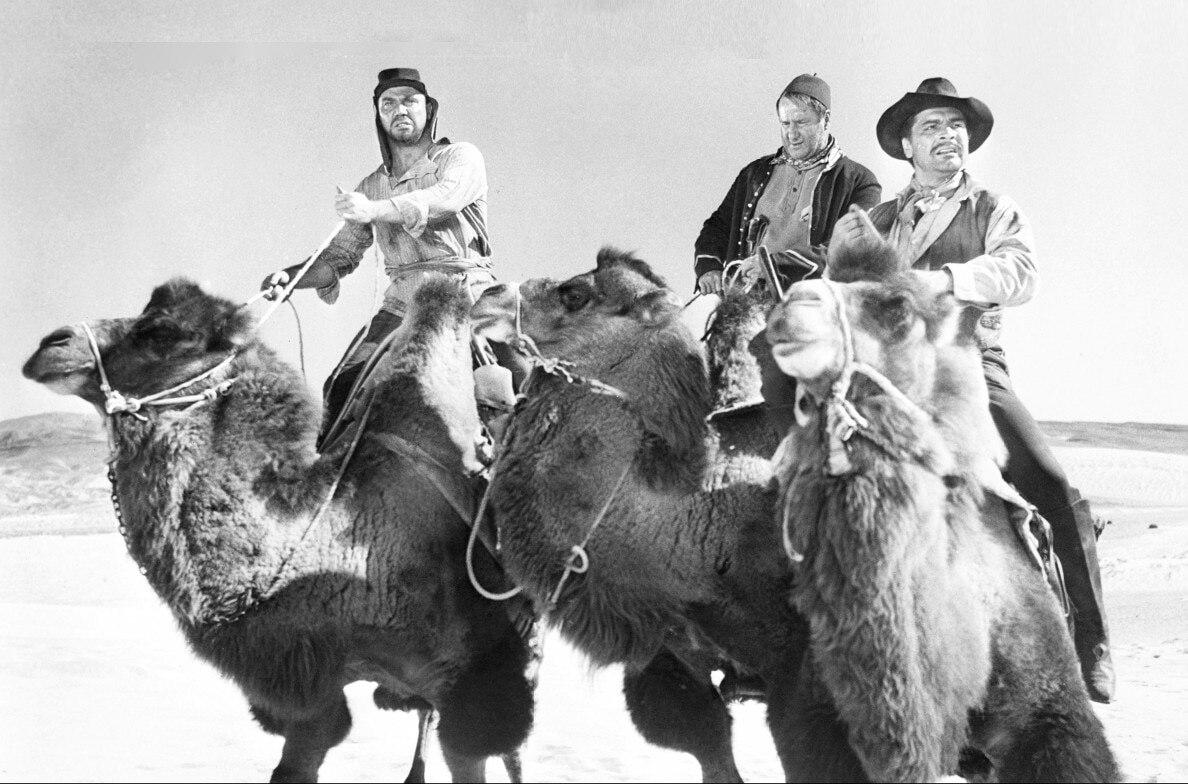
But coming first was the Monogram release Desert Pursuit (1952), a wilderness chase story set in 1870. In W. Scott Darling's screenplay adaptation, prospector Ford Smith (Wayne Morris) and Reno blackjack dealer Mary Smith (Virginia Grey) meet in the open desert. She's on the run after being accused of cheating, and he's on the way to the bank with the gold he panned from a Nevada stream. The vulnerable couple are pursued by a band of Arabs using camels, purportedly the descendants of foreigners imported to teach proper camel-tending. They've now become ruthless bandits.
Highly suited for a night of film programming about negative images of minorities in cinema, Desert Pursuit gives us actors George Tobias, Anthony Caruso and John Doucette as duplicitous Arabs with "sinister" names like Hassan, Kafan and Ghazili. Pursuers and the pursued play tag in the chase across the desert, with Mary becoming Ford's girl after she realizes that she attended the wedding of the sweetheart for whom he's been saving himself. John receives some aid from the local Native Americans, among them actors Frank Lackteen and young Gloria Talbott.
Reviewers in 1952 weren't kind to Desert Pursuit, indicating that cowboys and camels were not likely to click as a commercial combination. They complained about the story's lack of action, not its ethnic insensitivity. The desert cinematography in Lone Pine and Olancha Dunes did garner some praise. All noted the episode in which the Native Americans, apparently exposed to Christian teachings, initially mistake the camel-mounted Arab marauders for the Three Wise Men of the nativity story.
The talent behind Desert Pursuit is a portrait of postwar Hollywood in transition. Ex-studio contractees Virginia Grey and Wayne Morris spent the '50s scrambling for work, finding most of it on television. Former Navy Air ace Morris is credited as an associate producer on the film as well. Best remembered for his late-career performance in Stanley Kubrick's Paths of Glory (1957), Morris found himself in diminishing parts and died unexpectedly seven years later, at age 45. Director George Blair enjoyed a prolific career in B-pictures for outfits like Monogram and Republic, but after Desert Pursuit he almost immediately turned to episodic TV work. His last feature film was the quirky exploitation shocker The Hypnotic Eye (1960).
By Glenn Erickson
Desert Pursuit
by Glenn Erickson | October 05, 2018
SIGN UP FOR OUR NEWSLETTERS

CONNECT WITH TCM