Richard Price drew from his high school experience for his first novel, a collection of vignettes about life in his Bronx neighborhood in 1962 and 1963. Published in 1974, The Wanderers is named for the Italian-American gang that the main characters belong to but it's less a gang novel than a remembrance, a coming-of-age portrait of guys in a macho culture on the cusp of becoming adults and the futures available to them in a world that is giving way to the changes of the 1960s. The novel was quickly bought up by Samuel Goldwyn, Jr. and Price was hired to write the screen adaptation; but he was unable to translate the book's episodic nature into a narrative feature and the project languished.
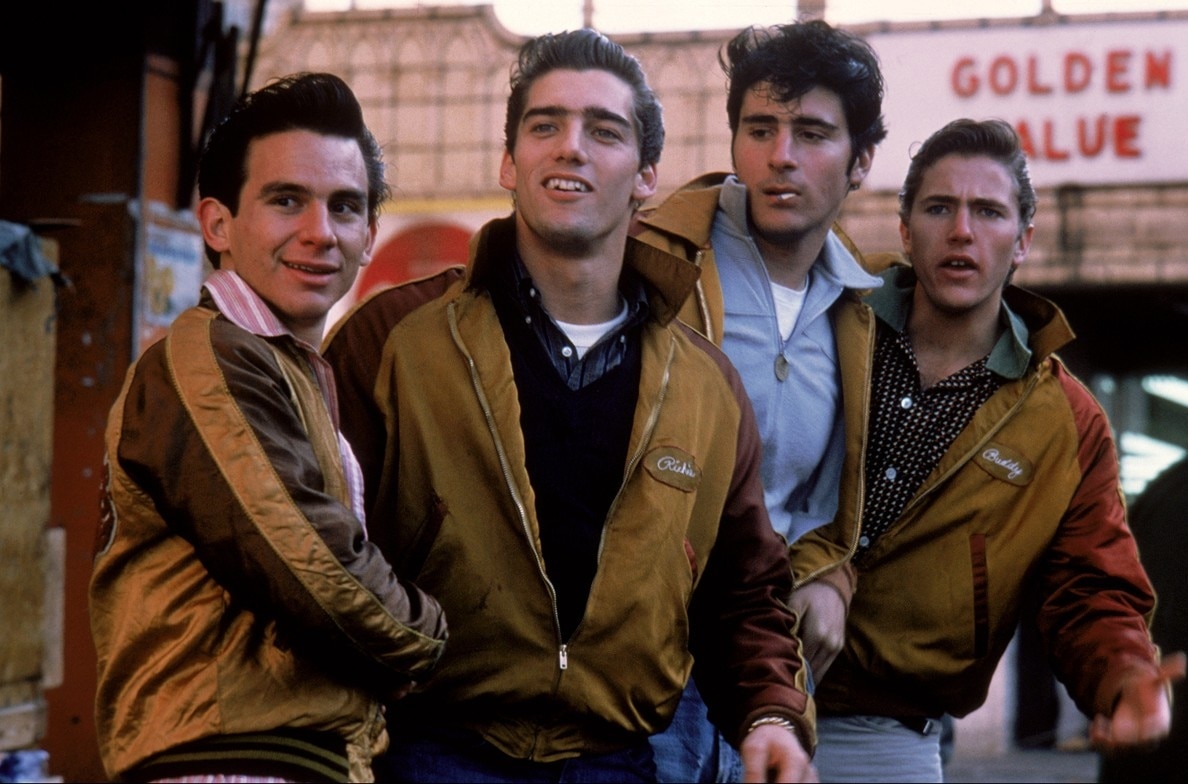
Filmmaker Philip Kaufman was introduced to the novel by his then-14-year-old son, who insisted that it would make a great film. Kaufman was a little older than Price and grew up in Chicago but he recognized the culture of boys joining gangs (which Kaufman describes as really more like clubs than the modern conception of violent criminal gangs) and proclaiming their allegiances with colorful jackets. He optioned the book and his wife, Rose Kaufman, wrote the first draft, which was shopped around the studios. In the years it took to land a production deal (the studios had no faith in "teenage movies," according to Kaufman), he kept rewriting and refining the film with Rose, until Orion Pictures took on the project. It went into production quickly and he shot it back-to-back with his remake of Invasion of the Body Snatchers (1978).
Kaufman chose to cast unknowns and non-actors as his teenage characters. Ken Wahl was a pizza delivery driver when he was invited to audition for one of the supporting roles. Kaufman was so impressed that he cast him as the handsome Richie, the closest that the gang has to a leader. Tony Ganios, who played the hulking Perry, was found by calling around gyms looking for a "six-foot, four inch, 18-year-old kid" and Erland Van Lidth De Jeude, who plays the enormous leader of the Fordham Baldies, was a wrestling champion and an engineering graduate of M.I.T. Linda Manz, who had just finished shooting Days of Heaven (1978) for Terrence Malick, was still an unknown (the film wasn't released until later) but made such an impression during her audition that the part of Peewee was created for her. Only a couple of young performers came to the film with significant acting experience, notably Toni Kalem, who had a few TV and Off-Broadway credits to her name when she was cast as Richie's girlfriend Despie, and Alan Rosenberg, who attended the Yale School of Drama and was cast as Turkey. Rosenberg went on to an impressive career, including roles on TV's L.A. Law and Chicago Hope and serving as president of the Screen Actors Guild.
With a relatively low budget and short shooting schedule, Kaufman prepared for the production by scouting Bronx locations with members of the cast and engaging them in improvisations in the weeks leading up to principal photography. Kaufman wanted to be historically accurate but also create a stylized vision of life in 1963 Bronx as seen by a teenager in high school. He worked with his Body Snatchers cinematographer Michael Chapman to create a vivid, colorful palette for the street scenes that gives way to the dingy reality of their oppressive apartments and broken family lives. For the scene when the Wanderers first meet the feared Ducky Boys, a gang of Irish-Americans notorious for their ruthlessness, Kaufman and Chapman recreated the atmosphere of Body Snatchers to suggest a mythic, larger than life quality. The gangs featured in the novel and the films--the Wanderers, the Del-Bombers, the Fordham Baldies, the Wongs and the Ducky Boys--were real gangs in Richard Price's neighborhood and members of the real-life Baldies even showed up to watch the shoot.
Philip and Rose Kaufman took liberties with the novel, removing some characters and adding others, and they pushed the setting up a year to 1963 to situate them at a moment of social change and upheaval, including the assassination of President John F. Kennedy. One of the most memorable additions, featuring Bob Dylan's "The Times They Are a-Changin" at Folk City in Greenwich Village, was made possible thanks to Kaufman's friendship with Dylan, who rarely licensed his music to movies. There is no equivalent scene in the novel but it was important to Kaufman, who wanted to suggest the cultural revolution leaving these Bronx kids behind. Despite the changes, author Richard Price praised the film: "I love that picture. It's not my book, and I don't care. The spirit is right, and the way Phil Kaufman directed it showed me another way of looking at my own book." Kaufman also gave Price a cameo in the film: he's one of the men bankrolling the bowling alley hustlers.
Coming after the violence spawned by screenings of The Warriors, theaters were reluctant to book another "gang" film and it suffered mixed reviews and spotty distribution, but it was a hit overseas and built a fan base over the years from TV and repertory showings. In 1982, a Wanderers fan club formed in Telluride, Colorado and reunited at every Telluride Film Festival in their jackets to watch the film at a special screening, and in 1996 it received a brief rerelease.
In 2016, Kino Lorber remastered the film for theatrical rerelease (where it played in more theaters than its original run, according to Price) and a subsequent special edition DVD and Blu-ray release, which included a slightly longer "preview cut" featuring five minutes of additional footage cut from the release version.
Sources:
Philip Kaufman, Annette Insdorf. Univ. of Illinois Press, 2012.
Cult Movies III: 50 More Hits of the Reel Thing, Danny Peary.
""The Wanderers" Comes Home at Last", Michael Sragow. The New Yorker, July 16, 2012.
"Wanderers Forever - Live Q&A at NYC's Film Forum," Karen Allen, Toni Kalem, Tony Ganios and Richard Price, moderated by Bruce Goldstein, December 4, 2016. Kino Lorber Home Video, 2017.
"The Wanderers Q&A at LA's Cinefamily," Philip Kaufman, Alan Rosenberg and Peter Kaufman, moderated by Hadrian Belove, November 17, 2016. Kino Lorber Home Video, 2017.
"Audio Q&A at Film Forum," Philip Kaufman, moderated by Bruce Goldstein, December 19, 2016. Kino Lorber Home Video, 2017.
"Audio Q&A at Film Forum," Richard Price, moderated by Brian Rose, December 5, 2016. Kino Lorber Home Video, 2017.
AFI Catalog of Feature Films
IMDb
By Sean Axmaker
The Wanderers
by Sean Axmaker | October 04, 2018
SIGN UP FOR OUR NEWSLETTERS

CONNECT WITH TCM