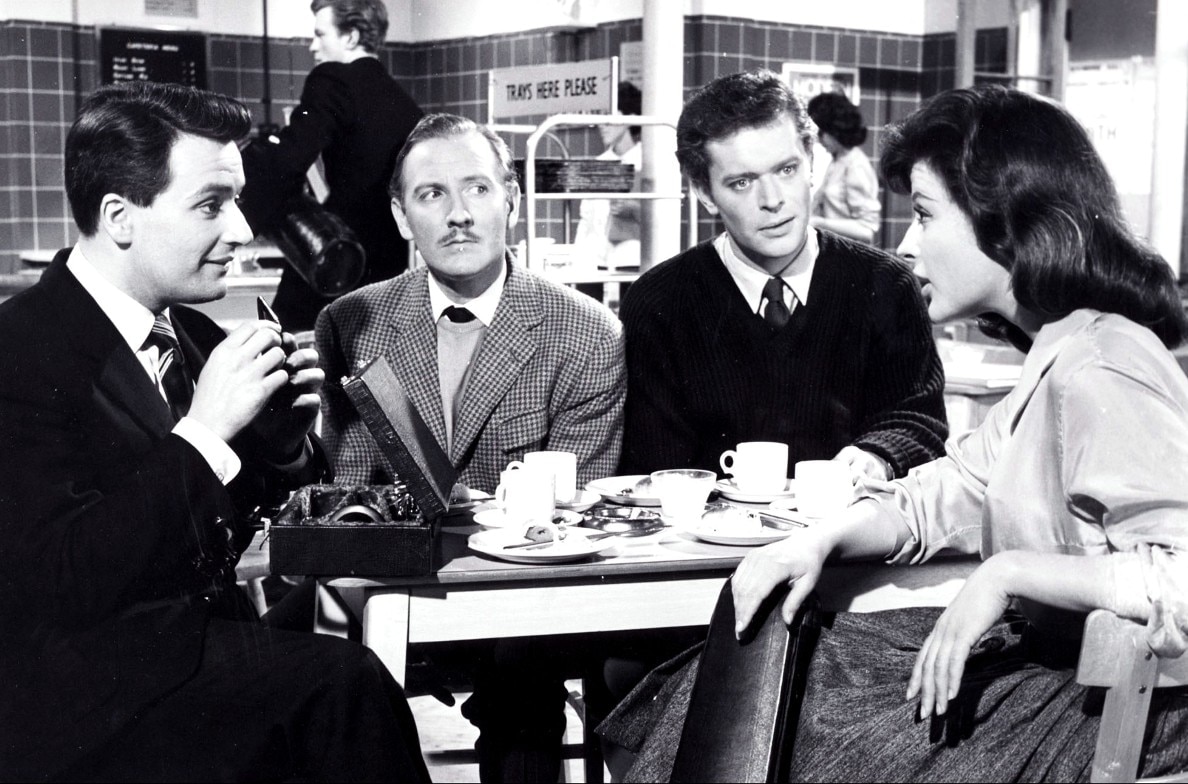
Raising the Wind aka Roommates (1961) was a film that combined the stars of two very popular British film series. The Carry On films had become a staple of British comedy in the 1950s and 1960s and would number an astonishing 31 films from 1958 to 1992 with Christmas specials, theatrical productions, and even a short television series. The other series was the Doctor films, that had helped to make Dirk Bogarde a star. Over 16 years, there would be seven Doctor films as well as a television series. Raising the Wind starred some of the best performers from both franchises, like Leslie Phillips, James Robertson Justice, Kenneth Williams, Sidney James, and Jim Dale (who would later earn his greatest fame and three Grammy Awards as the narrator of the Harry Potter audiobooks.) Also in the cast were a young Jill Ireland and Joan Hickson, who is best remembered for starring in the Miss Marple series in the 1980s and 1990s.
Raising the Wind is a frothy comedy about musical students from the fictional London Academy of Music and the Arts who decide to share an apartment to save money and have a space to practice. One of the students, Mervyn (Phillips) writes a song and later sells it while drunk to ad men Sid (James) and Harry (Lance Percival) for £50. When he sobers up, he remembers that selling the song would violate the terms of his student grant and desperately tries to buy it back, but Sid and Harry want £500 that Mervyn doesn't have.
Under the working title of The Happy Band, the film was shot at Pinewood Studios in Buckinghamshire, with the music academy exterior filmed at University College on Gower Street in London, which was also used as the exterior for the fictional St. Swithin's hospital in the Doctor series. The screenplay and original story were by Bruce Montgomery, and director Gerald Thomas found it so funny that he wrote Montgomery that it had caused him to "put on several pounds in weight through laughing." The multi-talented Montgomery (who wrote detective novels under the pseudonym of Edmund Crispin) composed and conducted the film's score (his 40th at the age of 39) and acted as a technical advisor for actor Leslie Phillips, who he taught to conduct so convincingly that the Sinfonia of London, the real orchestra used in the film, applauded Phillips after a take. Montgomery himself would appear as the conductor of The Messiah.
Montgomery enjoyed working in the familiar atmosphere of Raising the Wind since he had written the film scores for all of the Carry On and Doctor films up to that time. In preparation for filming, Montgomery asked his friend Thomas Armstrong if Gerald Thomas and producer Peter Rogers could visit the Royal Academy of Music to get atmosphere for the film. Armstrong had a difficult time choosing just 60 members of the London Philharmonic Choir to appear onscreen because there were so many volunteers.
Although Bruce Montgomery would later write that Raising the Wind wasn't "a picture calculated to raise the cultural tone of the nation," it certainly raised the box office take for the British film industry when it was an overwhelming success after its premiere at the Plaza Theater in Lower Regent Street, London on September 7, 1961. It would earn more than any other film up to that point in 1961 at the box office.
By Lorraine LoBianco
SOURCES:
https://www.bfi.org.uk/films-tv-people/4ce2b6b3e18e1
http://collections-search.bfi.org.uk/web/Details/ChoiceFilmWorks/150032829
The Internet Movie Database
Whittle, David Bruce Montgomery/Edmund Crispin: A Life in Music and Books
Roommates
by Lorraine LoBianco | October 04, 2018
SIGN UP FOR OUR NEWSLETTERS

CONNECT WITH TCM