In 1960, author Howard Fast, under the pen name E.V. Cunningham, published his novel Sylvia, a story about a woman with a dark and mysterious past. Fast was a prolific writer and an outspoken member of the Communist Party. In 1950, Fast was summoned to testify before the House Committee on Un-American Activities, but he refused to comply with the committee's request for him to name individuals who had contributed to various Communist causes, and as a result, he was imprisoned for contempt. During his prison sentence, Fast was inspired to write Spartacus in 1951, his most famous novel and a not-so-thinly veiled criticism of the Red Scare tactics at the hands of Congress. While the blacklisting undoubtedly hurt his career, Fast managed to find success with self-publishing--a risky venture at the time. But even after managing to be published under his real name during the blacklist, Fast would still occasionally use a pen name, as he did with his story Sylvia.
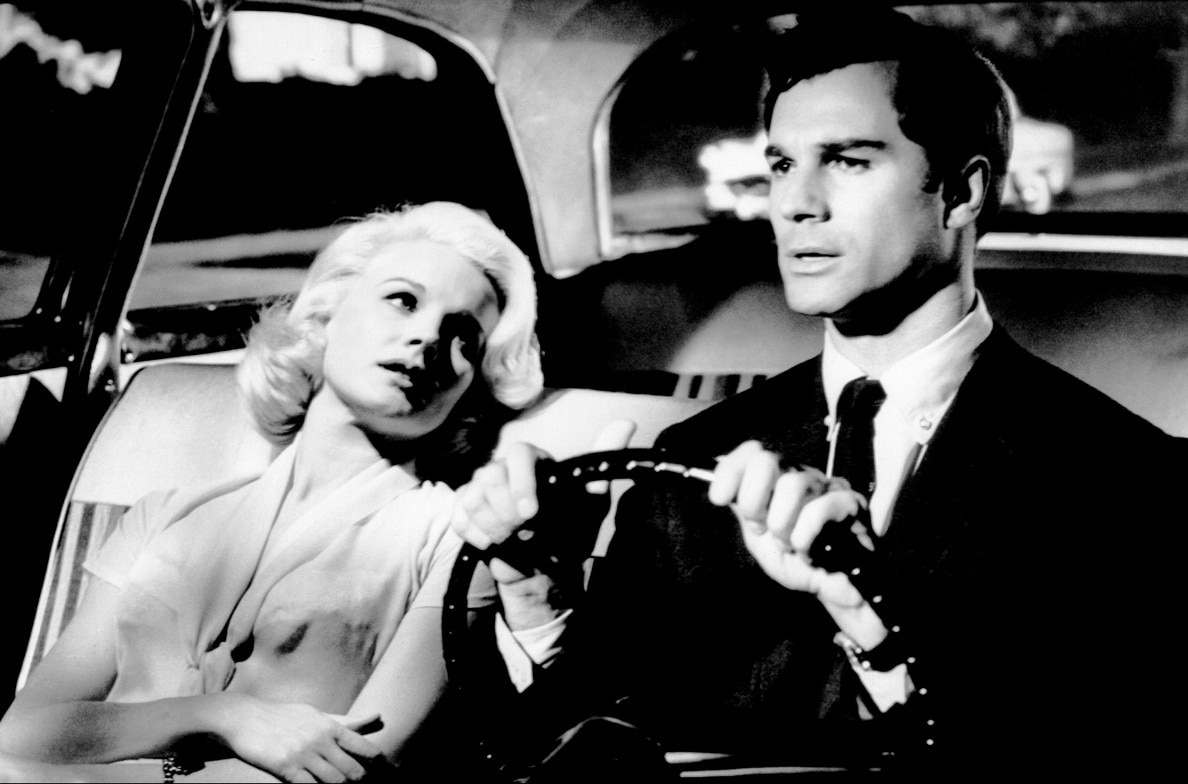
Sylvia West (Carroll Baker) is a successful, published writer of poetry, earning the affections of a prominent California millionaire named Frederic Summers (Peter Lawford). After a courtship and marriage proposal, Summers decides he must hire a private investigator, Alan Macklin (George Maharis), to look into Sylvia's past to guarantee her intentions to marry him are honorable. Using the subject of her poetry as a guide, leading him to her hometown of Pittsburgh, PA, Macklin discovers that she has a dark and troubling past, including working as a prostitute.
Following the release of Cunningham's (Fast) novel in 1960, producer Martin Poll immediately purchased the film rights to the story with the intent of hiring Martin Ritt to direct and Paul Newman to star. But the project was shelved until 1964, and by then Ritt and Newman had moved on to other projects, so Poll was tasked with finding a new director and cast.
Carroll Baker made her feature-film debut in Easy to Love (1953), but her breakthrough role came in George Steven's family epic Giant (1956), starring Rock Hudson and Elizabeth Taylor. She continued working with some of the greatest directors in Hollywood and that same year, Baker starred in the controversial Baby Doll (1956), directed by Elia Kazan and co-starring Karl Malden and Eli Wallach, earning her first and only Academy Award nomination for Best Actress. While her home studio of Warner Bros. attempted to groom her as a Marilyn Monroe-type, Baker proved to be an unconventional star with appearances in films such as William Wyler's 1958 Western The Big Country, her second husband Jack Garfein's masterpiece Something Wild (1961), Edward Dmytryk's The Carpetbaggers (1964) and John Ford's Cheyenne Autumn (1964).
George Maharis got his start in television, gaining notoriety for his role as Buz Murdock in the popular series Route 66. In 1963, Maharis left the show and embarked on a film career, with Sylvia being one his early first feature-length pictures. Maharis starred in several films throughout the 1960s, including The Satan Bug (1965), The Happening (1967) and The Desperados (1969). But by the 1970s, Maharis returned to television, starring in made-for-television movies and guest starring on several popular series.
Director Gordon Douglas started his career working for Hal Roach, writing and directing comedy bits for the producer's films, including the popular Our Gang series and for the comedy duo Stan Laurel and Oliver Hardy. In the early 1940s, Douglas left Hal Roach Studios, signing a contract with RKO. Most of his work for the studio was for their lower budge serial films, such as The Great Gildersleeve (1942) and its various sequels. Douglas eventually signed on to direct for Warner Bros., with films such as the sci-fi classic Them! (1954) andYoung at Heart (1954) starring Frank Sinatra and Doris Day. Besides his work on Them! and Our Gang, Douglas is perhaps best known for his collaboration with Frank Sinatra, working with the singer/actor four more times: Robin and the 7 Hoods (1964), Tony Rome (1967), Lady in Cement (1968) and The Detective (1968).
Sylvia was partially filmed on-location in Pittsburgh, featuring impressive aerial shots of the city as well as prominent local landmarks. For the California scenes, the production took place at Paramount Studios and in various locations around Los Angeles, including LAX and Beverly Hills.
Upon its initial release, Sylvia had a lukewarm response from both audiences and critics, but in recent years the film has been reevaluated and has received more favorable reviews, with particular praise for Carroll Baker's performance.
Director: Gordon Douglas
Producer: Martin Poll
Screenplay: Sydney Boehm
Cinematography: Joseph Ruttenberg
Editing: Frank Bracht
Art Direction: Roland Anderson and Hal Pereira
Original Music: David Raskin
Cast: Carroll Baker (Sylvia West), George Maharis (Alan Macklin), Joanne Dru (Jane Phillips), Peter Lawford (Frederic Summers), Viveca Lindfors (Irma Olanski), Edmond O'Brien (Oscar Stewart), Aldo Ray (Jonas Karoki), Ann Sothern (Grace Argona).
BW-115m. Widescreen.
by Jill Blake
Sources:
Afi.com
http://dearoldhollywood.blogspot.com/2012/03/sylvia-1965-film-locations.html
Sylvia (1965)
by Jill Blake | August 23, 2018
SIGN UP FOR OUR NEWSLETTERS

CONNECT WITH TCM