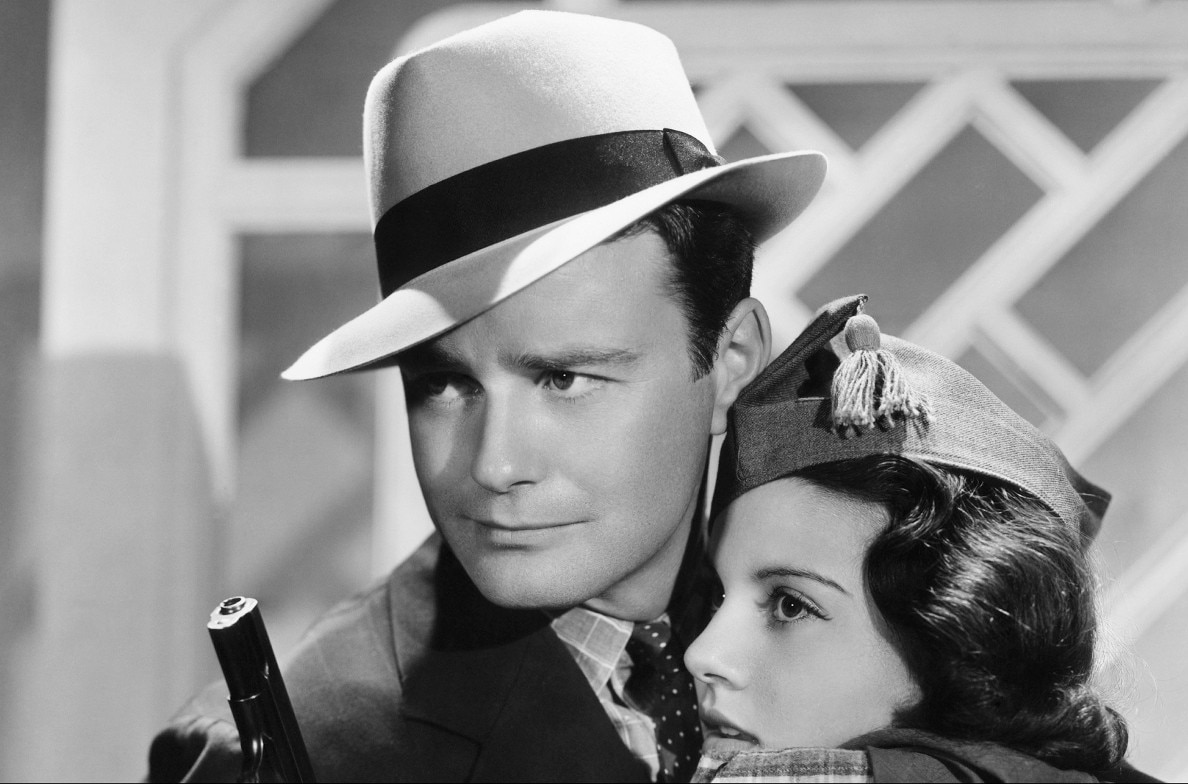
After the success of MGM's Oscar-winning Grand Hotel (1932), which essentially created the "all-star" film as well as the idea of telling several interweaving stories in a single setting, studios all over Hollywood rushed to make copycat productions. One of these was Paramount's The Last Train from Madrid (1937), although as The New York Times observed, the cast was "taken from Paramount's second-string list." Instead of, say, Bing Crosby, Claudette Colbert, and Mae West, the film gives us Dorothy Lamour, Lew Ayres, Gilbert Roland, Karen Morley, Lionel Atwill, and Anthony Quinn. Lamour is billed first despite having only a few lines, and it is actually Quinn, in only his fifth credited role, who gives perhaps the most memorable performance and his first truly significant one. He was even lauded by name in major reviews of the time.
This film's other claim to fame lies in having been the first Hollywood feature to acknowledge the Spanish Civil War, which broke out in 1936. (Wings of the Morning, a 1936 British film, contains a brief reference to the war.) Quinn plays a Spanish army officer providing passage by train to various people trying to escape Madrid before the borders close. He helps an old friend (Roland) who's in political danger, but soon a melodrama arises between them and Roland's old girlfriend (Lamour). Meanwhile, Quinn's commanding officer (Atwill) starts to suspect Quinn of turning traitor. Ayres is on hand as an American reporter.
Variety called The Last Train from Madrid "a mixture of Grand Hotel and Shanghai Express," noting that Paramount "doesn't take any political chances with this one." Indeed, the film shies away from presenting any political arguments for or against the war, instead treating it as a backdrop to melodrama. As noted film scholar William K. Everson later wrote: "Hollywood in the '30s was notably reluctant to take any kind of a stance on European political affairs... Exhibitor groups resisted it, and were strong enough to arrange effective boycotts. Pressure groups were constantly at work, and towards the end of the '30s, America's own Neutrality Act technically made it a violation of that act to take obvious sides."
Two months after this film's release, the Spanish Civil War cropped up in two more films: Twentieth Century-Fox's Love Under Fire (1937), starring Loretta Young and Don Ameche, and the well-received documentary The Spanish Earth (1937).
Look fast for Alan Ladd as a soldier and Cecil B. DeMille in a crowd.
By Jeremy Arnold
The Last Train from Madrid
by Jeremy Arnold | August 22, 2018
SIGN UP FOR OUR NEWSLETTERS

CONNECT WITH TCM