Born in Hong Kong to a Chinese father and a British mother, Nancy Kwan was the first Asian actress since Anna May Wong in the silent era through the 1930s to achieve some measure of stardom in Hollywood. Her success roughly corresponded to that of two other actresses: Japanese native Miyoshi Umeki, the only Asian woman to date to have won an acting Oscar (Best Supporting Actress for Sayonara, 1957), and French-Vietnamese France Nuyen, who made her debut in South Pacific (1958). But Kwan, a trained ballet dancer discovered in London by producer Ray Stark, started at the top, sharing billing with William Holden in The World of Suzie Wong (1960) and top-billed in her second film, the musical Flower Drum Song (1961).
Within this brief period of success for Asian actors (including James Shigeta and others), Kwan had the most starring roles, albeit in some less-than-stellar movies, popping back and forth between the U.S. and the U.K. to appear opposite Pat Boone, Glenn Ford, Robert Goulet, Dick Van Dyke and Tony Curtis. Kwan's roles in many of her early films helped break some taboos against interracial romance on screen.
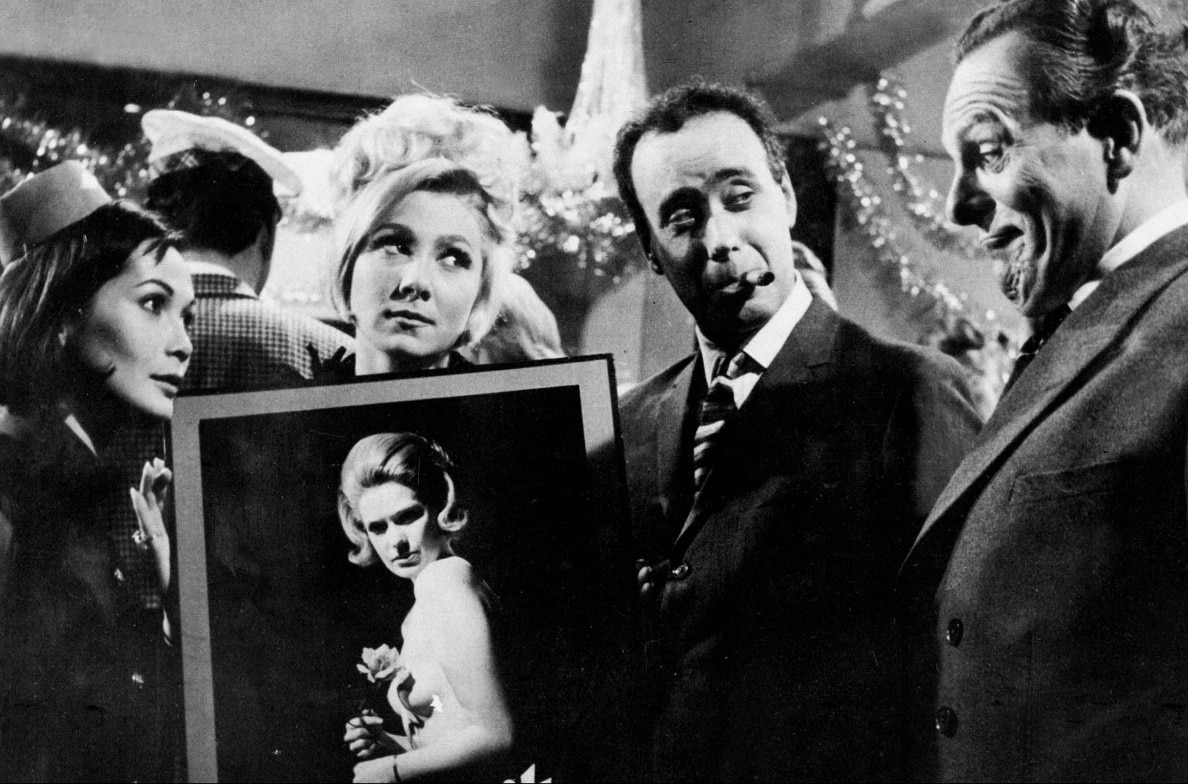
In The Wild Affair, produced in England, she is the object of attraction for her male office co-workers. As Marjorie Lee, she is spending her last day of work before leaving to get married, worried that at 20 she is still a virgin who has not yet tasted all that life has to offer before settling down. Urged on by her alter-ego Sandra (also Kwan), a sexy, self-assured persona who talks back to her via her mirror, she flirts with the idea of having an affair and, following a vampish makeover, going wild at the office Christmas party.
Writer-director John Krish, best known at this point for documentaries, had someone more like Sarah Miles (Ryan's Daughter, 1970) in mind when he was adapting William Sansom's novel, but Kwan was given the role on the orders of Stark, who was then one of the heads of co-producing entity Seven Arts. Kwan proved to be a winning choice, capturing both the prim, inexperienced Marjorie and the sophisticated, adventurous Sandra.
The film was ultimately a box office bomb. It was filmed in 1963 but shelved until it was finally released on the bottom half of a double bill with another picture that rode the wave of Swinging '60s London, The Pleasure Girls (1965). All the same, it was one of the first films to depict the new look, style and flexible morality of the time. Had it not been held back from release, it might have beaten The Haunting (1963) and Sing and Swing (1963) to the screen as the first movie to showcase the work of fashion designer Mary Quant. Although the claim has been challenged by others, Quant is often credited as the creator of the mini-skirt and became the leading figure in the Mod fashion movement. Later in the decade, she popularized hot pants.
Kwan's hairstyle in the movie was another on-trend touch, created by rising stylist Vidal Sassoon. The photo session that captured Kwan's transformation from long hair to a geometric bob - a major break from the stiff, teased beehives popular to that point - was featured in British Vogue and in the opening credits sequence of the movie. A profile shot of Kwan sporting the sensational new do was published in newspapers and magazines throughout the world and made Sassoon globally famous. Unfortunately, by the time the film was released, the look and attitudes the story showcased were already familiar and routine.
The movie is known for one other sartorial milestone. It is believed to be the only film in which Terry-Thomas appeared without his trademark mustache.
Director: John Krish
Producer: Richard Patterson
Screenplay: John Krish, based on the novel The Last Hours of Sandra Lee by William Sansom
Cinematography: Arthur Ibbetson
Editing: Russell Lloyd, Norman Savage
Art Direction: Terence Marsh, Wallis Smith
Music: Martin Slavin
Cast: Nancy Kwan (Marjorie Lee), Terry-Thomas (Godfrey Deane), Victor Spinetti (Quentin), Jimmy Logan (Craig), Betty Marsden (Mavis Cook)
By Rob Nixon
The Wild Affair
by Rob Nixon | August 14, 2018
SIGN UP FOR OUR NEWSLETTERS

CONNECT WITH TCM