"They're back...for everyone who believes in the beat."
Tag line for Breakin' 2: Electric Boogaloo
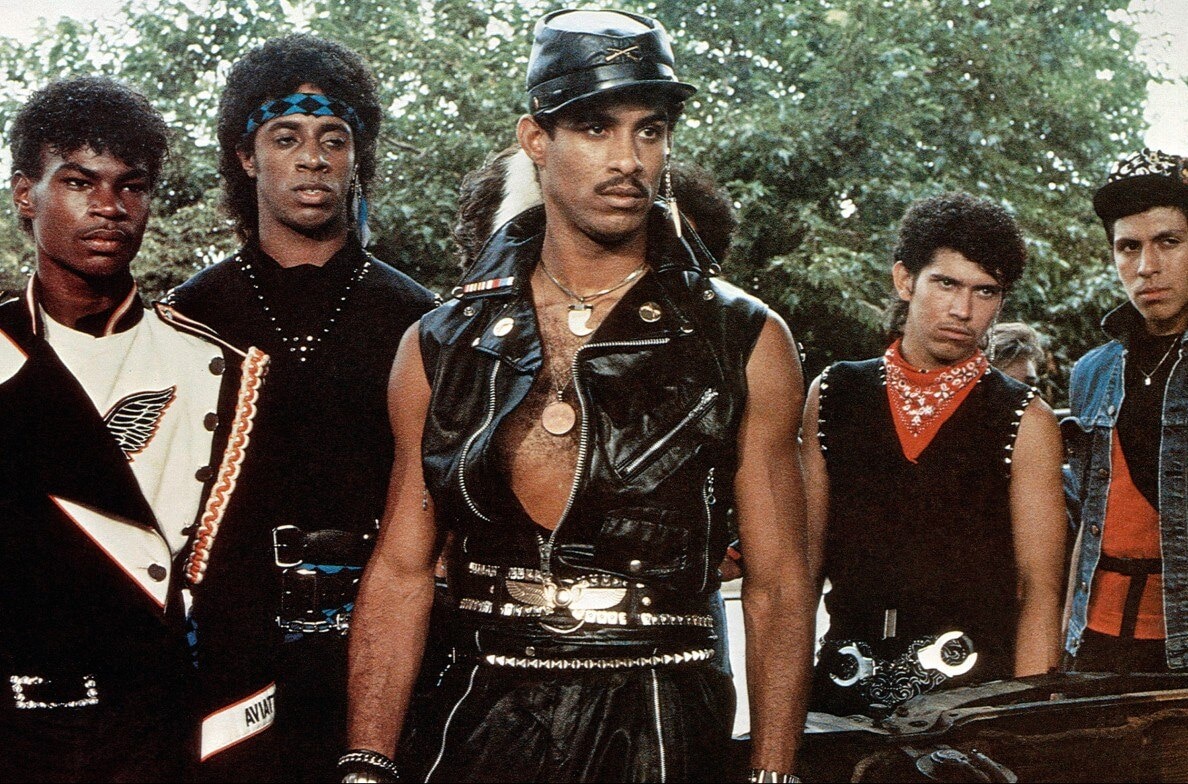
Although this sequel to Cannon Films' hit Breakin' (1984) is far from the strangest film produced by Israeli cousins Yoram Globus and Menahem Golan, its rhyming title and focus on almost non-stop dancing has earned it a place in the hearts of film cultists. Unlike many more critically revered musicals, it can also lay claim to having become a part of the language.
Breakin' had been a response to the success of Flashdance (1983), only with more focus on dancing than plot and with real break dancers and poppers Adolfo "Shabba-Doo" Quinones and Michael "Boogaloo Shrimp" Chambers in the cast. When the film grossed more than $30 million, they set out to make a sequel, which hit screens just seven months after the original. Like the original, the film was inspired by the short-lived Radiotron, a hip-hop music club across the street from MacArthur Park in Los Angeles. Officially, the building was the Youth Break Center, created by Carmelo Alvarez to provide a safe space for local youth who had gotten into trouble for break-dancing in the streets. The original film was about the Center's founding, with a subplot about society girl Tracy (Lucinda Dickey), who finds herself drawn to street dancer Ozone (Adolfo Quinones) and his pal Turbo (Michael Chambers). The sequel dealt with attempts to demolish the center that had been temporarily thwarted when Alvarez led a youth march on Los Angeles City Hall (the Center was demolished in 1985). The sub-title came from Quinones' street name, Boogaloo, and Golan's attempts to sell his dancing in the original: "Look at Boogaloo dance electric!" (Globus quoted in Matt Patches article for Grantland, "How Breakin' 2: Electric Boogaloo Became a Movie and Then a Meme").
To write the film, Golan and Globus hired novelist Julie Reichert and his wife, performance artist Jan Ventura, on the recommendation of documentarian Michael Ventura, who was at their offices working on his own documentary on one of Cannon's rare upscale productions, John Cassavetes' Love Streams (1984). Reichert and Ventura knew nothing about break-dance culture, so they went to the streets to research it. Then they had to throw out their research when Golan and Globus insisted on getting a G rating. The break dancers they had met did not use G-rated language. The producers also demanded a Romeo and Juliet romance between street dancer Ozone and society girl Kelly. Finally, they just threw out the couple's script and got someone else to write the film. For director, they hired Sam Firstenberg, who had made Revenge of the Ninja (1983) and Ninja III, The Domination (1984) for them. He didn't know anything about street dancing either, but he knew how to shoot action sequences, which is how he approached the dance numbers.
Dickey, Quinones and Chambers re-create their roles from the original Breakin' (1984). Also from the original is Ice-T, whose role as a rapper is given more of a name, Radiotron Rapper. Quinones' wife at the time, Lela Rochon, also returns for a small role as a dancer. Christopher McDonald declined to return from the first film. Far down in the credits list is child actor Kimberley McCullough, making her film debut a year before she achieved fame as Robin Scorpio on General Hospital, a role she is still playing 34 years later.
For the scene in which dancers perform on the walls of a room, the production borrowed the rotating room from A Nightmare on Elm Street (1984). Freddie's glove hangs on the wall as a tribute to the horror film. The scene was inspired by Golan's love of Fred Astaire movies and was an homage to "You're All the World to Me" in Royal Wedding (1951).
This was one of two films distributed for Cannon by Tri-Star Pictures (the other was 1985's Lifeforce). It was not supposed to come out so soon after Breakin', but Tri-Star ran into trouble when its big production for the season, Supergirl (1984), tanked at the box office. They pushed Cannon to get Breakin' 2: Electric Boogaloo into theatres. Eight editors worked for two weeks round the clock to get the film ready sooner, then it opened in 2,000 theatres over the Christmas holiday weekend. The result was a $15 million gross, which wasn't as good as the original but, given Cannon's low-budget production, still represented a profit (and out-performed Supergirl).
Most of the reviews were less than enthusiastic, with Janet Maslin of the New York Times quipping that it "slights dramatic matters to concentrate exclusively on dancing. The movie contains so much of it that it's exhausting even to watch...." In the minority, Roger Ebert gave the film three stars and praised it for its unpretentious devotion to sheer entertainment: "Here is a movie that wants nothing more than to allow some high-spirited kids to sing and dance their way through a silly plot just long enough to make us grin."
Ebert had hoped the film would lead to a string of low-budget musicals using the music teens were actually listening to. That didn't quite happen. Breakin' 2: Electric Boogaloo inspired an unofficial sequel, Rappin' (1985), though there was no plot connection and the only returning actor was Ice-T, this time playing himself. More recently, the five Step Up films and the two Stomp the Yard (2007) musicals can be seen as spiritual children of
The film has also entered the language, with its subtitle, Electric Boogaloo now used to refer to any unnecessary sequel. On Mystery Science Theatre 3000, for example, the robot Crow once said he had been approached to star in "On the Waterfront II: Electric Boogaloo." The band Five Iron Frenzy subtitled their second album Electric Boogaloo. When documentary filmmaker Mark Hartley set out to make a film about the history of Cannon Films, there was only one title possible: Electric Boogaloo: The Wild, Untold Story of Cannon Films (2014). Perhaps someday there will be a follow-up documentary called Electric Boogaloo 2: Electric Boogaloo.
By Frank Miller
Director: Sam Firstenberg
Producers: Pieter Jan Brugge, Yoram Globus, Menahem Golan
Screenplay: Jan Ventura, Julie Reichert
Based on characters created by Charles Parker, Allen DeBevoise
Cinematography: Hanania Baer
Score: Michael Linn
Cast: Lucinda Dickey (Kelly), Adolfo Quinones (Ozone), Michael Chambers (Turbo), Susie Coelho (Rhonda, Harry Caesar (Byron), Joe de Winter (Mrs. Bennett), Lu Leonard (Head Nurse), Ice-T (Radiotron Rapper), Kimberly McCullough (Kimberly/Dancer), Donovan Leitch, Jr. (Dancer), Lela Rochon (Dancer)
Breakin' 2: Electric Boogaloo
by Frank Miller | August 10, 2018
SIGN UP FOR OUR NEWSLETTERS

CONNECT WITH TCM