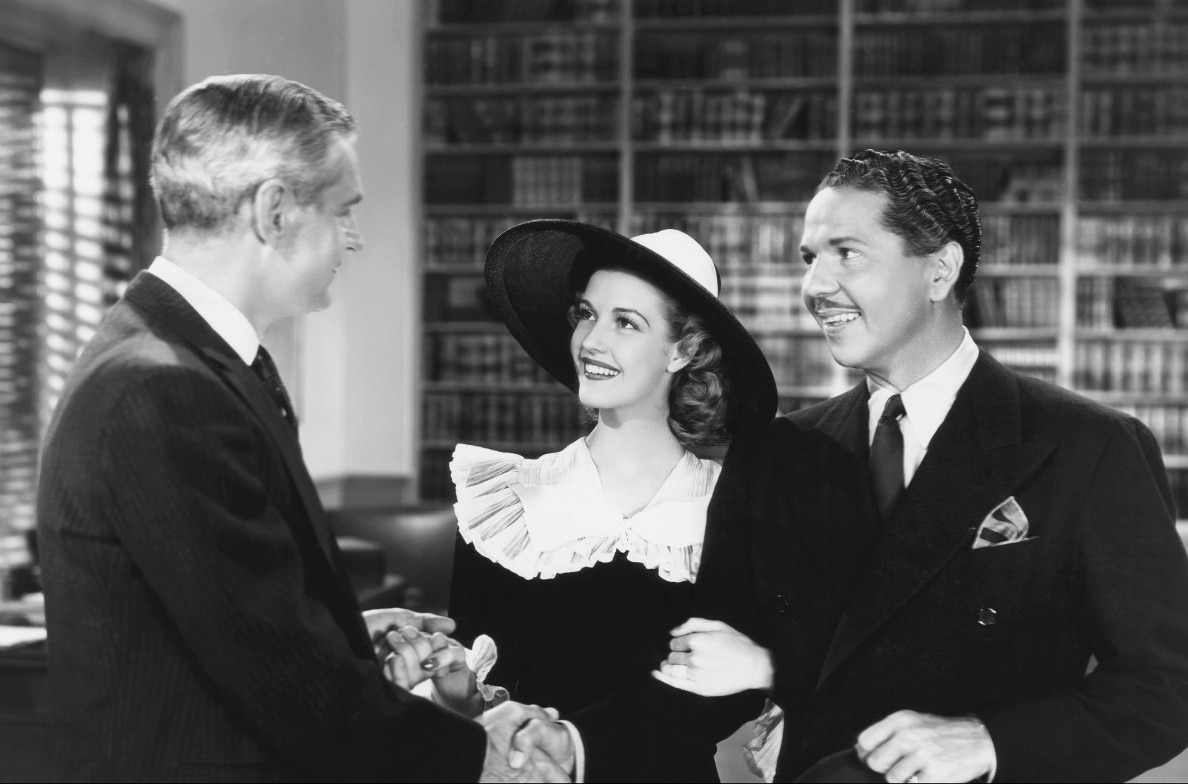
"A blackmail mob is waiting for you to go out with one of these girls!" "Want an 'escort' for this evening? Beware of tomorrow!" "Tired of being lonely? There'll be a mobster around to see you!" teased the poster for Glamour for Sale (1940), written by John Bright and directed by D. Ross Lederman for Columbia Pictures. Inspector Jim Daly (Roger Pryor) goes undercover to expose shady escort services with the help of an insurance executive, Harry T. Braddock (Arthur Loft). Ann Powell (Anita Louise), working for a legitimate agency, is hired to escort Jim, while Peggy Davis (June MacCloy) is hired to accompany Harry. Peggy's agency is revealed to be a blackmail scam called The Companion Club, run by crooks Frank Regan (Don Beddoe) and Louis Manell (Paul Fix). Peggy pulls her usual trick by getting Harry drunk and photographing him in a compromising position. The following day, Manell blackmails Harry by threatening to publish the photos unless he pays $2,000. Unable to come up with the money, Harry commits suicide. To avenge Harry, Jim and Ann risk their own lives to bring down The Companion Club.
Under the working title of I'm for Rent, Glamour for Sale ran into trouble during pre-production in April 1940, when the Hays Office (the motion picture self-censorship board created by the industry in order to avoid federal and local censorship) reviewed the script and sent a memo to the producers, warning them against showing "excessive drinking" and "rolling" drunks for money. Harry's suicide was discouraged because "as the means of solving a problem [it] is frowned upon by the industry," as well as creating blackmail and extortion schemes that could be "easily imitated" by the public. Even something as inconsequential as Ann stealing a book was criticized as "compounding a felony." The following month, another memo arrived about taking precautions when filming the scene in which Jim and Ann embrace on a couch. While Columbia complied with the Hays Office, the resulting film (shot in only three weeks from mid-July to August 7, 1940) was still too much for the censors in Australia, Trinidad and Ireland - they all rejected Glamour for Sale.
Released in September of 1940, the film made no great impact on the public or critics like The Hollywood Reporter, who panned it, saying "as long as pictures like Glamour for Sale are released, theatres will have to resort to lotteries and giveaways to keep their doors open."
by Lorraine LoBianco
SOURCES:
https://catalog.afi.com/Catalog/moviedetails/6145
The Internet movie database
Glamour For Sale
by Lorraine LoBianco | August 07, 2018
SIGN UP FOR OUR NEWSLETTERS

CONNECT WITH TCM