"That quaint old Paramount custom of producing an annual all-star variety show, which was allowed to lapse into the past tense after The Big Broadcast of 1938, has been hopefully revived with new vigor and a few new faces, too." So wrote Bosley Crowther in The New York Times on December 31, 1942, in his review of Star Spangled Rhythm.
Unlike Big Broadcast, however, Star Spangled Rhythm features not just a cast of major stars playing characters, but a bevy of additional stars appearing as themselves. The film was one of many all-star vehicles produced during World War II as escapist morale boosters - a way of giving audiences the delight of seeing more stars in one film than ever before. Warner Bros., for instance, made Thank Your Lucky Stars (1943) and Hollywood Canteen (1944); MGM produced Thousands Cheer (1943); United Artists made Stage Door Canteen (1943); and Universal turned out Follow the Boys (1944). They all followed roughly the same formula of using wispy plots to give multiple stars the chance to appear in song-and-dance numbers, comedy sketches and the like. As a result, these films wound up paying tribute as much to the particular studios themselves as to the national war effort.
Star Spangled Rhythm is even set on the Paramount studio lot, with Betty Hutton playing a switchboard operator who falls for Navy sailor Eddie Bracken just from his photo. Bracken's father is an old silent western star (Victor Moore) who now works as the studio gateman, though he has told Bracken he is a senior executive. When Bracken comes to visit the studio on leave, Hutton and Moore go into overdrive to keep up the deception, with comic results. There are plenty of in-jokes: real-life executive producer Buddy De Sylva is spoofed by Walter Abel as the film's "B. G. De Soto," and real Paramount vice president Y. Frank Freeman is played by Edward Fielding as "Y. Frank Freemont." (Freeman was a southerner and loved Coca-Cola; hence "Freemont" is seen pouring himself a Coke.) At one point, Moore is wreaking havoc in De Soto's office when Cecil B. De Mille calls to ask what the producer thinks of his new film, Reap the Wild Wind (1942). "It stinks," says Moore, because that's how he's been told to impersonate an executive - just to say "it stinks" to every question.
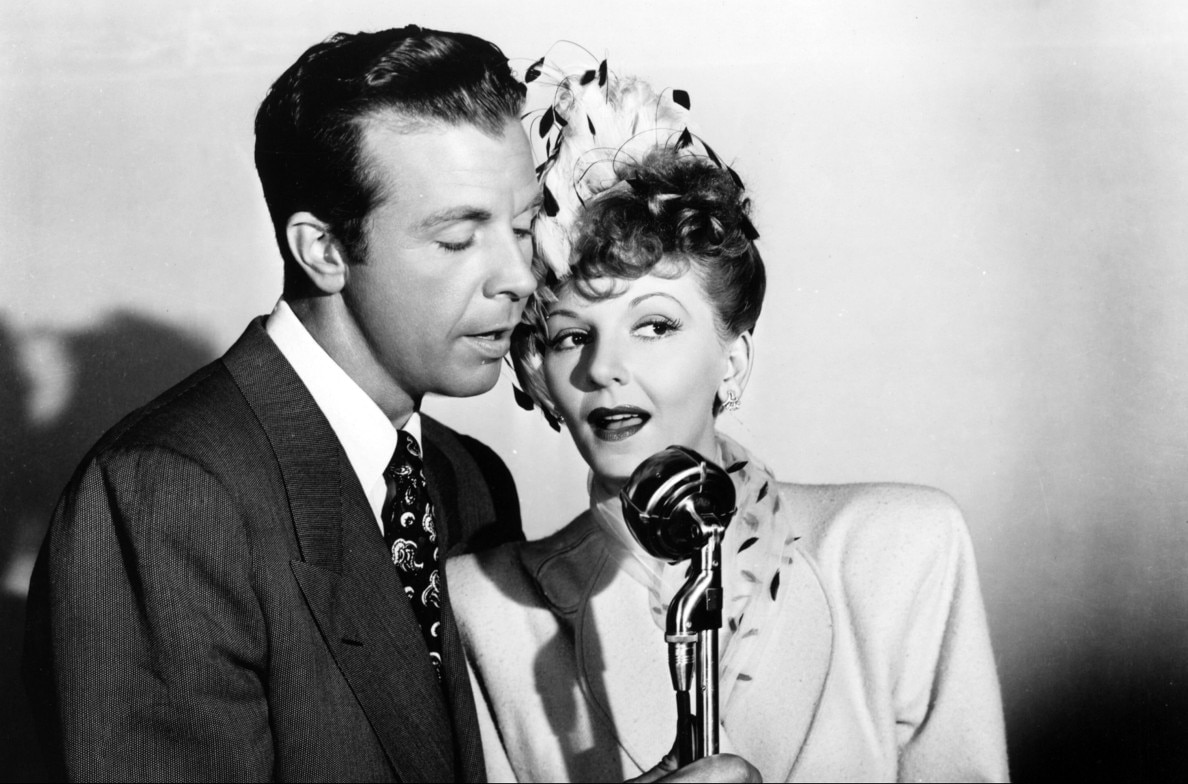
Director Preston Sturges appears as himself, too, but mainly the story is an excuse for over two dozen stars to appear as themselves, among them Bob Hope, Bing Crosby, Fred MacMurray, Ray Milland, Franchot Tone, Alan Ladd, Dorothy Lamour, Paulette Goddard, Susan Hayward, Dick Powell, William Bendix, Eddie "Rochester" Anderson, Vera Zorina, Albert Dekker, Veronica Lake, Susan Hayward, Marjorie Reynolds and Robert Preston. There's even a glimpse of future star Woody Strode, as Rochester's chauffeur. Crosby's nine-year-old son, Gary Crosby, can also be seen with his father.
Among the many skits and numbers is the introduction of a new song destined to become a standard: "That Old Black Magic," which is performed by Vera Zorina and would score an Oscar nomination for Harold Arlen and Johnny Mercer, who wrote all eight of the movie's songs. Elsewhere, Alan Ladd parodies his film noir image in a sketch with MacDonald Carey, Marjorie Reynolds and leads a song set on an aircraft assembly line, Crosby sings the flag-waver "Old Glory," and Lamour, Lake and Goddard team up for the famous time-capsule "A Sweater, Sarong, and a Peek-a-Boo Bang." Lake later wrote that this number "was dreadful, but fun." Afterwards, Bob Hope stepped up and asked her if she was saving her money. Why, she asked. "With a voice like that, you'll need it." "He was right," Lake wrote. "I never could sing."
Variety deemed the film "fresh, alive, and full of bounce... Only trouble exhibs will have in selling Star Spangled Rhythm will be in finding a marquee big enough to hold all the names."
By Jeremy Arnold
Star Spangled Rhythm
by Jeremy Arnold | July 24, 2018
SIGN UP FOR OUR NEWSLETTERS

CONNECT WITH TCM