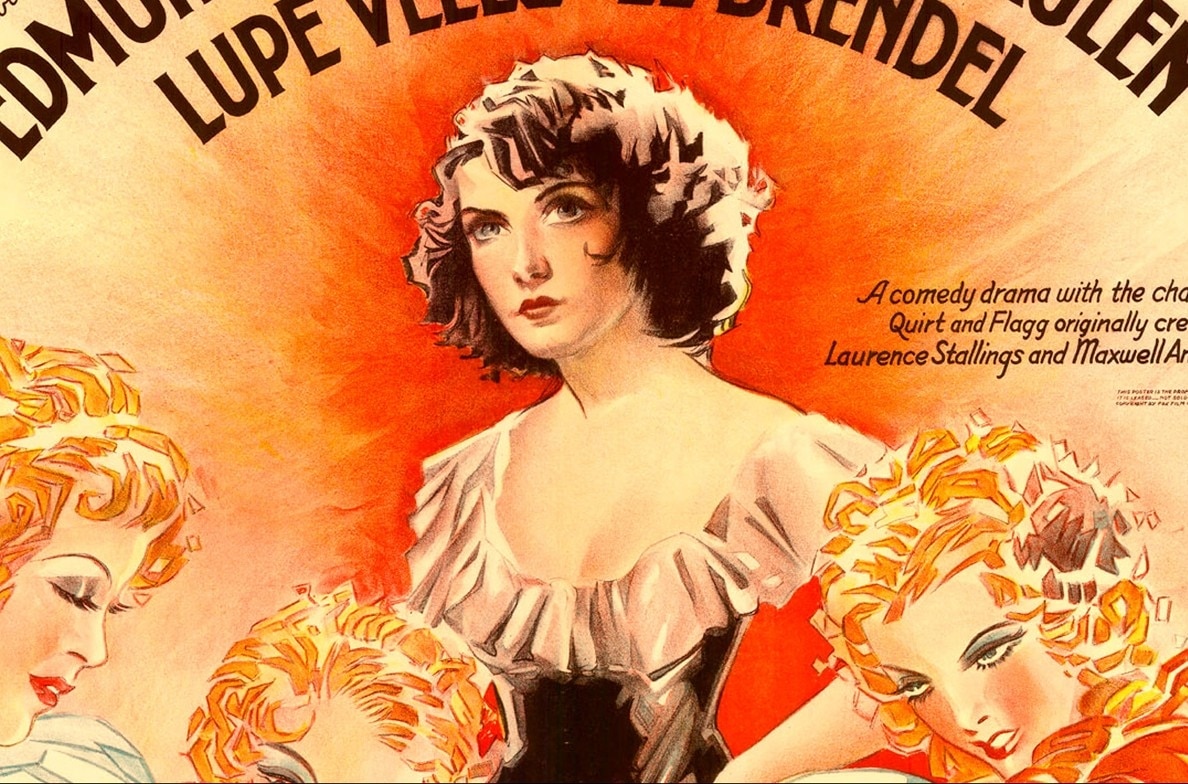
Classic-film lovers will find Hot Pepper (1933) of interest for a couple of reasons. For fans of Lupe Velez, the raucous comedy represents a turning point in her uneven career. For those charmed by pre-Code movies, the bawdy situations and sexual references are in line with the era's frankness. However, movie-goers of the early Depression were likely attracted to the film because it was the fourth in a series featuring two popular characters: Captain Jim Flagg and Sgt. Harry Quirt
Velez began her Hollywood career in 1927 at the Hal Roach studios, where she was cast in comedy shorts, including those with Laurel and Hardy. Her break came when she was spotted by swashbuckler Douglas Fairbanks and selected to costar in The Gaucho (1927). The film launched the first phase of her career, which can be loosely divided into three parts. At first, Velez was cast in dramas in which she played a variety of ethnic roles, including Cuban, Greek, Chinese, Caribbean and Native American characters. Most of the films were high-profile features by prominent directors with big-name male costars, including Gary Cooper, Lew Ayres and Walter Huston. These roles established Velez's image as an exotic woman who was passionate and sensual but also sympathetic and caring. Also, early sound films, such as Hell Harbor (1930), reveal that her voice was not as heavily accented as it would be in later movies.
A role in The Half-Naked Truth in 1932 steered Velez toward comedy, marking the second phase in her career. It was followed by Hot Pepper, described in reviews of the day as a "rip-roaring comedy." Historians and movie lovers praise her comedic abilities in the films from this period, particularly her timing and physicality. However, Velez's switch to comedy resulted in a narrowing of her image. Her characters tended to be Latin American, mostly Mexican. Often, they were show-business performers who were tempestuous, hot-blooded, even threatening. The more this star image was honed in films from 1934, such as Palooka, Laughing Boy and Hollywood Party, the more her characters became stereotyped, complete with heavy accents.
During this same time, Velez's off-screen life generated as much interest as her films. In the year Hot Pepper was released, she married Olympic swimmer and Tarzan star Johnny Weissmuller. Their relationship was notoriously tumultuous with repeated public altercations, followed by splits and then reunions. Her fiery temper off screen was referenced onscreen and vice versa, so that gossip and scandal orbited her career and image.
Discouraged, Velez left Hollywood to appear on Broadway in the mid-1930s. She also starred in a film in her native Mexico, La zandunga (1938). But, she was back in Hollywood by 1939 to star in The Girl from Mexico, the first of the Mexican Spitfire comedies, which dominated the third and last phase of her career. The Mexican Spitfire films exaggerated her fiery Latina persona, which deteriorated into stereotype as this B-movie series limped into the 1940s.
Hot Pepper showcased Velez near the beginning of her foray into movie comedy. Velez played the title character, a South American singer who lands a job in the night club of Harry Quirt during Prohibition. Pepper arrives in America by stowing away on the rum-running ship of Quirt's buddy, Jim Flagg. Quirt and Flagg are old friends from the Marines as well as arch-rivals for the affections of beautiful women from all over the world. The two compete for Pepper's affections, and she pits them against each other to get what she wants. As a pre-Code film, Hot Pepper includes scenes and lines that would not be allowed a year later after the Production Code was enforced. In one scene, Pepper ends up hiding in Flagg's house. When he tries to toss her out, she removes her clothing, including her brassiere, which she tosses in his face. She climbs into his bed but escapes his grasp just as Flagg's men drag in Quirt. In addition, certain lines would have been red-penciled by the Production Code Administration (PCA), including "I'm not feeling myself tonight," followed by, "Don't worry. I'll take care of that later." In 1937, Twentieth Century-Fox applied for the re-release of Hot Pepper, but the director suggested they withdraw the request from the PCA because it would never be granted a Code Seal due to the "sex elements" and "rough language."
In 1933, the biggest draw for Hot Pepper was neither the racy costar nor the bawdy atmosphere, but the two main male characters, Quirt and Flagg, played by Edmund Lowe and Victor McLaglen respectively. The actors had introduced the two rival Marines in the silent classic What Price Glory?, a comedy-drama based on the 1924 play by Maxwell Anderson and Laurence Stallings. Directed by Raoul Walsh, What Price Glory? was a unique balance of the horrors of war with the joyful bond of friendship between Quirt and Flagg. The pair brawled over the same women and played harsh tricks on each other but bonded over their bravery in battle. Lowe and McLaglen returned for the sequels The Cock-Eyed World in 1929 and Women of All Nations in 1931, also directed by Walsh.
Hot Pepper, the fourth and final sequel for Quirt and Flagg, differed from the previous films in that it was a straight comedy. None of the original drama about war or the bonds of friendship remained, and action director Walsh was replaced by John Blystone. Also, the pair were no longer in the Marines, reducing their identity as heroes. Quirt is little more than a con man, while Flagg is a rum-runner. Both end up operating nightclubs. Despite these changes, Fox Film Corp. wanted to remind audiences that the characters would be up to their old antics. An opening title declares: "Remember Quirt and Flagg? If not, What Price Glory in the Cock-Eyed World? They're leaving the Marines--still comrades--hands outstretched--for the same girl's knee!" In What Price Glory? , the knee had belonged to Dolores Del Rio; in The Cock-Eyed World, it was Lili Damita; in Women of All Nations, Greta Nissen. In keeping with casting an exotic costar for the male leads, Velez was tapped for Hot Pepper.
Velez gave the film a vitality that Lowe and McLaglen, who were perhaps better suited to action or drama, failed to muster. It seems fitting that Hot Pepper is better remembered as a Lupe Velez film rather than part of the Quirt and Flagg adventures.
Production Company: Fox Film Corp.
Director: John Blystone
Screenplay: Barry Conners and Philip Klein
Cinematography: Charles G. Clarke
Editor: Alex Troffey
Production Design: Joseph Wright
Cast: Harry Quirt (Edmund Lowe), Jim Flagg (Victor McLaglen), Pepper (Lupe Velez), Olsen (El Brendel), Hortense (Lilian Bond), Trigger Thorne (Boothe Howard), Lily (Gloria Roy)
By Susan Doll
Hot Pepper (1933)
by Susan Doll | July 24, 2018
SIGN UP FOR OUR NEWSLETTERS

CONNECT WITH TCM