While still a star running back for the Cleveland Browns--the pro football team where he achieved great distinction between 1957 and 1965-- the ruggedly handsome Jim Brown made his film debut in a supporting role in the Western Rio Conchos (1964). It wasn't until his contract with the Browns was over that he turned more seriously to acting. A prominent part in Robert Aldrich's war adventure The Dirty Dozen (1967) caught producers' eyes and Brown was given his first starring role in Kenner (1969) as an American seafarer who travels to Bombay (present day Mumbai) to avenge the murder of his friend by a notorious drug smuggler.
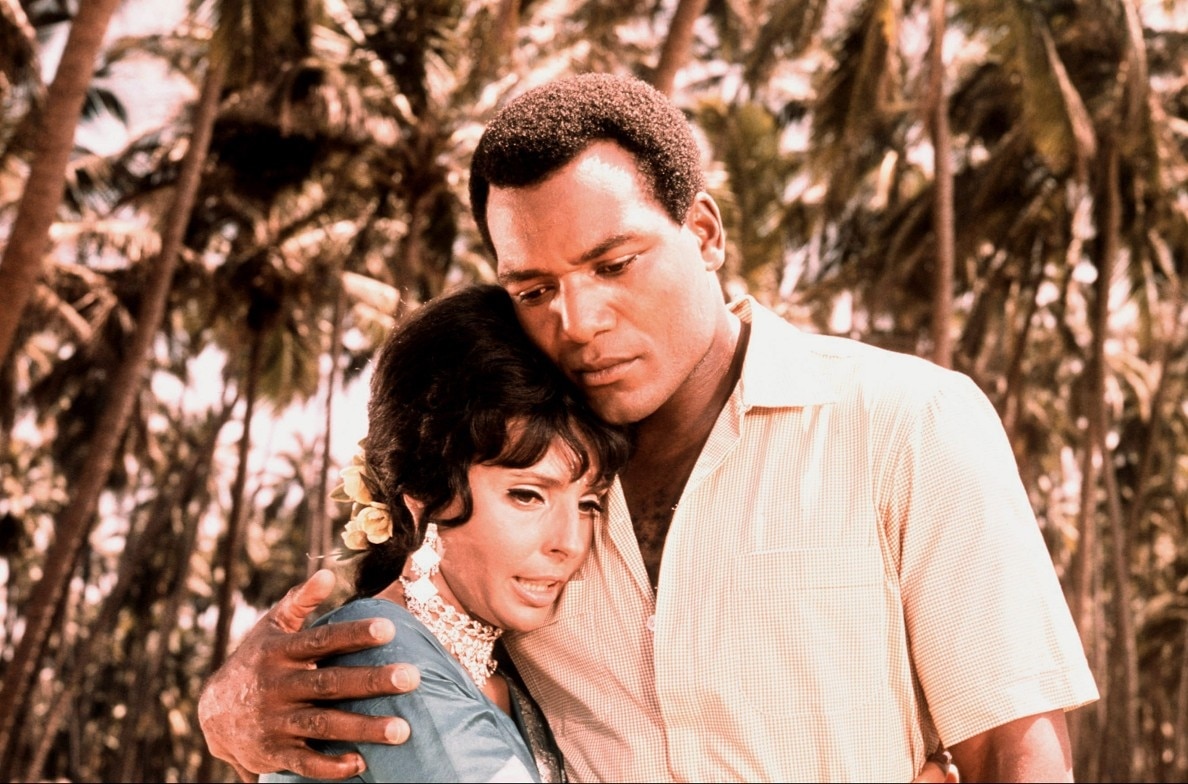
The story has its heartstring-tugging elements, namely Brown's relationship with a fatherless child and his beautiful Hindu mother, but the film is mostly an excuse for chases and fight scenes, some of them well staged in the exotic Indian locations. But director Steve Sekely's effective handling of the action does not disguise the threadbare quality of the production.
Sekely was a Hungarian-born journalist and writer who made his directorial debut in 1930 in Germany, where he worked for much of the following decade until he moved to the U.S., releasing his first Hollywood film in 1939. His career was limited to low-budget pictures mostly for Poverty Row studios, but just prior to this film he made what has become a classic of the sci-fi genre, The Day of the Triffids (1963) in England. Approaching 70, he next completed Kenner before returning to Hungary for one last project.
Despite being rather overexposed at the time (seven pictures released between June 1967 and March 1969), Brown emerged from this disappointing effort to become a sought-after star, becoming a leading player in the "Blaxploitation" genre of the early 1970s in ...tick...tick...tick... (1970), Slaughter (1972) and Black Gunn (1972), among others.
Hollywood may have been breaking down some racial divisions by casting Brown in leading roles and, controversially, having him romance actresses like Raquel Welch and Jacqueline Bisset, but not far enough ahead of the curve in Kenner, when they cast American actress Madlyn Rhue as Brown's Indian love interest, in skin-darkening make-up, no less.
Behind the scenes, however, race was not an issue. Indian-born Ram Yedekar handled the art direction, as he did later for the India-set films Gandhi (1982), Heat and Dust (1983) and A Passage to India (1984). Prem Dhawan, who studied under musician Ravi Shankar, shared music composing credits with award-winning Italian composer Piero Piccioni.
The original on-screen writing credit listed Harold Clemins and John Loring, a pseudonym for Robert L. Richards, a Writer's Guild nominee for the screenplay of Anthony Mann's Winchester '73 (1950), the classic Western starring James Stewart. Richards was blacklisted in the early 1950s for his leftist views but he kept writing under various false names for television and film before eventually becoming a carpenter. He retired to Mexico before he had the chance to see his real name restored to his numerous credits. Kenner was his last picture.
Director: Steve Sekely
Producer: Mary P. Murray
Screenplay: Harold Clemins, Robert L. Richards; story by Mary P. Murray
Cinematography: Dieter Liphardt
Editing: Richard Haermance
Art Direction: Ram Yedekar
Music: Prem Dhawan, Piero Piccioni
Cast: Jim Brown (Roy Kenner), Madlyn Rhue (Anasuya), Robert Coote (Henderson), Ricky Cordell (Saji), Charles Horvath (Tom Jordan)
By Rob Nixon
Kenner
by Rob Nixon | July 02, 2018
SIGN UP FOR OUR NEWSLETTERS

CONNECT WITH TCM