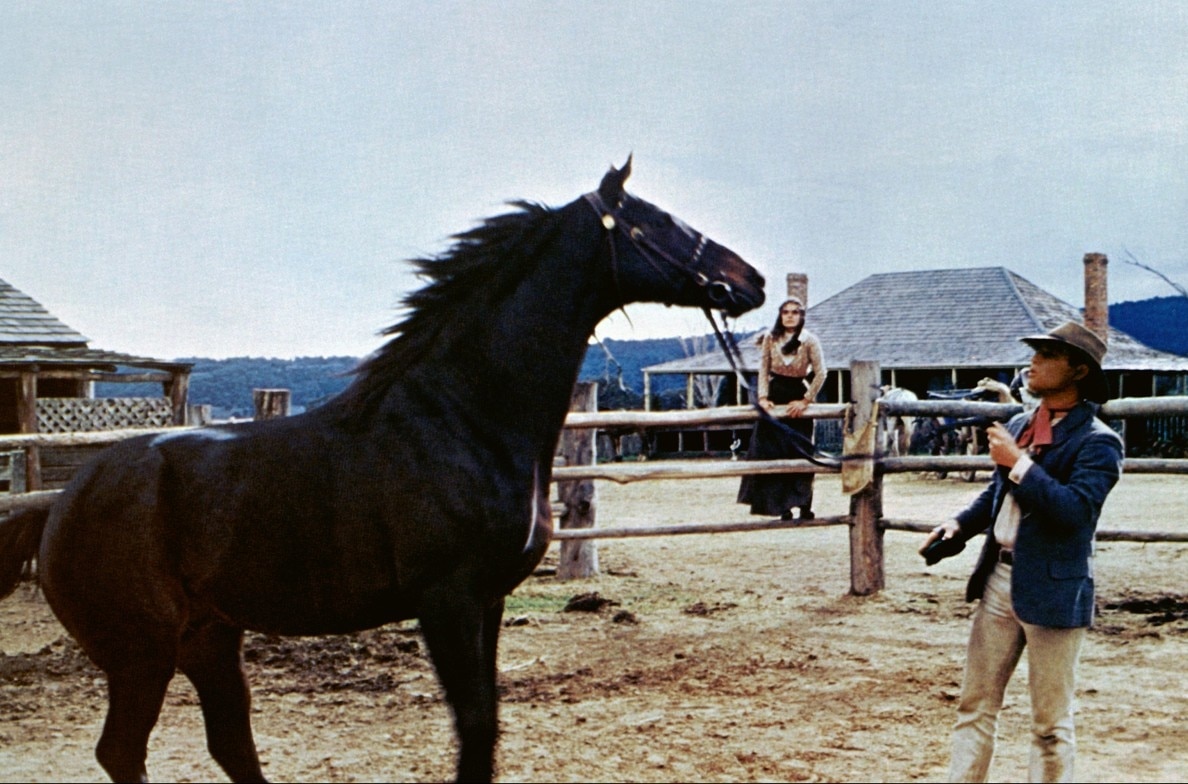
Breathtaking photography of the Adelaide Hills, amazing stunt work and a scene-stealing performance by Kirk Douglas as a feuding brother helped make this 1982 Western one of the most popular films of the Australian New Wave. Although hardly as innovative as Picnic at Hanging Rock (1975), Don's Party (1976) or My Brilliant Career (1979), The Man from Snowy River captured fans with its depiction of life on a frontier that was, in some areas, still very much untamed territory. It should be noted that the director is not the George Miller who directed the Mad Max films, but rather George T. Miller (though the initial is not included in the film's credits).
Australian poet A.B. "Banjo" Paterson's narrative poem about the search for a prizewinning racehorse in the mountains of New South Wales first appeared in 1890. Possibly inspired by two different stockmen (Australian cowboys), the poem is considered a key work in the development of the country's literature and national identity. Its importance is still recognized and an image from the Paterson's poem is featured on Australia's $10 bill along with microdots featuring the original text.
The story was originally filmed as a silent in 1920, with producer-writer-director Beaumont Smith the first to tackle the main problem in adapting it, providing a backstory to justify the unnamed protagonist's participation in the search of the racehorse and his heroic ride following a herd of wild horses down a steep cliff face. Smith created a story of a prodigal son who returns to the bush after being disinherited, where he falls in love with a squatter's daughter, the latter inspired by a character in another of Paterson's poems.
Over 60 years later, producer Geoff Burrowes was at a dinner party where someone suggested the poem would make a good movie. With television director George Miller, who made his feature directing debut with the film, a treatment with a new backstory was developed. In their version, stockman Jim Craig hopes to inherit his late father's station in the Adelaide Hills, but first must prove himself by working in the lowlands. There he encounters a one-legged miner and his estranged brother, a wealthy stationmaster. Craig and the stationmaster's daughter, Jessica, fall in love despite her father's disapproval. When a jealous farmhand lets Jessica's prize colt loose and tries to frame Jim, the young man joins the hunt to prove himself to the mountain men and Jessica's father.
Burrowes and Miller brought in John Dixon to write the script and enlisted writer-director Simon Wincer, who had worked with Miller on such television series as The Sullivans and Against the Wind, to help produce. He and another producer, Michael Edgley, managed to raise the money from private sources, a departure from other films in the Australian New Wave, which had been funded in whole or in part by the Australian Film Institute. For location, the producers decided not to film along the actual Snowy River, but rather in the mountains near Mansfield, Victoria. Not only had Burrowes' in-laws lived there for decades, but the area was easier to get to than the poem's New South Wales setting.
In an effort to break into the international market, the producers decided to hire a veteran Hollywood star for the dual roles of Spur and Harrison, an unusual move for an Australian production. After considering Burt Lancaster and Robert Mitchum, they chose Kirk Douglas. At first, his casting was not very popular in Australia. When Douglas arrived, he was greeted by a belligerent press corps. He won them over by reciting the first few lines of Paterson's poem. When nobody could tell him what the next line was, he advised the reporters to read the poem, which broke the ice.
To play Jessica, Douglas' daughter and the film's love interest, the producers cast the 23-year-old Sigrid Thornton, already a veteran actress who had made her television debut at the age of 8. Thornton had previously worked with Miller on the TV series Young Ramsay and with Wincer in the theatrical feature One More Minute (1979). Veteran character actor Jack Thompson, who had already become an international star in Breaker Morant (1980), played sheep shearer Clancy, a character taken from Paterson's poem "Clancy of the Overflow." For the male lead, Jim Craig, they cast Tom Burlinson, a Canadian actor who had relocated to Australia with his family at the age of 12. Burlinson had been building a career steadily through television roles, most notably in the prime-time soap opera The Restless Years.
Although he had no riding experience, Burlinson insisted on doing his own stunts in the film. When it came time for him to chase a herd of wild horse down a steep cliff face, he not only refused to step aside for a stuntman to do it, but also got the stunt in a single take. Little wonder the role made him a star.
The Man from Snowy River opened to glowing reviews in Australia, where it became the country's top box office film (it was also Australia's most expensive motion picture up to then). It now ranks among Australia's highest grossing films. It also enjoyed solid international success, voted audience favorite at the Montreal World Film Festival and nominated for the Golden Globe for Best Foreign Film. It inspired a 1988 sequel, Return to Snowy River, re-teaming Burlinson and Thornton but with Brian Dennehy taking over as her father. A TV series inspired by the poem ran for four seasons. There was also a television film adapted from the poem, The Man From Snowy River: Arena Spectacular (2003).
One result of the Australian New Wave was a rise in U.S. tourism to the country, which increased 20.5 per cent per year between 1981 and 1988. The Man from Snowy River in particular inspired an upsurge of adventure trips to the film's locations in Victoria. By 1996, there were 30 companies offering horseback tours of the region. In addition, the Hunt Club Hotel, where the cast and crew stayed during filming, now decorates its walls with memorabilia from the picture. One of the film's sets, the Craigs' hut, was left standing after production and became a popular tourist attraction. The film's composer, Bruce Rowland, scored the 2000 Summer Olympics in Sydney and featured the film's main title theme prominently.
Director: George Miller
Producers: Geoff Burrowes, Michael Edgley, Simon Wincer
Screenplay: Cul Cullen, John Dixon
Based on the poem by A.B. 'Banjo' Paterson
Cinematography: Keith Wagstaff
Score: Bruce Rowland
Cast: Tom Burlinson (Jim Craig), Terence Donovan (Henry Craig), Kirk Douglas (Harrison/Spur), Tommy Dysart (Mountain Man), Bruce Kerr (Man in Street), David Bradshaw (Banjo Paterson), Sigrid Thornton (Jessica Harrison), Jack Thompson (Clancy)
By Frank Miller
The Man from Snowy River
by Frank Miller | July 02, 2018
SIGN UP FOR OUR NEWSLETTERS

CONNECT WITH TCM