The Inside Story was directed by Allan Dwan during his tenure at Republic Pictures in the late 1940s. Dwan, a true pioneer in the Hollywood film industry, began directing in 1911. Along with Cecil B. DeMille and John Ford, he helped formulate what the job of a Hollywood studio director would be. His career spanned fifty years, from the silent era through the breakdown of the studio system in the 1950s. He is credited with more than 400 films.
While Ford called Twentieth Century-Fox home and DeMille was ensconced at Paramount, Dwan was not associated with one major studio. In the silent era, he worked at several studios, including Essanay, Universal and Paramount, where he directed Gloria Swanson in eight films. When sound caught the industry off guard, and studios struggled to convert their production facilities to sound stages, Dwan landed at Fox. Despite his experience, the veteran director was relegated to Fox's B-movie unit. In September 1945, Dwan signed with Republic Pictures, the legendary Poverty Row studio that specialized in low-budget movies, series and serials. On the surface, his decision to work for a low-rent studio may seem like a step down, considering his status as a Hollywood insider and veteran director. But there was more to Republic at that time than its reputation for B-movie fare.
Republic was created in 1935 when Herbert J. Yates united several struggling Poverty Row production companies into one studio. Yates sought to cash in on the rise of the double feature in theaters. Republic produced and distributed Westerns, serials and low-budget genre movies designed to share a double bill with A-budget films from the major studios. The studio's top star was singing cowboy Gene Autry, who headlined a series of low budget, hour-long, modern-day Westerns. That's the Republic that comes to mind for most classic film fans whenever the studio is mentioned.
However, during World War II, Yates saw profits soar at Republic and he decided to venture into making A-budget movies. Republic didn't abandon its low-budget fare, but it extended its output to include films that Yates considered to be prestigious. He organized the studio's offerings into four categories--Jubilee, Anniversary, Deluxe and Premiere. Jubilee movies included the Westerns with singing cowboys Autry and Roy Rogers. Anniversary films had slightly longer shooting schedules and bigger budgets, and Deluxe fare doubled the budgets and schedules of Anniversary movies. His Premiere features had budgets comparable to those of the major studios and were intended to compete with other films of its stature. Republic produced two to three Premieres per year. Yates hired the best directors for his Premiere films, including John Ford, Fritz Lang, Frank Borzage, Orson Welles and Allan Dwan.
Dwan received $1,000 per week, plus 5% of the net. More importantly, he was given the right to be credited as an associate producer on his films. He directed his first film for Republic, Rendezvous with Annie, in 1946. An intricate character comedy, the film ranks as one of his best in that genre. A high point in Republic's venture into A-budget films was Dwan's 1949 war drama Sands of Iwo Jima, starring John Wayne. It was the only Republic title to make it into the top five grossing films for a given year.
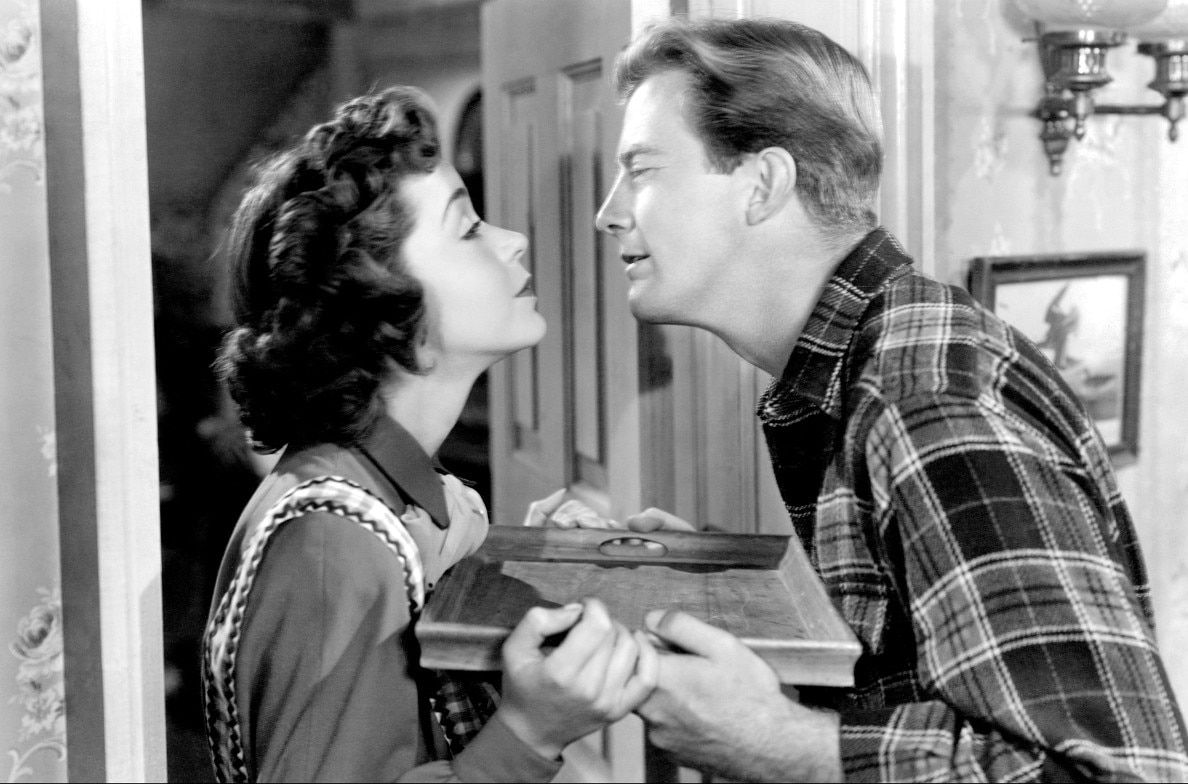
The Inside Story, released in 1948, is a warm-hearted comedy of errors starring Marsha Hunt and William Lundigan. The cast was rounded out by a selection of talented character actors familiar to most moviegoers. The Inside Story is set in a small town in Vermont during the bank holiday of 1933, in which banks were closed by the government to avoid hordes of panicked people withdrawing all of their money, thus destabilizing an already fragile economy. The story revolves around six residents in various financial predicaments, who accidentally get access to $1,000 meant for someone else. The money had been placed in the safe of the local inn. However, when innkeeper Horace Taylor (Gene Lockhart) finds it, he believes it is payments owed to him from his debtors. He pays off his own debts but learns from Uncle Ed (Charles Winninger) that the money belonged to a guest at the inn. Horace frantically searches for the money, which is rapidly circulating around town. Also searching for the dough are two hapless bootleggers.
According to Allan Dwan and the Rise and Decline of the Hollywood Studios, the definitive biography by Frederic Lombardi, Dwan was a sensitive director in regard to his actors. Many of his films featured large casts that included prominent stars and notable character actors, and Dwan guided them with assurance, especially in comedies. The Inside Story includes two strong female characters--Francine (Hunt), the feisty daughter of innkeeper Horace Taylor and Audrey O'Connor (Gail Patrick), a devoted wife forced to support her family when her husband cannot find work. Interestingly, the women characters in the story, including local mill owner Geraldine Atherton, are the movers and shakers in the town. Because of the Depression and the lack of work and opportunity, the male characters, such as artist Bill Williams (William Lundigan) and Audrey's husband Tom (Robert Shayne), are stagnating. Gail Patrick, in her last feature film, played a softer character than her usual haughty socialites, scheming vixens or "other women" that were her forte at the major studios. Gifted actress Marsha Hunt starred as Francine. Hunt would appear in only one more film before falling victim to McCarthyism and the Blacklist, which curtailed her stardom. Though she appeared in episodes of various television series, she turned her energies to humanitarian causes during the 1950s and 1960s.
Like many films from the classic era, The Inside Story was invigorated by the performances of recognizable character actors. Florence Bates, who built her career on playing colorful matrons, co-stars as the wise-cracking Geraldine Atherton. Roscoe Karns played the insurance agent who is responsible for the money and Allen Jenkins mugged his way through his role as a gangster.
Allan Dwan was the consummate studio director, meaning his choice of visual techniques serviced the story or characters. His unpretentious, invisible editing advanced the narratives of his films in a clear, clean way. Each shot was a calculated part of the narrative structure, rather than an occasion to exhibit "style." Perhaps for that reason, he never got the same attention or respect by cinephiles or film scholars as his peers Ford, Wyler, Wellman and Hawks.
Producer: Allan Dwan for Republic Pictures
Director: Allan Dwan
Screenplay: Ernest Lehman, Geza Herczeg, Mary Loos, Richard Sale, with Allan Dwan
Cinematography: Reggie Lanning
Editing: Arthur Roberts
Music: Nathan Scott
Production Design: Frank Arrigo
Cast: Francine Taylor (Marsha Hunt), Waldo "Bill" Williams (William Lundigan), Audrey O'Connor (Gail Patrick), Geraldine Atherton (Florence Bates), Horace Taylor (Gene Lockhart), Uncle Ed (Charles Winniger), Tom O'Connor (Robert Shayne), Eustace Peabody (Roscoe Karns), Eddie (Allen Jenkins), Eph, Editor of The Bugle (Frank Ferguson), J.J. Johnson (Will Wright), Mason (Hobart Cavanaugh), Ab Follansbee (Tom Fadden)
1948 B&W 87 mins
By Susan Doll
The Inside Story
by Susan Doll | June 19, 2018
SIGN UP FOR OUR NEWSLETTERS

CONNECT WITH TCM