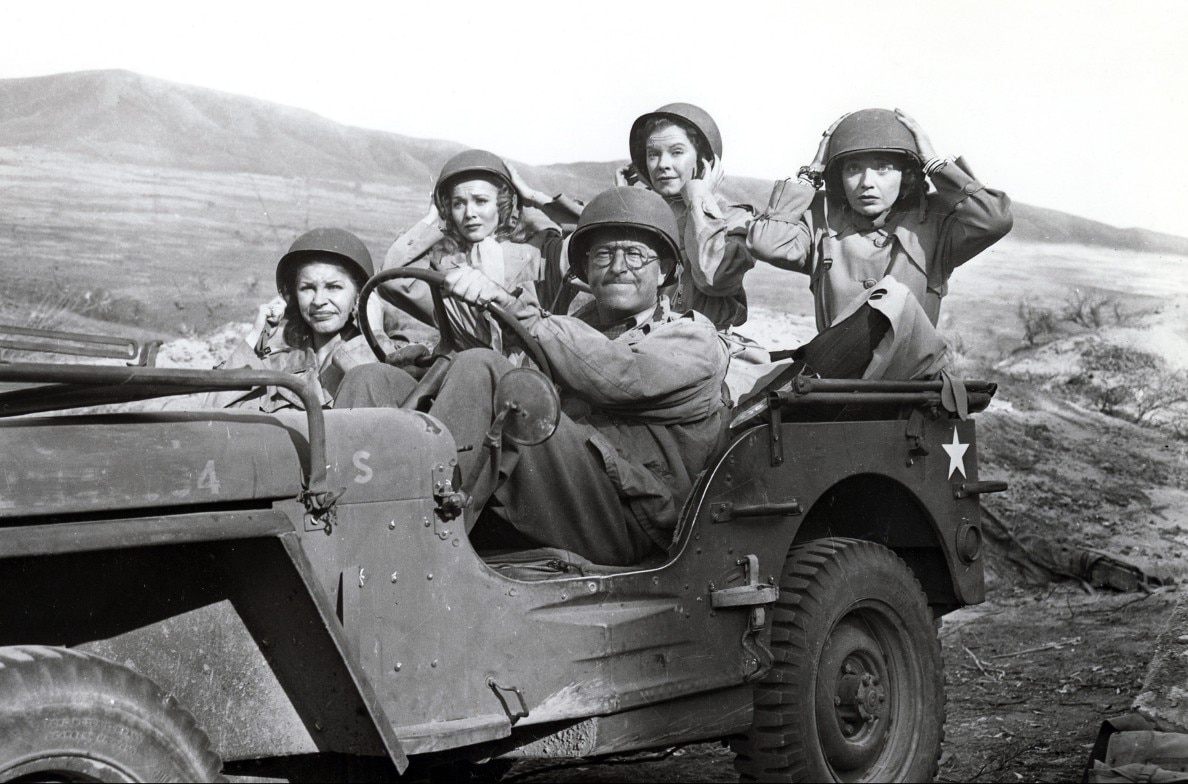
Twentieth Century-Fox's film Four Jills in a Jeep (1944) was, as the opening credits stated, "based on the experiences of four of the many performers who take entertainment to America's men in uniform in the theatres of war as well as in the camps at home." The four performers were the film's stars: Kay Francis, Carole Landis, Martha Raye and dancer Mitzi Mayfair. They left the United States on October 16, 1942 and for three months toured Bermuda, the British Isles, where they often performed several shows a day for the troops and did a command performance for the British royal family, where Mayfair taught Princess Margaret how to dance the Jitterbug. From England, the troupe moved on to North Africa for three weeks and became the first USO tour to reach the troops there. When the North Africa tour ended, Landis returned to England in January 1943, where she married U.S. Army Air Forces Capt. Thomas C. Wallace, who she had met while in England in November, despite Francis' warning against a quick wartime marriage. Mayfair served as Landis' maid of honor.
It was Lou Irwin, Mayfair's agent, who first suggested to Fox that the women's touring experience would make a good film. According to the Fox legal records, only Francis and Mayfair actually worked with the writers to craft the storyline. Froma Sand and Fred Niblo, Jr. developed the original story, with the screenplay adapted by Robert Ellis, Helen Logan and Snag Werris. Co-star Phil Silvers would later claim that each of the women had different versions of what happened during the tour and wanted the script to reflect her point of view.
Writer Snag Werris enjoyed working on Four Jills in a Jeep especially with Kay Francis. "This was a true fun assignment. They were swell gals. Kay was a real pro and a joy to work with." Knowing that Francis had trouble pronouncing the letter "r," Werris later recalled writing a sentence in the script as a gag, "something like 'I ran into Ralph in Roanoke and rapidly wrung his neck.'" As Francis came across the line, she yelled, "Where is that son of a bitch Snag? I'll kill him!" But it was all in fun, as Werris recalled, "none of the four took herself too seriously. They got along well." William A. Seiter directed the film, which had the working titles of Camp Show and Command Performance, named after a popular radio show at the time in which members of the armed services would send in requests, like hearing the sizzle of a T-bone steak cooked by Lana Turner.
The film begins with Francis appearing on Command Performance with Jimmy Dorsey. After the show, Dorsey tells her he is about to go on a USO tour and Francis says that she has been given permission to form her own troupe. Mayfair, Landis, and Raye join her and they go to England and North Africa, where the women all fall in love. Landis falls in love with Capt. Ted Warren (John Harvey) mirroring her real-life marriage to Thomas Wallace. Production began on October 18th and lasted until early December 1943. The Fox files at UCLA hosts studio chief Darryl F. Zanuck's notes, which included a demand that Raye tone it down. "Martha Raye usually talks too fast and too loud. Try to make her play Martha-Raye-off-stage and not Martha-Raye-on-screen." Also in the film was popular singer Dick Haymes, making his credited film debut, and Fox stars Alice Faye, Betty Grable and Carmen Miranda who played themselves in cameos to help boost the film at the box office. The Hollywood Reporter noted that Jack Oakie had been floated for a comedic lead and Cornel Wilde would appear in a juvenile role, but neither appeared in the final film.
On her return to the United States, Landis wrote a book with Edwin Seaver about her experience during the tour, which was serialized in The Saturday Evening Post from December 18, 1943 - January 15, 1944. Fox let Landis use Four Jills in a Jeep for the title to help promote the film, still in post-production, although it was not the basis for the screenplay. The book was published later in 1944.
Four Jills in a Jeep was criticized on its release because it was felt that the women hadn't merited the attention when others had done more for the troops (a criticism that was unfair in Francis' and Raye's cases, at least), and that it over glamorized the real experience (which, according to Francis' diary, included being bombed and shot at).
Four Jills in a Jeep was Mayfair's last film. She married Fox music executive Charles Henderson on April 7, 1944 and happily retired from public life. Francis's warning to Landis proved prophetic, as the marriage to Capt. Thomas Wallace would not survive the war. After another marriage and an affair with Rex Harrison, Landis would commit suicide in 1948. Francis, who had been a major film star a decade before, dedicated much of her time during the war to entertaining the troops and working long hours as the head of the Unit of the Naval Aid Auxiliary, earning the respect of Bob Hope, who said in a 1997 interview "Nowadays people forget what a trouper Kay was. She did a lot for the USO and gave her all to many patriotic causes. She was a real class act."
Francis only made three more films for the low budget Monogram studios and two early television appearances before retiring a very wealthy woman in 1951. Raye would be the only one of the Four Jills to continue performing in a career that lasted well into the 1980s. She would be the first "honorary captain" of WWII and continued to tour with the USO, and aided wounded servicemen in the Korean and Vietnam wars. President Bill Clinton gave the Presidential Medal of Freedom to Martha Raye in 1993. She died the next year and was buried with special permission at Fort Bragg with the veterans she loved.
By Lorraine LoBianco
SOURCES:
https://catalog.afi.com/Catalog/moviedetails/1667?sid=7bbb1517-73d1-4698-8b51-52e066f18e38&sr=4.5350533&cp=1&pos=0
The Internet Movie Database
Kear, Lynn, and Rossman, John Kay Francis: A Passionate Life and Career
"Mitzi Mayfair Weds Music Chief Tonight" The San Jose News 7 Apr 44
Four Jills in a Jeep
by Lorraine LoBianco | June 14, 2018
SIGN UP FOR OUR NEWSLETTERS

CONNECT WITH TCM