One of the most ambitious films in the career of (now) much-loved maverick filmmaker Seijun Suzuki, Fighting Elegy (Kanka erejii, 1966), is also a labor of love. Suzuki was eager to adapt the novel by Takashi Suzuki, whose theme of the relationship between repressed sexuality and violence (especially in its most extreme form, modern warfare) seemed tailormade for the director. Ultimately Suzuki managed to convince his regular studio, Nikkatsu, to snap up the rights for what was intended to be two films spanning the entire course of the novel. However, only this film was made, leaving its bleaker second half unfinished after Suzuki was booted by Nikkatsu under now-legendary circumstances over his stylistically extreme and wildly perverse Branded to Kill (1967).
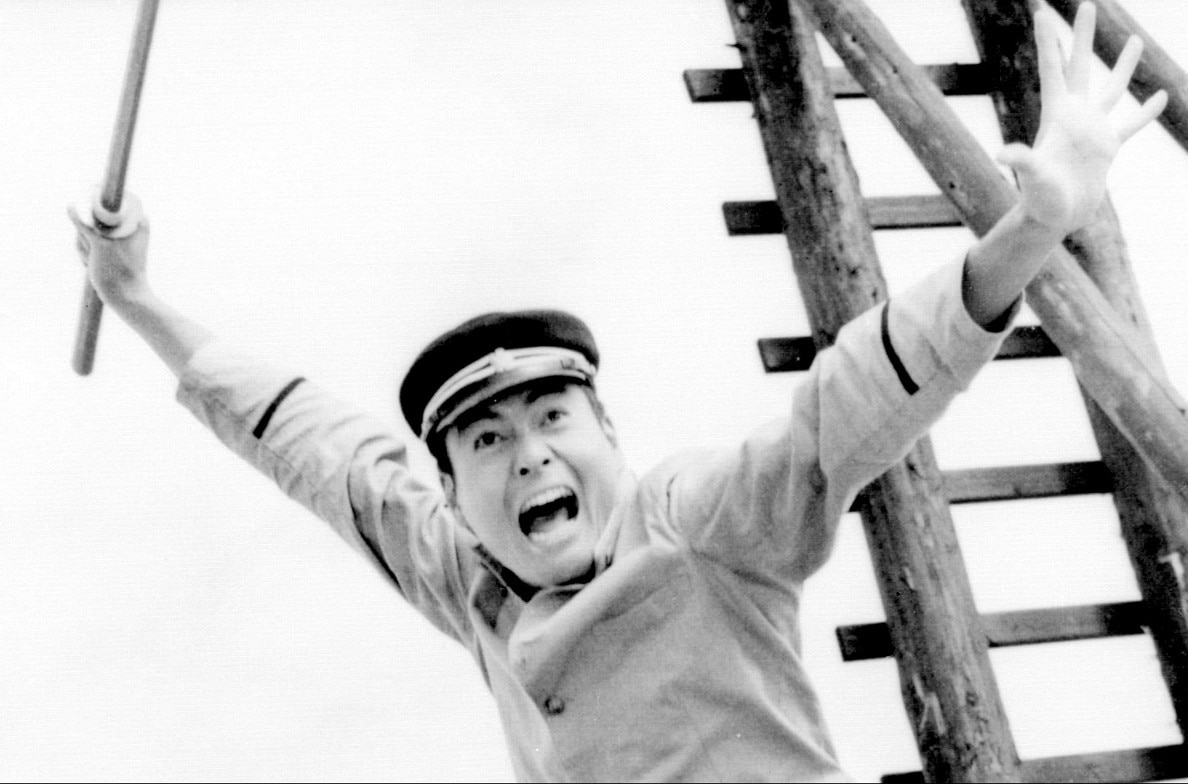
Also shown to English-speaking audiences under the titles The Born Fighter and Elegy to Violence, Fighting Elegy charts the turbulent teenaged years of Kiroku (Hideki Takahashi, star of Suzuki's 1965 yakuza film Tattooed Life). Raging with hormones and living at a boarding house, he's being groomed for warfare at a military school but finds distraction in a crush on pretty Michiko (Junko Asano). With his primal urges unable to find release, he soon falls in with a dangerous gang of youths headed by Turtle (Yusuke Kawazu) and Kiroku starts down a very dangerous road.
In equal parts hilarious and disturbing, Fighting Elegy finds Suzuki returning to the terrain of Japanese youth he explored in some of his fascinating earlier films like The Boy Who Came Back (1958), The Wind-of-Youth Group Crosses the Mountain Pass (1961), Teenage Yakuza (1962), The Incorrigible (1963) and Born Under Crossed Stars (1965). His affinity for getting sincere, dedicated performances out of young actors was already a given; however, it really pays off here thanks to one of his strongest scripts courtesy of Kaneto Shindo, best known for penning the sexually-charged horror classic Onibaba (1964).
The film is also singular in the director's output for its heavy reliance on real (and, at the time, still fresh) Japanese history, including a climactic characterization of activist Ikki Kita and the attempted 1936 overthrow of the Emperor in late February of 1936 (historically known as the February 26 Incident). Suzuki himself was only 12 at the time of the events at the film's end, and served in the Japanese military during World War II where he endured two major shipwrecks and--as he often discussed in later interviews--found a rich vein of dark humor in the madness and widespread death of combat. That included his own familiarity with the consequences of sexual frustration among young men, as he noted on multiple occasions the use of prostitutes to handle the needs of soldiers in combat, a detail worthy of this film's source novel. Fortunately, Suzuki found less violent means of reaching adulthood, and while his own rebellion may have cost him his livelihood at Nikkatsu, including the legendary court case that would temporarily derail his career, he would come out of the experience a far more fortunate and admirable figure than the protagonist of Fighting Elegy.
By Nathaniel Thompson
Fighting Elegy
by Nathaniel Thompson | May 18, 2018
SIGN UP FOR OUR NEWSLETTERS

CONNECT WITH TCM