Movies don't get much better than Double Indemnity
(1944). Universal Home Entertainment's new "Legacy Series"
DVD release does the movie proud, offering a 2-disc
edition of Billy Wilder's classic film noir that boasts an
outstanding transfer of the picture itself, two audio
commentaries, an introduction by TCM's own Robert
Osborne, a documentary on the film's making, a trailer,
and even a long-forgotten 1973 television remake.
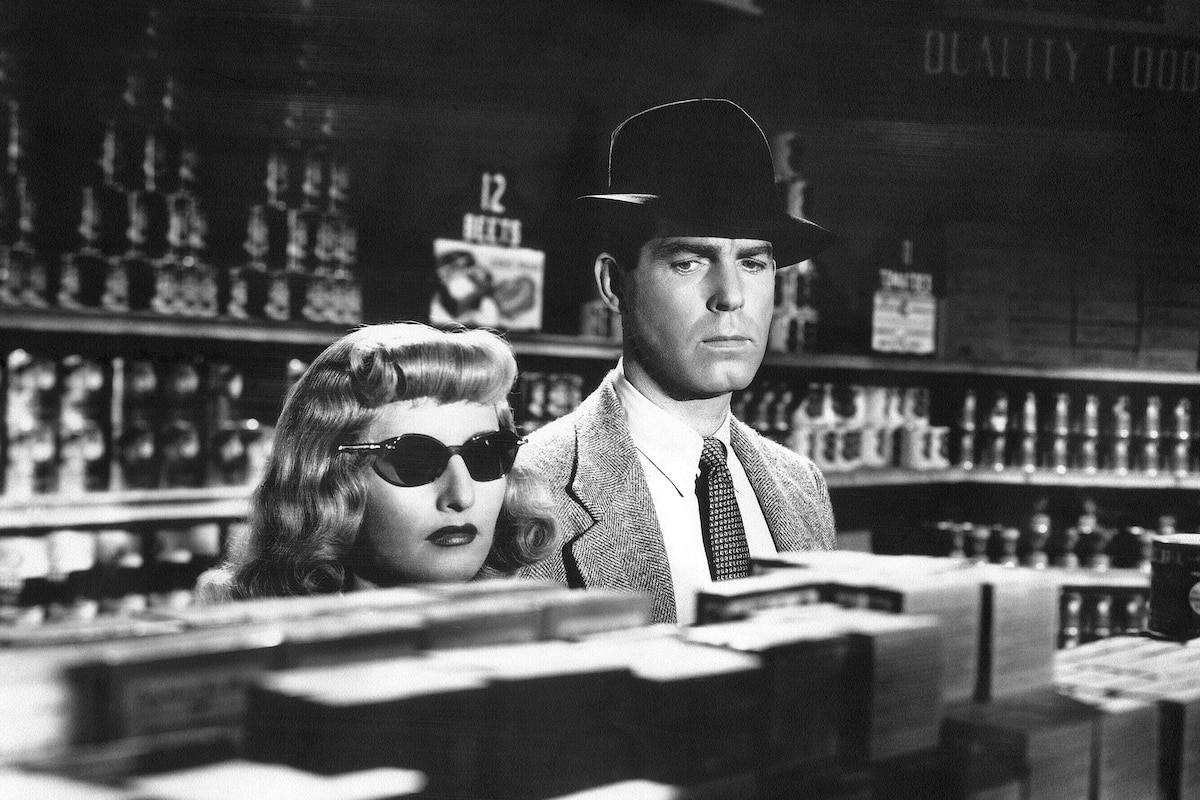
The crackling good story follows insurance agent Walter
Neff as he begins an affair with married Phyllis
Dietrichson (Barbara Stanwyck) and plots with her to kill
her husband in such a way that they can collect his double
indemnity life insurance benefit. As Neff's boss, Barton
Keys (Edward G. Robinson), grows suspicious of the death
and starts investigating, Neff wonders what he's gotten
himself into with the treacherous Dietrichson. Co-writers
Wilder and Raymond Chandler tell the story in flashback as
a wounded Neff relates his exploits into his office
dictaphone in the middle of the night.
Wilder and Chandler adapted James M. Cain's novel, which
had been thought unfilmable due to its sordid subject
matter. Actors were afraid it would ruin their careers.
Stars all over Hollywood turned down Walter Neff,
(including George Raft, who passed on more famous parts
than anyone around) before Wilder realized that Fred
MacMurray would be the perfect, if far-from-obvious,
choice. MacMurray had to be talked into it - "I'm just a
saxophone player," he protested - but his first role away
from mild comedies proved a revelation. Wilder's top
choice for Phyllis Dietrichson was always the versatile
Barbara Stanwyck, but she also took some heavy persuading.
Ultimately, MacMurray and Stanwyck formed in Double
Indemnity one of the great pairings in screen
history.
Edward G. Robinson didn't agree to the role of Keys at
first either - not because of sordidness but because it
was a supporting part. Luckily, he finally realized that
he was at a point in his career where meaty supporting
roles in great films would be far better than starring
roles in run-of-the-mill pictures. His Barton Keys stands
up now as one of his most memorable performances.
While there were other movies before 1944 that can be
called "film noir," Double Indemnity was really the
first to bring it all together in a way that most people
think of the term. It was so revolutionary in style and
substance that it influenced a vast and immediate
unleashing of other noirs like the imitations Mildred
Pierce (1945) and The Postman Always Rings
Twice (1946) as well as Out of the Past (1947)
and The Blue Dahlia (1946). It also established
Billy Wilder as a director of the first order. This was
just his third outing as director, and his was one of
seven Oscar nominations including Best Picture. Double
Indemnity absolutely should have won, but voters went
with Going My Way instead. The following year,
however, Wilder did pick up two Oscars for writing and
directing The Lost Weekend (1945) (co-written by
Charles Brackett).
Of the DVD's above-mentioned extras, the documentary about
the making of Double Indemnity is terrifically
informative and engaging. Often these things are thrown
together to appeal only to the most casual fans, but this
one will also be of interest to more experienced movie
watchers. On-camera contributors include Eddie Muller,
Richard Schickel, Vivian Sobchack, James Ellroy, Alain
Silver and Elizabeth Ward, most of whom are familiar from
other noir DVD commentaries in recent years. The piece is
especially good on Wilder's writing collaboration with
Raymond Chandler, which was extremely strained. The audio
commentaries by Richard Schickel on the one hand, and by
Nick Redman and Lem Dobbs on the other, are also
satisfying, making this a disc full of more information
than anyone could ever want on the film.
The 1973 TV remake, placed on disc 2, stars Richard
Crenna, Samantha Eggar and Lee J. Cobb. It's watchable
purely for laughs, as this is an amazingly amateurish show
in all respects. Wilder's and Chandler's dialogue is
spoken the wrong way in scene after scene; there's no
chemistry, no pacing, no suspense. One could argue there's
instructional value in seeing the same material handled so
poorly in contrast to the original, but honestly it seems
not worth Universal's money (or more importantly, ours) to
have manufactured a separate disc just for this turkey.
Still, because of the treasures on disc 1, this is a total
package well worth getting.
For more information about Double Indemnity, visit
Universal Home Entertainment. To order
Double Indemnity, go to
TCM Shopping.
by Jeremy Arnold
Double Indemnity (Special Edition) - DOUBLE INDEMNITY (Special Edition) on DVD
by Jeremy Arnold | July 07, 2006
SIGN UP FOR OUR NEWSLETTERS

CONNECT WITH TCM