Reviewers and Academy Award voters loved John Ford's melodrama
The Informer, now available on DVD from Warner Bros., when
it debuted in 1935. The New York Film Critics Circle gave it
awards for best picture and best director. And although it lost
the best-picture Oscar to Mutiny on the Bounty, the Academy gave
it six nominations and four wins, honoring Ford as best director
and Victor McLaglen as best actor along with Dudley Nichols for
his screenplay and Max Steiner for his score.
Moviegoers were less enthusiastic-the film's domestic gross was
only a little higher than its $215,000 budget - and while Ford
himself was strongly committed to the project, he wasn't very keen
on how it turned out, telling critic Lindsay Anderson in 1950 that
it came "a long way down the list" of his personal favorites. "It
lacks humor - which is my forte," he later told Peter
Bogdanovich.
Ford was right about the film's humorless mood, but the
story-based on a novel by Liam O'Flaherty, an Irish author with
Marxist politics--doesn't exactly cry out for lighthearted
treatment. Set in Dublin in 1922, it centers on Gypo Nolan, a
lunkheaded Irishman who's somehow gotten involved with the Sinn
Fein rebellion against British rule. Tossed out of the rebel group
and addled by romantic dreams of escaping to America with his
prostitute girlfriend, he walks into a police station and informs
on a close friend (Wallace Ford) to collect the reward. The friend
then dies in a shootout with the cops. Stabs of conscience (what
have I done?) and pangs of paranoia (will the IRA find out?)
attack Gypo immediately, pushing him into a nonstop psychological
slide. The movie's style mirrors his deteriorating state, wrapping
scene after scene in murky fog and offering glimpses of the
delirious visions that invade Gypo's suffering, whiskey-dazed
mind. The plot culminates in a late-night IRA council meeting
called to determine The Informer's identity and eliminate
him so he can't cause additional damage. Among those present are
Gypo, the sister (Heather Angel) of the rebel he squealed on, and
a meek tailor (played by Donald Meek, fittingly enough) whom Gypo
has falsely accused of being the squealer.
It's easy to imagine The Informer as a hard-hitting
suspense drama, but Ford takes it in a different direction,
leaving little doubt that Gypo's disloyal deed will catch up with
him and bring him down. As early as the opening credits we see his
silhouetted figure with arms outstretched as if he were being
crucified, and the fogbound images shot by cinematographer Joseph
H. August, reflecting Ford's fascination with German Expressionist
film, are consistently ominous. Ford favors psychological anxiety
over narrative tension at every opportunity, so that despite its
heavy dose of Christian symbolism - the finale takes place under a
looming crucifix in a cathedral, underlining themes of forgiveness
and redemption-the film's effect is closer to Greek tragedy, where
the outcome is never in question and interest lies less in what
will happen than in how the predetermined end will come about.
Gypo is a disconcertingly simple and often unsympathetic character
as he stumbles through the dark Dublin night from one drunken
rendezvous to another, randomly yowling his own name into the
shadows ("Gypooooo!") and squandering his blood money along the
way. But his moral dilemma is as vivid as it is authentic, and his
story is grimly effective if you take it on its own stylized
terms.
According to Hollywood legend, Ford made sure Gypo would show
the right degree of extreme confusion in the climactic IRA scene
by luring McLaglen into a heavy-drinking bout the night before it
was shot. In his book John Ford: The Man and His Films,
critic Tag Gallagher goes further, reporting that Ford kept
McLaglen off balance throughout the production by making fun of
him, changing his lines, slipping him drinks, and shooting
"rehearsal" takes without telling him the camera was running.
Sneaky? Sure. But the result was an Oscar® for each of them.
And miffed as he may have been at the time, McLaglen did several
more Ford films in later years.
It's harder to explain the Oscar® for Steiner, since his score
is one of the movie's weak elements, stressing dramatic moments
far too strongly and imitatively "mickey-mousing" the action more
than once. Steiner was one of the great movie composers, but he
badly underperforms here. By contrast, Nichols's screenplay is
usually tight and terse, supporting Ford's evident desire to
approach the image-driven storytelling of Expressionist silent
films. On the downside, the film's few female characters (the
betrayed man's sister and mother, Gypo's girlfriend and a
high-class hooker he gives money to) and are so underwritten that
they serve little purpose except as sentimental foils for the men
who drive the narrative.
The Informer was made at RKO after several other studios
passed on it, worrying it wouldn't be commercial enough. They had
a point, as the movie's relatively low earnings proved. But its
"art movie" aura, resulting from the atmospheric visuals Ford used
to compensate for low-end production resources, helped it make up
in prestige what it lacked in box-office clout. Despite its misty
tone, the film looks appealingly crisp on Warner Bros.' new DVD
edition. The only extras are a theatrical trailer and a ten-minute
documentary, aptly called "Out of the Fog," in which Bogdanovich
and others share their views on the film's story, style, and
background. It's unlikely that The Informer would win
multiple Oscars® today, but as a slice of Depression-era film
history - and as one of a great director's most respected works,
at least when first released - it's worth a good look by modern
moviegoers.
For more information about The Informer, visit Warner Video. To order The
Informer which is only available as part of the John Ford
Collection, go to
TCM
Shopping.
by David Sterritt
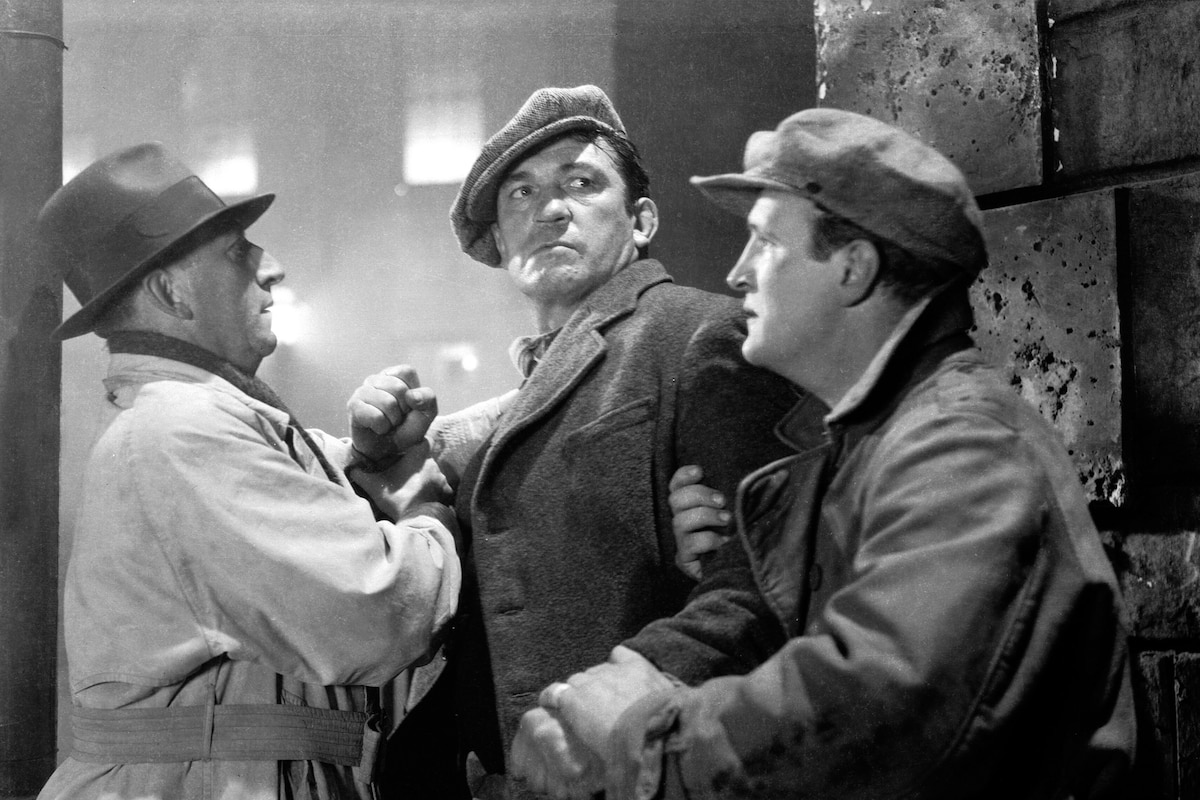
Informer, The - Victor McLaglen in John Ford's THE INFORMER on DVD
by David Sterritt | June 29, 2006
SIGN UP FOR OUR NEWSLETTERS

CONNECT WITH TCM