Like many classic British comedies of the 1950s, The Smallest Show on Earth (1957) (also known as Big Time Operators) finds humor in eccentric characters waging ingenious schemes. This film is especially fun because it satirizes, and lovingly pays tribute to, the world of small-town movie theaters.
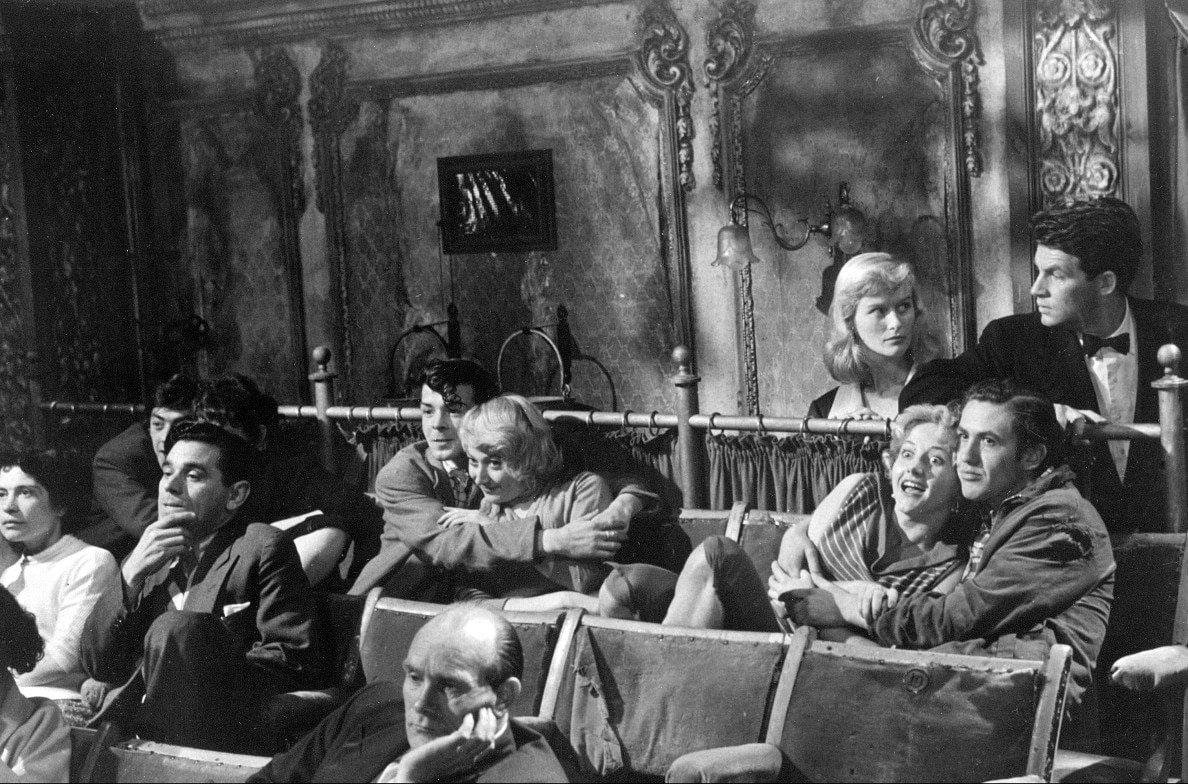
A newly married couple (Bill Travers and Virginia McKenna, both of whom later appeared in and became known for Born Free [1966]) inherit a cinema located in a northern England town and excitedly travel there with plans to sell it. But they discover their cinema is not the town's opulent Grand Theatre but the crumbling old debt-ridden Bijou, known locally as the fleapit. It has peeling plaster, rats in the auditorium and sits next to a pungent glue factory. The whole building vibrates every time a train passes.
They have also inherited the Bijou's three ancient employees. There's a drunken projectionist named Mr. Quill whose projector would make Rube Goldberg blush, a cashier and former silent-film pianist named Mrs. Fazackalee, and a senile doorman, Old Tom, who longs for a bright new uniform. Played respectively by Peter Sellers, Margaret Rutherford and Bernard Miles, these three are really the comic heart of the film.
Travers and McKenna decide to revitalize the Bijou so that the Grand's owner, Mr. Hardcastle, will want to buy it. One gimmick to increase concession sales involves showing a movie set in the desert, cranking up the auditorium's heat, then sending a soft drink vendor down the aisle to the sweating audience.
The Smallest Show on Earth was written by John Eldridge and based on a story by William Rose, who had written the classic comedy Genevieve (1953), which did for old cars what this film attempts to do for old movie houses. It was also a rare comedy for director Basil Dearden, who would soon make the more serious Sapphire (1959) and Victim (1961).
Film scholar William K. Everson later wrote that the Bijou was likely based on a real-life movie house, the tattered Golden Domes in the Camberwell area of south London. It was "only very slightly exaggerated" for the film, he wrote, right down to the passing trains. Ironically, the film's Grand Theatre was portrayed by a cinema in London's Hammersmith suburb called the Regal, which years later fell victim to a freeway built over and around it.
One of the high points of this charmer comes when Sellers projects a silent film (Comin' Thro the Rye (1923), directed by British film pioneer Cecil M. Hepworth) to a tiny audience after hours, with Rutherford accompanying on the piano. "Old film," says Sellers. "Classic, you might say. I've saved 'em for years, bits of 'em. We used to run 'em like this in the old days, but not for years we haven't done it. Now it seems like old times once more."
By Jeremy Arnold
The Smallest Show on Earth
by Jeremy Arnold | April 13, 2018
SIGN UP FOR OUR NEWSLETTERS

CONNECT WITH TCM