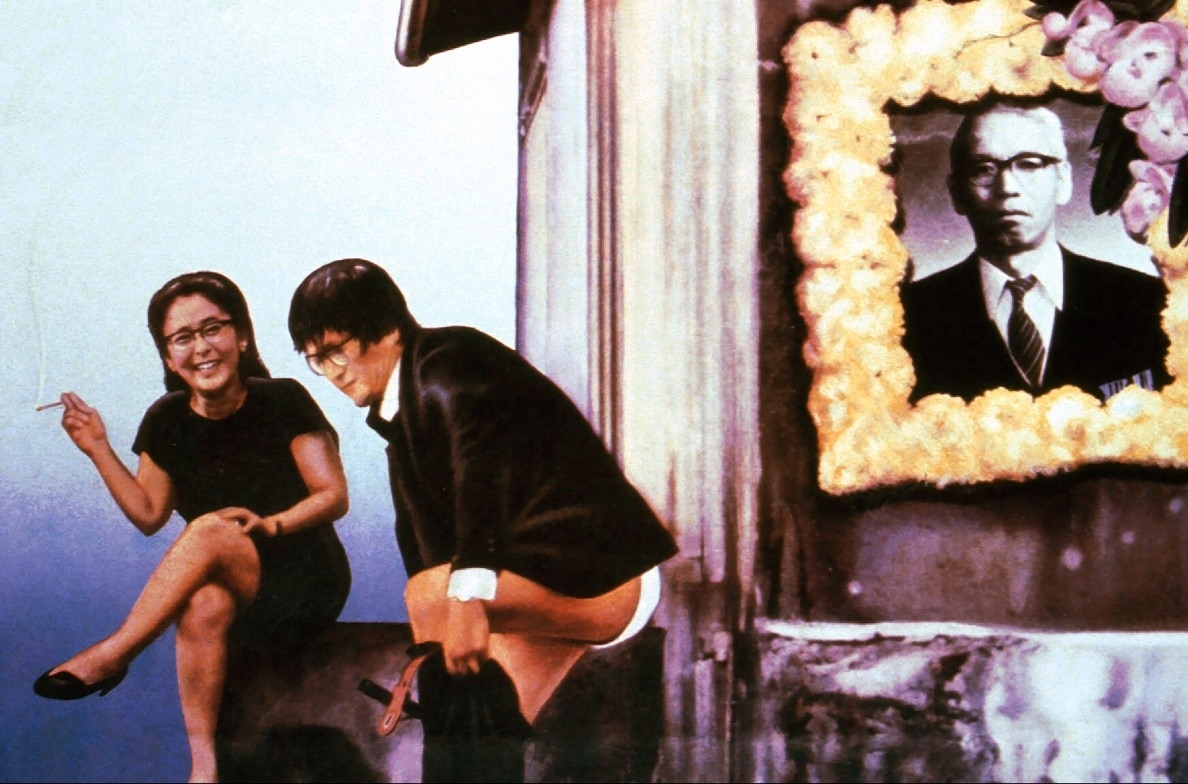
The Funeral (1984) seems an unlikely title for a comedy, but director Jûzô Itami chose to make his first film a humorous look at death. With a script he wrote himself, Itami's The Funeral covers three days between the sudden death of the diabetic father of the hip, popular Tokyo actress Chizuko Amamiya (Nobuko Miyamoto, who Jûzô Itami had married in 1969) until the time that he is cremated and his ashes are buried. In only three days, Chizuko and her actor husband Wabisuke Inoue (Tsutomu Yamazaki) have to deal with planning all the minute details of a proper Buddhist funeral for an upper class Japanese family. This modern, high-tech couple explore their options 1980s-style with a videocassette entitled The ABCs of the Funeral but still want to honor their ancestor in the time-honored Japanese tradition. It's a dark comedy with shades of Tony Richardson's The Loved One (1965) in its commentary on the funeral industry and the sexual intrigue of Jean Renoir's Rules of the Game (1939).
Itami may have been a first-time director, but he was not new to show business. His father was Mansaku Itami, a film director who worked primarily in pre-war Japan. Like his son, the elder Itami's films were satires on Japanese society. Mansaku Itami died of tuberculosis at the age of 46 in 1946, and it was memories of his funeral that influenced Jûzô Itami to write The Funeral. Although his father had passed away nearly forty years before, Jûzô had been hesitant to become a director so as to avoid what he called "challenging the mountain" of his father's reputation. Before he went behind the camera, Jûzô Itami was in front of it, having worked at various times as a talk show host, and, beginning in 1960, as a film actor. With The Funeral he became a director, a screenwriter and an assistant producer. Under its original title of Osôshiki, the film was made under the auspices of Itami's "Itami Productions" and New Century Productions.
While the film played at the 1985 Cannes Film Festival, The Toronto International Film Festival and the Chicago International Film Festival, it did not reach New York until December 1987, two years after Itami's most famous film Tampopo (1985) and A Taxing Woman (1987), both of which also starred Miyamoto and Yamazaki, had been international hits. When The Funeral finally screened in New York, the legendary New York Times critic Vincent Canby praised the film, calling it a "robust comedy [...] a film that is quintessentially Japanese though it recalls (without in any way imitating) the work of the quintessentially French Jean Renoir, and a tough-minded satire that is almost always sweet. [...] Mr. Itami creates a moving, wonderfully rich picture of upper-middle-class family life in contemporary Japan. [...] Mr. Itami, at 54, is not exactly a stripling, but he's far and away the most exciting new filmmaker to burst onto the international scene in a decade. Burst may not be exactly the right word. That makes it sound as if he were some kind of skyrocket that could fade away at any minute. On the basis of his first three films, that seems unlikely."
Unfortunately, in the the thirteen years following the release of The Funeral, Itami would only make a total of ten films, all starring his wife. His skyrocket would be extinguished sooner than anyone could expect. In 1992, the director ran afoul of the Yakuza (the Japanese equivalent of the Mafia) after the release of his controversial film Minbô no onna (''Minbo, or the Gentle Art of Japanese Extortion'') (1992). Angered by their depiction in the film, five members of the Yakuza brutally attacked Itami, slashing his handsome face and neck, scars he would later wear as a badge of honor. In 1997, Itami was said to have committed suicide at the age of 64, two days before a tabloid was to publish a story alleging that he had had an extra-marital affair. This remained the official story until 2009, when journalist Jake Adelstein wrote in his exposé of the Yazuka, Tokyo Vice, that he had been told by an informant that the Yakuza had murdered Itami. "A gang of five of his people grabbed Itami and made him jump off a rooftop at gunpoint. That's how he committed suicide." The Itami family did not have a funeral for the director, preferring to watch all of his films en lieu of a memorial service.
By Lorraine LoBianco
SOURCES:
Canby, Vincent "Film: 'The Funeral,' A Comedy by Jûzô Itami" The New York Times 23 Oct 87
Earp, Madeline "'Erase it, or be erased': Life on a Japanese mafia hit list" Committee to Protect Journalists 24 Feb 10
The Internet Movie Database
https://mubi.com/films/the-funeral
Wudunn, Sheryl "Juzo Itami, 64, Filmmaker Who Directed 'Tampopo'" The New York Tiems 22 Dec 97
The Funeral
by Lorraine LoBianco | March 20, 2018
SIGN UP FOR OUR NEWSLETTERS

CONNECT WITH TCM