The pedigree of The Only Game in Town (1970) is extraordinary. First, there are the stars, Elizabeth Taylor and Warren Beatty. She just four years off her second Academy Award win for Who's Afraid of Virginia Woolf (1966) and he just three years off his massive critical, commercial and cultural smash, Bonnie and Clyde (1967). Then there's the director, George Stevens. He had worked with Taylor before, on A Place in the Sun (1951) and Giant (1956), winning the Academy Award for Best Director both times. Follow that up with the movie's composer, the legendary Maurice Jarre and then throw in equally legendary French New Wave cinematographer Henri Decaë. Finally, there's the writer, Frank D. Gilroy, Pulitzer Prize winning author of The Subject was Roses, adapting his own work based on an earlier play. What could possibly go wrong? Quite a few things as it turns out but that doesn't mean the journey's not worth taking.
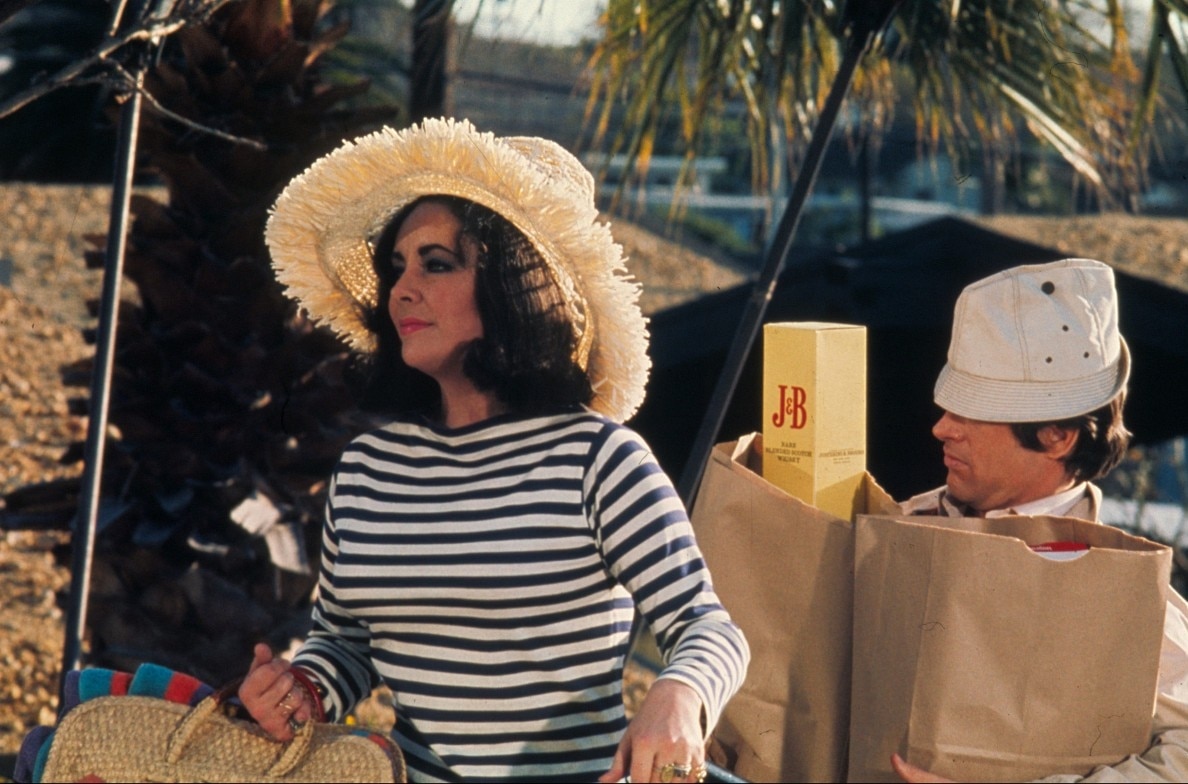
The story is that of a Las Vegas showgirl, Fran (Elizabeth Taylor), leading a rather pointless day to day life while waiting for her married lover to finally get that divorce he keeps saying he's going to get. She wanders into a piano bar one night after work and finds Joe Grady (Warren Beatty) at the keyboard, playing whatever the customers want, as long as they throw some money in his jar. He plays, she drinks, they find themselves attracted to each other and she takes him back to her apartment. There, they drink some more, talk and eventually move into the bedroom in a shot reminiscent of a similar shot in Stevens' A Place in the Sun. Before Fran and Joe bed down for the evening the camera drifts to a digital clock display that changes to 3 in the morning to indicate Fran and Joe have done the deed. Then they talk some more.
The conflict of the story comes down to this: Fran realizes her days as a chorus girl are numbered. She's in her mid-30s--Taylor's actual age at the time--and the man she wants to marry won't get a divorce. Maybe Joe would be a better fit. Joe, on the other hand, is sick of Vegas and just wants to leave. His problem is that he doesn't have enough money and every time he gets close, he blows it in the casinos.
It's a great story and would make for a hell of a movie. The problem several critics had with it, and audiences too judging from the disappointing box office, was probably voiced best by critic Vincent Canby who remarked that the very pedigree mentioned at the top of this piece was perhaps too much for such a simple, intimate tale. He likened it to outfitting a rowboat for a luxury Mediterranean cruise. Of course, that only works as a valid criticism if one is of the mind that simply by casting big names and having a big name director helm it, you take people out of the movie. To go back to the boat analogy, it doesn't hold water with me and probably never will. If the movie works, it doesn't matter who the stars are, I'll believe it. No, Taylor and Beatty and Stevens aren't the problem at all. If there is a problem, it is the writing, or lack thereof.
Frank Gilroy's piece is so sparsely written it could have been tightened up easily into a short two act play. As a movie, maybe a solid 75 minute venture. There's a feeling to the film that the actors and director are purposely taking their time with each shot and each conversation because if they proceed at normal speed the movie will be over in, well, 75 minutes. Thing is, there is absolutely nothing wrong with a 75 minute movie, but when you've got Taylor, Beatty and Stevens on the payroll, perhaps you feel obligated to give the audience a little more.
Still, the movie worked plot-wise even if performance-wise, everything felt a little anemic. And the box office take, while small, wouldn't have resulted in such financial disaster if Elizabeth Taylor hadn't insisted on the film being made in Paris so she could be close to Richard Burton, who was working on a production there at the time. Essentially, a movie that takes place just a short jump away from Hollywood, and could have been shot in a few weeks on a dime, quintupled its budget to accommodate one of its stars desires to be close to her partner. That drove the budget up well beyond what it should have been and made the small intimate tale into a movie that was almost guaranteed to fail. Afterwards, George Stevens decided to call it quits and retired.
Decades later, none of this matters as we look at the film now as it stands. And, frankly, it stands pretty well. It's a surprisingly effective quiet little film that one would never associate with Taylor or Beatty. Filmed in Paris, with insert shots from Vegas, the movie is forced into long interior takes, which Henri Decaë makes work. The music is a sleepy jazzy score that works all on its own. No, it's not what one would expect from the powerhouse teaming of all those big names. It's small, quiet and intimate. And though Gilroy could have fleshed it out a bit more, or Stevens tightened it up a bit more, it still works, at the very least as a fascinating departure for everyone at hand. Who knew movie stars made small, personal movies at the height of their power and fame?
Director: George Stevens
Producers: Fred Kohlmar, Edgar Lansbury
Writer: Frank Gilroy
Cinematographer: Henri Decaë
Music: Maurice Jarre
Editing: John Holmes
Cast: Elizabeth Taylor (Fran Walker), Warren Beatty (Joe Grady), Charles Braswell (Lockwood), Hank Henry (Tony), Olga Valéry (Hooker)
By
Greg Ferrara
The Only Game in Town
by Greg Ferrara | February 21, 2018
SIGN UP FOR OUR NEWSLETTERS

CONNECT WITH TCM