When Martin Scorsese finished Age of Innocence (1993), the lavish, costumed period drama seemed out of place in his canon. It didn't focus on gangsters or religious guilt masked as violence. But it did focus on sexual and emotional repression, something Scorsese had been exploring throughout his career, and something that the classic Edith Wharton novel, upon which is the film is adapted, is awash. The characters of Newland Archer (Daniel Day-Lewis) and the Countess Ellen Olenska (Michelle Pfeiffer) are adrift in a sea of repressed desires, unwilling to brave the storm of social judgment to accept what their hearts are telling them. And it all takes place in New York. This is Scorsese all the way.
The film begins with the camera hurriedly chasing glimpses around the opera as we are introduced to the characters via both narrator (Joanne Woodward) and character gossip. There is the aforementioned Newland Archer and Countess Elllen Olenska, but there is also May Welland, Ellen's cousin and the fiancée of Newland. They are seated together at the opera as Newland journeys over to greet them in their box seats. The conversation is banal but New York society has already taken notice. The Countess, a New Yorker by birth, has returned from Poland having separated from her husband, a Count. She intends to get a divorce and the well-established socialites find all of it just a bit distasteful. Newland, however, is kind and gracious with her and the two quickly develop unspoken feelings for one another. When the Countess becomes determined to get a divorce, the law firm that employs Newland, sends him to dissuade her. Their passion only grows deeper but Newland cannot break with society and leave May.
Scorsese's first stab at a lavish costume drama was not entirely successful. Audiences didn't flock to it as they had his previous movies but the movie generally received positive reviews. Now, however, decades after its release, it looks to be one of Scorsese's best films. A story like this requires the push and pull of both expressionism and restraint. Scorsese does not abandon his cinematic style but, rather, adapts it. The camera still moves fluidly but it swirls around characters and situations locked in place, paralyzed by fear and social standing. The narration is formal but revealing. The character's feelings and emotions are nuanced but seething. And the acting through all of it is superb.
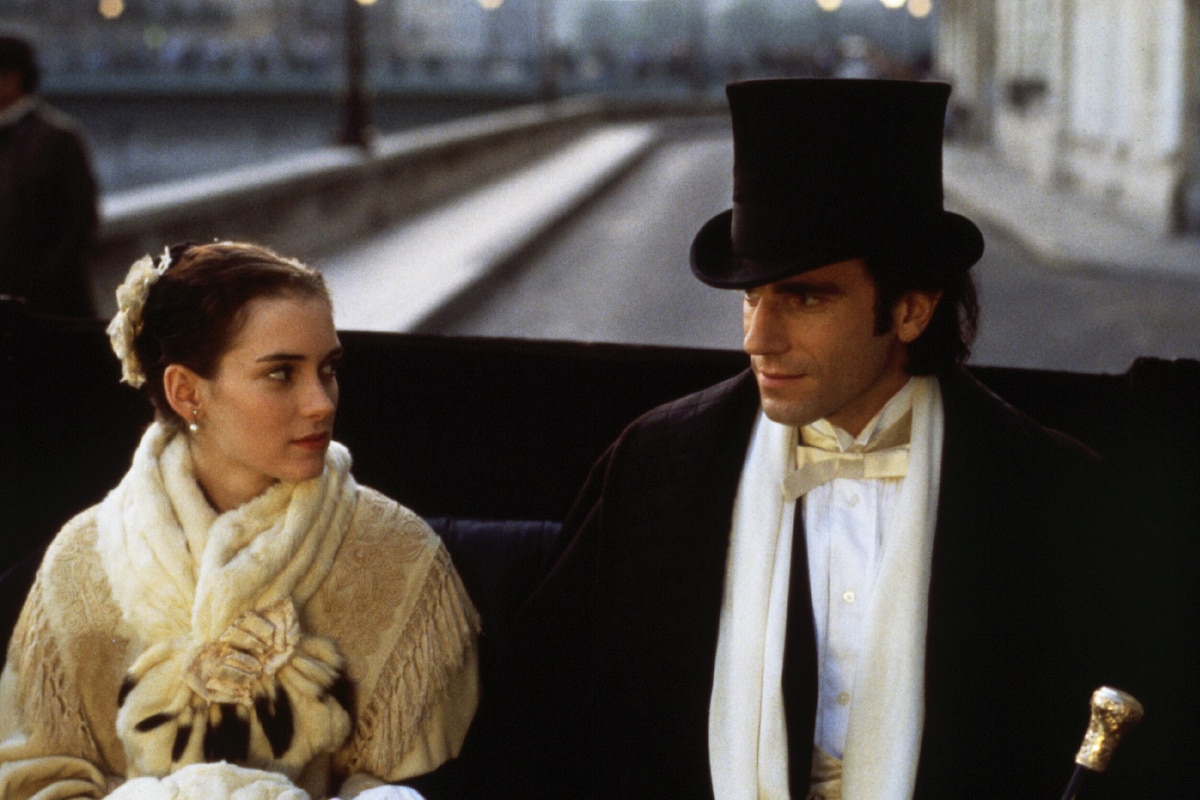
Scorsese had his actors listen to tapes of people speaking from the period, recorded nearly a century before, to get a feel for how dialogue was expressed and where inflections were made. Daniel Day-Lewis does such a good job of mimicking the cadences of the day that it feels like another actor than the one we know from so many expressive performances. And Michelle Pfeiffer is simply heartbreaking as the Countess, a woman who could not understand why the world was so decidedly against her freedom. And Winona Ryder, especially to anyone who has read the book, is simply perfect as May. She embodies both the physicality and psychology of May to such an expert degree that it feels like the May of the novel has leapt off the page and onto the screen.
Of course, there are so many other notable performances in the film that it's hard to keep up. From Joanna Woodward's expert narration to Michael Gough's Henry van der Luyden and Richard E. Grant's Larry Lefferts, the performances keep the movie rooted in a time and place that feels exactly right. Above all, there is Miriam Margolyes as Mrs. Mingott. Her performance as the grandmother of May, and the unofficial arbiter of New York society, is possibly the best in the film.
The settings were largely real locations in New York and Pennsylvania, instead of studio built sets. Sites included the Luykas Van Alen House in Kinderhook, NY, the Paine Mansion in Troy, NY, and the Philadelphia Academy of Music in Philadelphia, PA. This gave the film a feel of authenticity for which sets might not have allowed.
The screenplay was written by Martin Scorsese and Jay Cocks, an American film critic that Scorsese had started working with years before on an adaptation of Gangs of New York. That production, also taking place in historic New York, would not be made until 2002, even though Scorsese and Cocks began work on it in 1976. Age of Innocence would be the first one to see release and the movie that served as a stepping stone to the second. Although it did not receive a nomination for Best Picture, it did win the Oscar for Costume Design, and Winona Ryder was nominated in the supporting category. Other nominations included the screenplay, score and art direction. Age of Innocence remains one of Martin Scorsese's most beautiful and enduring works.
Director: Martin Scorsese
Screenplay: Martin Scorsese, Jay Cocks
Producers: Barbara De Fina, Bruce S. Pustin, Joseph P. Reidy
Music: Elmer Bernstein
Cinematography: Michael Ballhaus
Film Editing: Thelma Schoonmaker
Production Design: Dante Ferretti
Art Direction: Speed Hopkins
Set Decoration: Robert J. Franco , Amy Marshall
Costume Design: Gabriella Pescucci
Cast: Daniel Day-Lewis (Newland Archer), Michelle Pfeiffer (Ellen Olenska), Winona Ryder (May Welland), Richard E. Grant (Larry Lefferts), Alec McCowen (Sillerton Jackson), Geraldine Chaplin (Mrs. Welland), Mary Beth Hurt (Regina Beaufort), Stuart Wilson (Julius Beaufort), Miriam Margolyes (Mrs. Mingott)
By
Greg Ferrara
The Age of Innocence
by Greg Ferrara | February 08, 2018
SIGN UP FOR OUR NEWSLETTERS

CONNECT WITH TCM