A title like Blue Sky suggests a movie stocked with nature, sunshine and contentment. Adding to that expectation, the 1994 release called Blue Sky was directed by Tony Richardson, whose most famous film is Tom Jones, the rollicking 1963 comedy that won the Academy Award for Best Picture. Richardson made many downbeat movies, though, including such classics as A Taste of Honey (1961) and The Loneliness of the Long Distance Runner (1962), and while Blue Sky has several scenes of lighthearted fun, it explores a thoroughly serious theme in a fundamentally serious way.
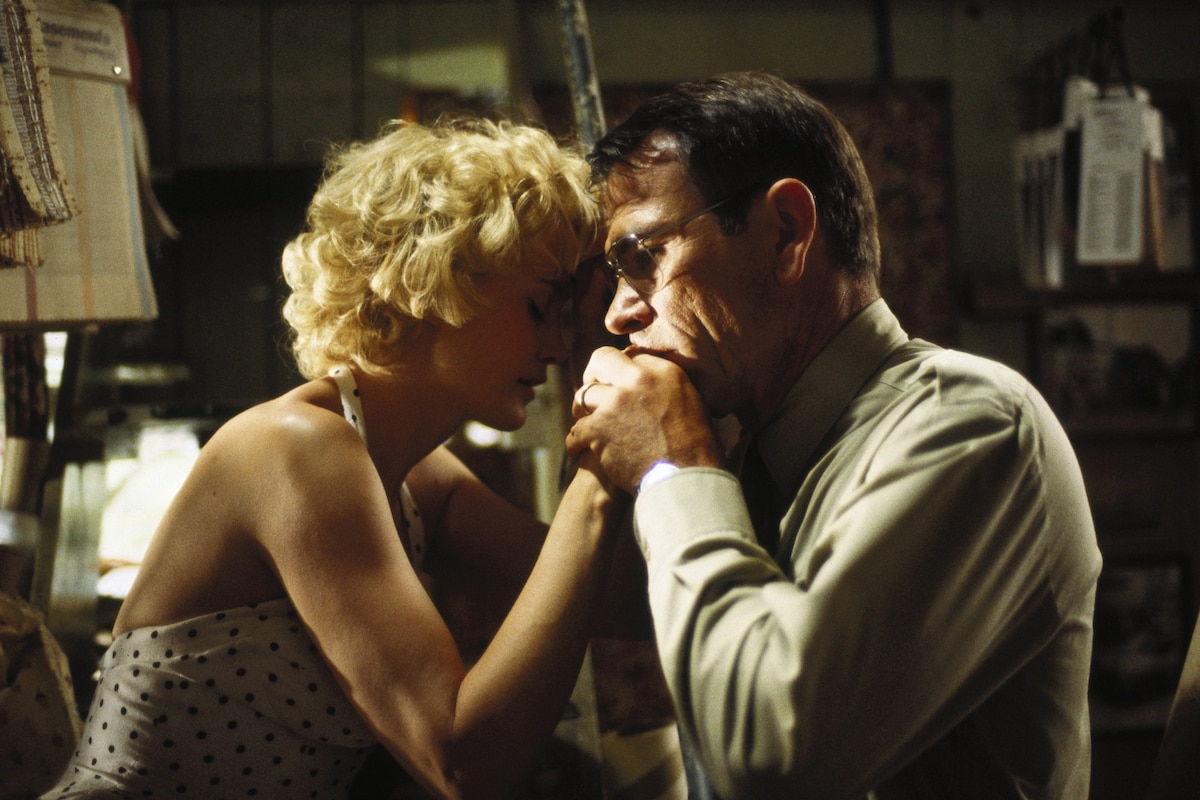
It also gives Jessica Lange one of her most memorable roles, for which she earned an Oscar for best actress - a highly impressive achievement, since her character has to share the screen with the attention-grabbing topic of nuclear testing amid the cold-war tensions of the early 1960s. She plays Carly Marshall, the psychologically unstable wife of Hank Marshall, played by Tommy Lee Jones in a performance of equal power.
Hank is an army officer and nuclear engineer who studies the effects of atomic energy in connection with Blue Sky, a secret testing program that makes him increasingly uncomfortable as he realizes how carelessly it's managed by authorities higher up the chain of command. His steadiness and good humor contrast vividly with the flightiness and fantasy that surge through Carly's personality, making her sweet and charming one moment, bitter and irrational the next. Her self-control problems complicate life for Hank and their two young daughters, and they often spill over to the military community outside.
The story begins in Hawaii, where the Marshalls have palm trees around them and truly blue skies overhead. Carly's erratic behavior gets Hank transferred to Alabama, where they have to make new friends and handle the strain of living in a rundown house. The only bright spot for Carly is a show being prepared by the wives of the other officers - a welcome activity for a woman who believes she could have been another Marilyn Monroe or Brigitte Bardot if life had given her a chance.
Hank copes with Carly while juggling the pressures of his job and dealing with his commanding officer, Vince Johnson, a calculating and controlling man whose wife is involved with the upcoming show. Vince himself gets involved with Carly, bringing about a hugely embarrassing moment for her older daughter, who has started dating Vince's son. The movie's climax arrives when Hank grows alarmed about two men disastrously affected by a nuclear test he monitored. Staging a hasty cover-up, his superiors send him to a military hospital where drugs and confinement keep him silent about the incident, and also about how Vince took advantage of his mentally troubled wife. The only person who can rescue Hank is Carly, who may or may not be up to the task.
The original story for Blue Sky was created by co-screenwriter Rama Laurie Stagner, who based Carly and Hank on the emotionally fraught relationship she observed between her own parents when she was growing up. She also took cues from an unpublished memoir by her father, who was indeed a safety officer for an underground atomic test in Nevada in 1962. "The explosion wasn't supposed to come out of the ground," he recalled for an Arizona newspaper when Blue Sky was released, "but it did. It blew out the side of a mesa, and I knew it was my duty to fly in there in a helicopter and check the extent of what happened." As in the movie, he spoke up about what went wrong and the terrible impact it had on people near the blast, but ran into indifference and resistance from higher officers.
Stagner used herself as the model for Alex Marshall, the older daughter in the film, and gave this character some of the snappiest dialogue. "He's blind and she's crazy. They're perfect for each other," Amy says, describing her parents' stubborn inability to get their wobbly relationship in order. Hank is also quite articulate at times, as when he tries to explain Carly's volatility by saying she's kind of like water, which changes from liquid to solid to gas without altering its basic properties. Carly and younger daughter Becky get off some zingers too.
Blue Sky was the last movie Richardson completed before his death in 1991. Shortly after the film wrapped, however, its production company partially shut down and then went bankrupt. This was an odd fate for Orion Pictures, which had just finished raking in Oscars for Kevin Costner's 1990 western Dances with Wolves and Jonathan Demme's 1991 thriller The Silence of the Lambs. But a string of recent flops had fatally weighed the studio down, and its bankruptcy delayed the release of Blue Sky and several other movies until the company reemerged in a different form three years later. Reviews of Blue Sky were mostly good, and reviews of Lange, who had scored an earlier Oscar nomination for playing the psychologically challenged actress Frances Farmer in Graeme Clifford's 1982 biopic Frances, were mostly ecstatic.
The solid supporting cast of Blue Sky includes Powers Boothe as Vince and Carrie Snodgress as Vera Johnson, his snide and condescending wife; also present are Chris O'Donnell as their son and Amy Locane and Anna Klemp as the Marshall girls. But top acting honors go to Lange and Jones, who turn in some of their finest work as the struggling couple at the center of the story.
Director: Tony Richardson
Producer: Robert H. Solo
Screenplay: Rama Laurie Stagner, Arlene Sarner, Jerry Leichtling
Cinematographer: Steve Yaconelli
Film Editing: Robert K. Lambert
Art Direction: Gary John Constable
Music: Jack Nitzsche
With: Jessica Lange (Carly Marshall), Tommy Lee Jones (Hank Marshall), Powers Boothe (Vince Johnson), Carrie Snodgress (Vera Johnson), Amy Locane (Alex Marshall), Chris O'Donnell (Glenn Johnson), Mitchell Ryan (Ray Stevens), Dale Dye (Col. Mike Anwalt), Tim Scott (Ned Owens), Annie Ross (Lydia), Anna Klemp (Becky Marshall)
Color-101m.
by David Sterritt
Blue Sky
by David Sterritt | January 25, 2018
SIGN UP FOR OUR NEWSLETTERS

CONNECT WITH TCM