Mel Gibson's second feature film directorial effort, a sprawling epic about the fight for Scottish independence in the 13th century, is one of those divisive pictures whose cinematic worth is frequently debated. Braveheart was nominated for ten Academy Awards and won five, including Best Picture and Best Director. Yet, it has shown up on several lists of the least-deserving Best Picture Oscar winners of all time. In 2005, Empire magazine ranked it the worst picture of the Academy's honorees. On the other hand, the British film magazine's readers' poll - perhaps boosted by a high number of Scottish respondents - voted it the best film of its year.
Critical opinion at the time of its release was equally split. The New York Times said it was "a great ambitious gamble that pays off...an exhilarating new-fashioned epic," while the Washington Post dismissed it as "bloody, glib, saccharin and lengthy."
Could it be that everyone's right about this movie? Bloody it certainly is, and at three hours, the film well earns the label "lengthy," but the story charges along on action, drama, romance, painstaking art direction, and over-the-top heroism. With elements of Spartacus (1960), the Robin Hood legends, Shakespeare's Henry V, and even, as one reviewer pointed out, Die Hard (1988) running through the sweeping tale of a charismatic leader and his oppressed people, it engaged audiences enough to make it the 13th highest-grossing film of 1995.
The "glib" slam was based, in part, on a scene depicting the Scottish rebels lifting their kilts and mooning the approaching English army. Whether or not the display of bare bottoms was a common insult in the 1200s, historians have been quick to point out that kilts were not worn in Scotland before the 16th century, and certainly not in the style shown on screen.
That's one aspect of Braveheart everyone, admirers and detractors alike, seems to agree on: the widespread historical inaccuracies. In a 2009 interview with London's Daily Mail, Gibson acknowledged his decision to place dramatic needs over historical fact. Likewise, screenwriter Randall Wallace noted that, in the absence of verifiable facts about the legendary Scottish rebel William Wallace (played on screen by Gibson), he based his script on the 15th century epic poem "The Acts and Deeds of Sir William Wallace, Knight of Elderslie" by a writer known as Blind Harry, aka Henry the Minstrel. Little is known about the balladeer beyond his claim that he based his poem on a book by a boyhood friend of Wallace, the existence of which has never been confirmed. However, it's generally agreed that Harry's account is largely the stuff of fiction.
"Is Blind Harry true?" Wallace has said. "I don't know. I know that it spoke to my heart and that's what matters to me, that it spoke to my heart."
Blind Harry can't shoulder all the criticism for the movie's view of history. Gibson and Randall Wallace also took heat for some elements that did not come from the poem, among them the depiction of English King Edward I as a bloodthirsty psycho and his son, future King Edward II, as an effeminate homosexual. Some Scots also took offense at the less-than-flattering portrayal of national hero Robert the Bruce, who until this film was more generally known as the Brave Heart rather than William Wallace.
Such considerations, however, were put aside when the country saw a significant spike in tourism following the film's great popularity. An economic report in 1996 claimed the movie had brought Scotland ₤7-₤15 million in additional tourist revenue.
About six weeks of principle production took place in Scotland, specifically the Glen Nevis valley, an exceptionally rainy area that offered only three days of sunshine. Gibson took advantage of that brief fair weather to film the story's wedding scene.
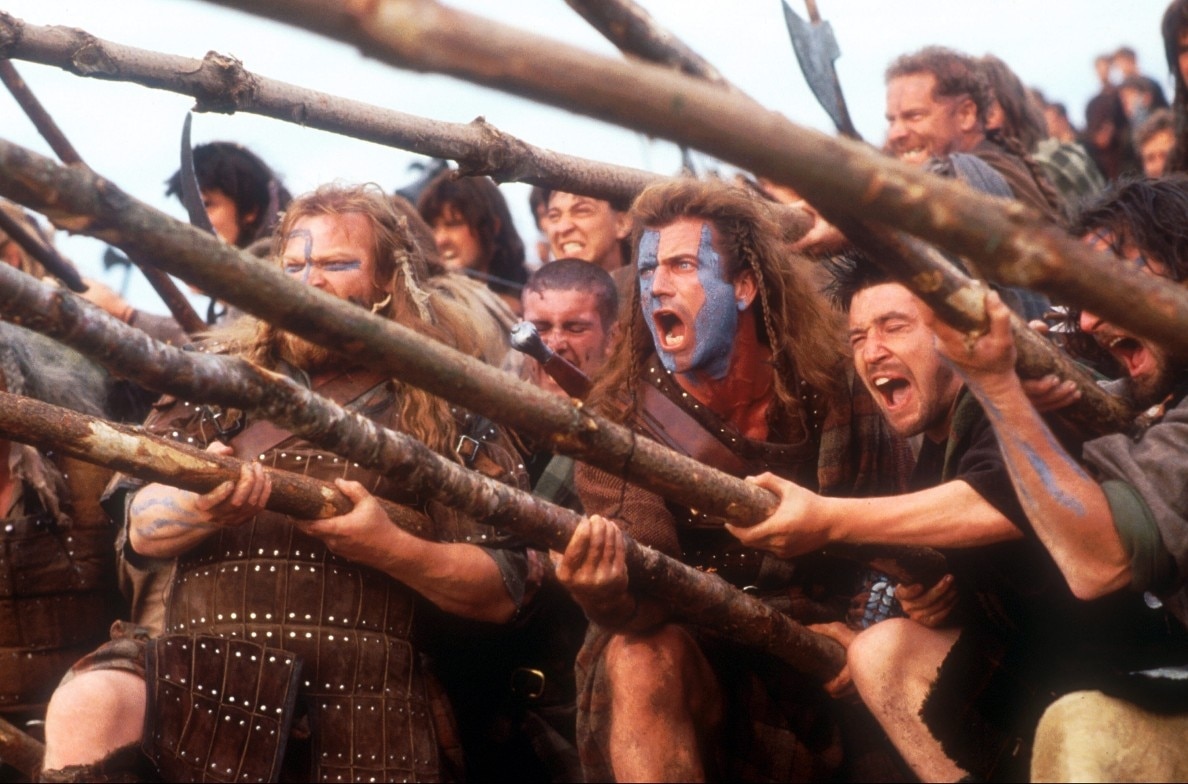
The big battle sequences were shot in Ireland. Members of the Irish Army Reserve, as many as 1,600 in some scenes, were employed as soldiers for both sides of the conflict. The Battle of Stirling took six weeks to film and used close to half a million feet of film - more than 90 hours of footage. To get the maximum action and brutality (toned down in editing to avoid an NC-17 rating) while being mindful of animal protection, mechanical horses were designed for the battle sequences. They weighed 200 pounds each and ran on nitrogen cylinders to move them on tracks up to 20 feet at 30 miles per hour. The result was so convincing that an animal welfare organization accused Gibson of using real horses. The production had to provide video footage of the actual location shooting as proof of the mechanized beasts.
Gibson reportedly watched a number of other films in preparation for filming the battles, including Spartacus and Orson Welles' Chimes at Midnight (1965). The preparation paid off with intense, exciting footage. In 2007, CNN's "The Screening Room" listed the Battle of Stirling as one of the top 10 battle scenes in movie history, citing it as "scarcely a model of historical accuracy, but tremendous fun nonetheless and, if there were one, Gibson's rousing taunts would have won him the Oscar for best battlefield banter." Gibson came under particular praise from reviewers for staging Wallace's rousing call to arms not in the usual movie fashion - a single man speaking to his thousands of troops from one vantage point as if they could all hear him equally - but for the arduous task it must have been in real life, charging on horseback throughout the massed warriors screaming himself hoarse.
In addition to its five Academy Awards, Braveheart received numerous other nominations and awards, including prizes at the Golden Globes, BAFTA, the American Cinema Editors and the Writers Guild of America.
Director: Mel Gibson
Producers: Bruce Davey, Mel Gibson, Alan Ladd Jr.
Screenplay: Randall Wallace
Cinematography: John Toll
Editing: Steven Rosenblum
Art Direction: Daniel T. Dorrance, Ken Court, Nathan Crowley, John Lucas, Ned McLoughlin
Music: James Horner
Cast: Mel Gibson (William Wallace), Patrick McGoohan (Longshanks - King Edward I), Brian Cox (Argyle Wallace), Brendon Gleeson (Hamish), Sophie Marceau (Princess Isabelle), Catherine McCormack (Murron), Angus Macfadyen (Robert the Bruce)
By Rob Nixon
Braveheart
by Rob Nixon | January 25, 2018
SIGN UP FOR OUR NEWSLETTERS

CONNECT WITH TCM