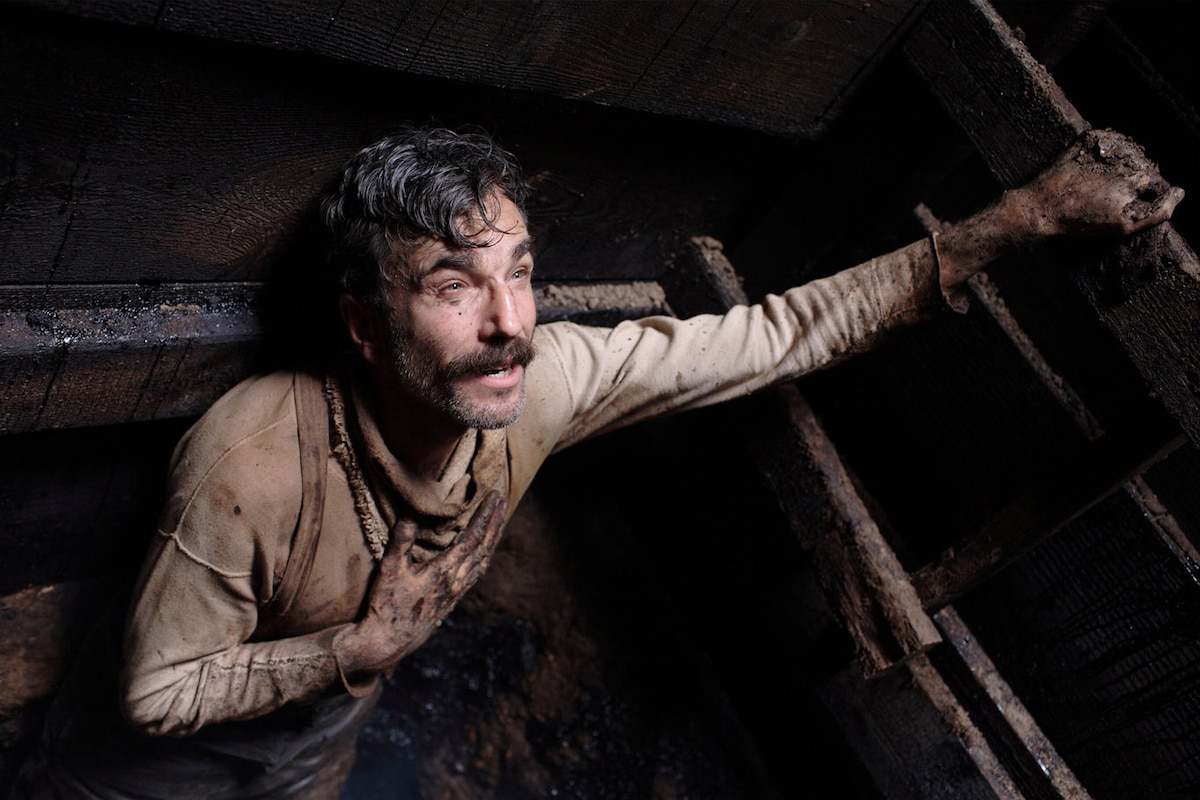
The fifth film by Paul Thomas Anderson reworks the American entrepreneurial success story as a frontier myth turned robber baron drama. It's loosely based on Upton Sinclair's novel Oil!, though Anderson focuses solely on the first section of the novel ("the first 150 pages," he told interviewers). Sinclair's oil tycoon James Arnold Ross is renamed Daniel Plainview for the film and the drama turns on his relationship with an adopted son and his struggle with evangelical preacher Eli Watkins (Eli Sunday in the film).
Anderson's film begins with Plainview as a driven, solitary prospector attempting to dig his way to the American dream by mining for gold when he ends up with a gusher. He reinvents himself, transforming from simple prospector to self-made oil man, and becomes brutally competitive as success breeds greed for power and control. He finds his nemesis in a self-aggrandizing young preacher who builds his church on Plainview's money.
Anderson began researching his topic to fill out the portrait of Plainview and the American oil industry at the turn of the 20th century. Sinclair based his oilman on real-life tycoon Edward Doheny and Anderson absorbed The Dark Side of Fortune, a biography of Doheny written by Margaret Leslie Davis. He also visited museums dedicated to the early days of petroleum and studied photographs of wildcatting and drilling of the era, and he watched John Huston's The Treasure of the Sierra Madre (1948) repeatedly.
Daniel Day-Lewis signed on after reading an early draft of the script. "I'd loved [Anderson's] films," he explained in a 2008 interview. "And the idea had occurred to me that we might enjoy getting up to the same kind of mischief, but when this script came it really took me quite by surprise in the most wonderful way. The bag was packed once I'd read it." Actually, it was a couple of years before the funding came through, and Day-Lewis -- who is legendary for his meticulous preparation for his roles - spent the time doing his own research. He studied the life of Doheny, read letters from men working the California oil fields in the early 20th century, and learned to work with the tools of the trade. And, prompted by Anderson, he also watched The Treasure of the Sierra Madre. Coincidentally, the measured baritone rumble of the voice Day-Lewis adopted for the character evokes John Huston, which is fitting as his story suggests the early days of Noah Cross, the character Huston plays in Roman Polanski's Chinatown. "A few people have asked me if I modeled the voice on John Huston," he remarked in another interview. "I didn't. But I did listen to some tapes of Huston's voice, among others. And there was something about the vigor of Huston's language that appealed to me." And he burrowed into the darkness of his character. "We all have murderous thoughts throughout the day, if not the week. We all live under some repression; we have to, it's part of the deal. And what is more invigorating than to unleash some of that stuff?"
Kel O'Neill was originally cast as Eli Sunday, the ambitious, scheming young pastor whose oil-rich land is leased by Plainview, but the part was recast after a few weeks of shooting. Paul Dano, who had previously worked with Day-Lewis in the film Jack and Rose (2005) and was already cast as Eli's meek brother, was offered the role of Eli while production was underway. He jumped into the character with only four days to prepare, supported by Day-Lewis, and the siblings were transformed into identical twins with Dano playing scenes opposite himself.
Unable to find suitable locations that evoked "what Bakersfield would have looked like before the discovery of oil" in his home state of California, Anderson took the company to West Texas and built his turn-of-the-century California town of Little Boston and constructed the oil fields of his film on a ranch outside of Marfa, the same town where the 1956 classic Giant was shot. In collaboration with his regular director of photography Robert Elswit, Anderson stripped the frame down to stark, spare images with isolated figures and skeletal oil derricks on endless plains against a pale sky. It's a very different style than the colorful, energetic business of his sprawling ensemble films Boogie Nights (1997) and Magnolia (1999).
For the soundtrack he turned to Jonny Greenwood, the guitarist of Radiohead. He had never before scored a film and approached the project without any preconceptions. Only a few sections were written for specific scenes, he explained in a 2007 interview. "I tried to write to the scenery, and the story rather than specific "themes" for characters. It's not really the kind of narrative that would suit that. It was all about the underlying menace in the film, the greed, and that against the... oppressive religious mood...." Initially apprehensive at the haunting music Greenwood presented him, it grew on Anderson as he continued listening to it and became a defining element to the film's distinctive mood. Greenwood has since written the music for every subsequent Anderson film.
Between the release of his previous feature, Punch-Drunk Love (2002), and pre-production on There Will Be Blood, Anderson served as back-up director for the aging Robert Altman on A Prairie Home Companion (2006). Altman had been a powerful influence on Anderson's films and over the course of the production they became friends. Altman passed away while Anderson was editing the film in Ireland. In tribute to his friend and mentor, Anderson dedicated the film to him.
There Will Be Blood won Academy Awards for Daniel Day-Lewis (his second Oscar for Best Actor) and cinematographer Robert Elswit and six additional nominations, including nods for Anderson for his screenplay and direction and for Best Picture (it went to No Country for Old Men). A decade later, Anderson and Day-Lewis reunited for the film Phantom Thread.
by Sean Axmaker
Sources:
"Daniel Day-Lewis: Interview," Dave Calhoun. Time Out: London, February, 2008.
"IndieWire Profile: "There Will Be Blood" director Paul Thomas Anderson," Eugene Hernandez. IndieWire, December 27, 2007.
"The Enigma of Day-Lewis," Peter Stanford. The Observer, January 13, 2008.
December 21, 2007 episode of Charlie Rose with Paul Thomas Anderson and Daniel Day-Lewis, PBS.
Reel Pieces interview with Daniel Day-Lewis and Paul Thomas Anderson by Anette Insdorf at 92nd Street Y, December 12, 2007.
"An Interview with Jonny Greenwood." Nonesuch, December 6, 2007.
IMDb
There Will Be Blood
by Sean Axmaker | January 25, 2018
SIGN UP FOR OUR NEWSLETTERS

CONNECT WITH TCM