Documentaries, more often than not, make little impact on the world around them. Even fewer actually attempt to make an impact on the world around them. Davis Guggenheim's documentary of former Vice President Al Gore's slideshow presentation on the environment, An Inconvenient Truth (2006), attempted to do just that and became one of the most controversial documentaries ever released.
There was a time when climate change would have never been considered a political issue but, as seemingly with all things in the modern age, it became one. When Al Gore started talking about the environment in the early eighties, no one considered it a touchy area. After all, we all live here and the climate affects every living creature. But by the time Gore began giving his climate warming presentation, two sides had been formed. One in which the science was considered undeniable and a call to action, and another in which it was all disputable and overblown. In 2006, when the documentary was released to the public, the lines had been drawn.
As this is not a science article, nor a political one, the merits of the documentary as a film should be all that matters. But, of course, when a documentary is intertwined with its political and scientific mission, that's almost impossible. The merits of what Gore says matter too. Unfortunately, despite the scientific consensus being in Gore's corner, his critics still question that merit to this day.
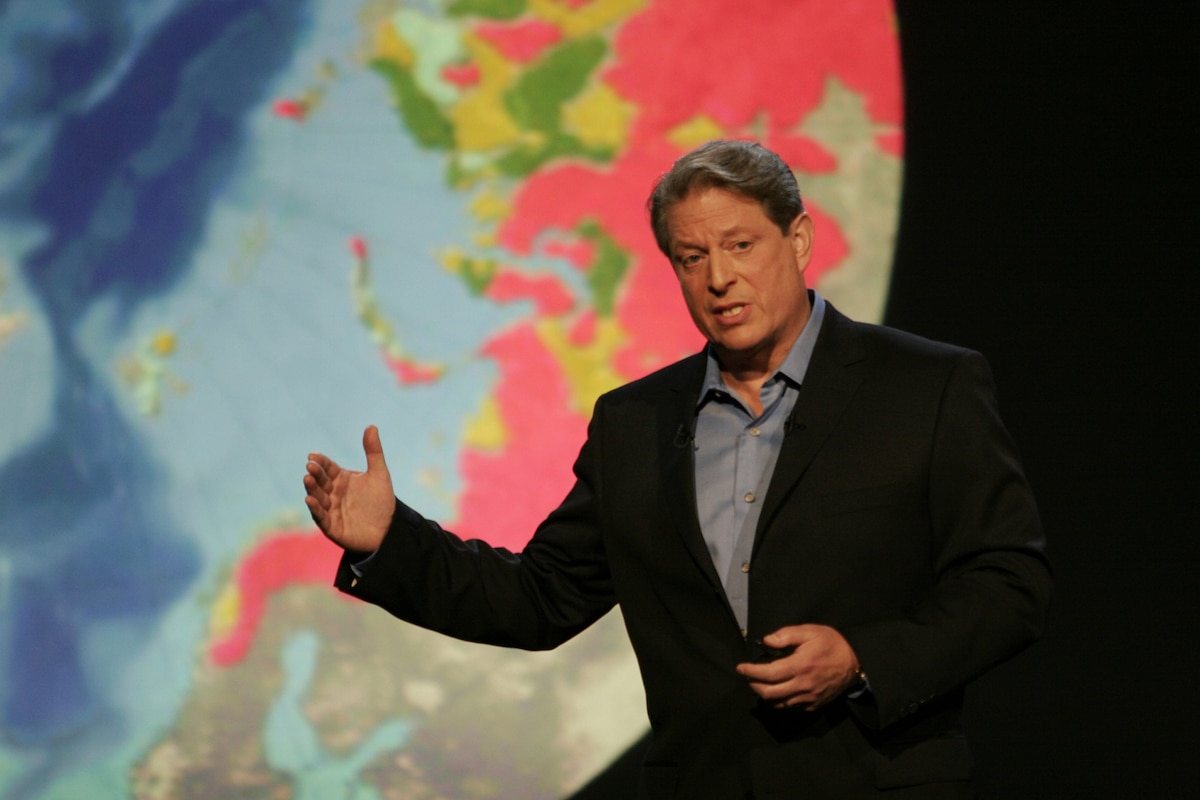
The documentary includes more than just Gore explaining that the climate of the planet is changing. It also includes brief insights into his personal demons, struggling with his sister's death, and dealing with the loss of the 2000 election. But it is the scientific presentation that carries the weight of the documentary and that presentation, despite being little more than a glorified slideshow, is surprisingly captivating.
Using images of the earth from outer space, humorous animation, and, above all, a wealth of scientific data, Gore expertly details that changing climate of the planet and the troubles it bodes for the future. He explains that steps need to be taken to mitigate the changes and that without them, we may hit a tipping point from which there is no return. The problem with this is that no one can say with certainty where that tipping point will be so Gore is relying on the urgency of his message to sway people to action.
Before 2006, the call to action on climate change was not nearly as strong as it was after and a large part of that is due to Gore's presentation, filmed by Guggenheim. Whether one wants to argue the merits of Gore's point or not, the success should be measured in visibility and awareness raised and in those two areas, An Inconvenient Truth is a home run. It raised awareness of the fragility of our one and only planet in a way nothing had before, and nothing has since, including a not very successful sequel.
The documentary came about when producer Laurie David saw Gore give the presentation at a local town hall meeting. She was blown away and quickly approached Gore about making it into a documentary. With the assistance of producer Lawrence Bender, the three got Davis Guggenheim to direct and, once released, the film became a sensation. Its several accolades and prizes culminated in an Academy Award for Best Documentary. Not only that, it became the first documentary to also take home a second Oscar, this time for Best Song.
The strength of science is that it adapts and conforms to new data. It does not rest on dogma or dictate. Has the scientific data changed since this film was released? Almost assuredly. But that doesn't mean the previous information founded by science is obsolete or incorrect. On the contrary, the new data merely builds off previous data by scientists. This film still remains both impactful and necessary as a call to arms for the environmental movement. With scientific knowledge progressing, Gore's enthusiasm in presenting the subject continues to be invigorating and enlightening along with it.
Director: Davis Guggenheim
Producers: Lawrence Bender, Laurie David, Scott Z. Burns
Writer: Al Gore
Music: Michael Brook
Cinematography: Davis Guggenheim, Robert Richman
Film Editing: Jay Cassidy , Dan Swietlik
Song ("I Need to Wake Up"): Melissa Etheridge
Cast: Al Gore (Himself)
By
Greg Ferrara
An Inconvenient Truth
by Greg Ferrara | January 19, 2018
SIGN UP FOR OUR NEWSLETTERS

CONNECT WITH TCM