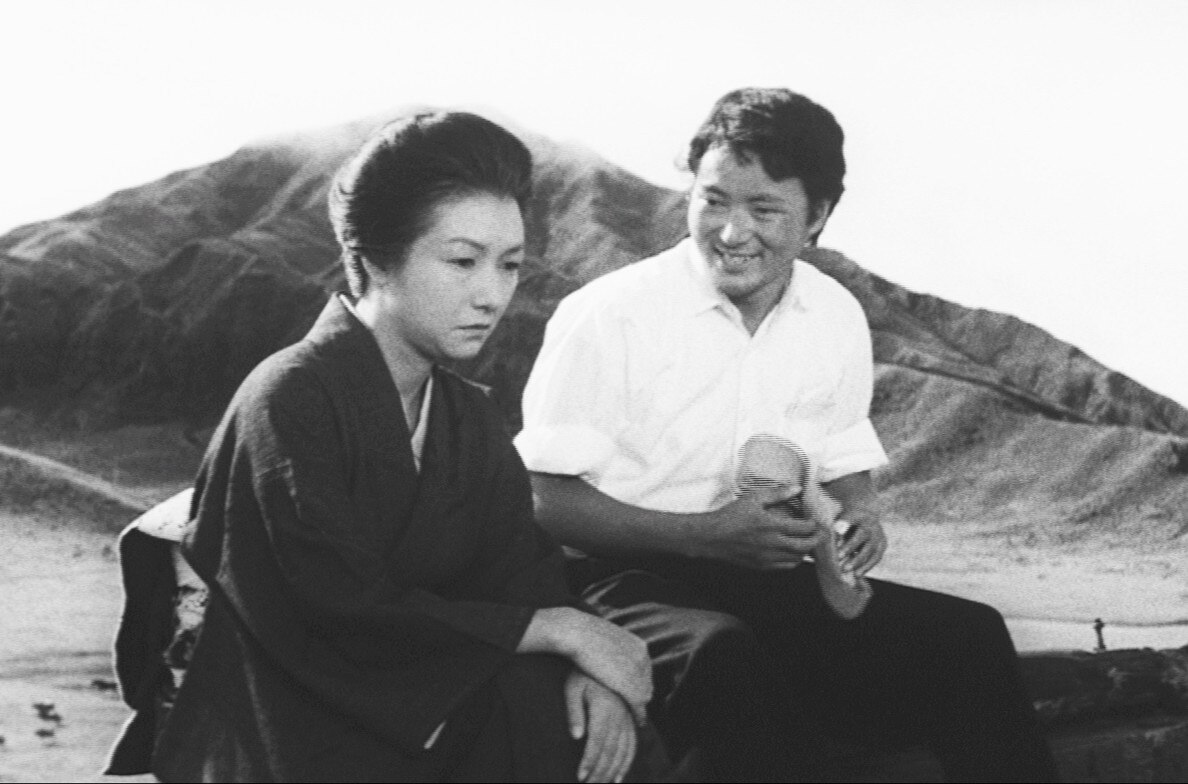
Immortal Love (1961) aka Bitter Spirit and known in the original Japanese as Eien no hito, was written and directed by Keisuke Kinoshita. Set in 1932 Japan, Immortal Love follows several different storylines over the course of three decades. It begins with the tragedy of Sadako (Hideko Takamine), who is engaged to her true love Takashi (Keiji Sada), away at war against the Chinese. While he is gone, another soldier, Heibei (Tatsuya Nakadai), returns to the village having been crippled from an injury sustained in battle. The arrogant Heibei takes a fancy to Sadako and rapes her, despite her engagement to Takashi. Not knowing she is pregnant, Sadako, unable to deal with the rape and the loss of her virginity, tries to kill herself but is saved by Takashi's brother Rikizo (Kiyoshi Nonomura). Heibei's wealthy father Heizaemon (Yasushi Nagata), owns the land Sadako's family works as tenant farmers, and is able to pressure Sadako's father Sojiro (Yoshi Katô) to force her to marry Heibei.
Eventually, they have a daughter, Naoko (Yukiko Fuji) and two sons, Eiichi (Masakazu Tamura), the product of Sadako's rape, and Morito (Masaya Totsuka) but their marriage is based on mutual hatred and is spent finding ways to make the other unhappy. The story then shifts to the children's own search for love after having witnessed their parents' unhappy life together. Eiichi takes his own life as a teenager when he learns how he was conceived, Morito becomes a communist in modern-day Japan, and Naoko falls in love with Takashi's son Yutaka (Akira Ishihama) and runs off with him with her mother's help; just one more attempt to get back at Heibei, who disapproves of the match.
Produced for the Shochiku Company, Immortal Love was a family affair of sorts. It was shot in evocative black-and-white by Kinoshita's brother-in-law, Hiroshi Kusuda, while Kinoshita's brother, Chûji composed the soundtrack, using Spanish flamenco music as his influence, rather than traditional Japanese. This was not the first film to star Hideko Takamine and Tatsuya Nakadai. They appeared in seven films together, including When a Woman Ascends the Stairs in 1960. Takamine also appeared with Keiji Sada in eight films before his death in a car accident at the age of 37 in 1964.
Released in Japan on September 16, 1961 and the United States later in the year, Immortal Love was Japan's official submission for the 34th Academy Awards, where it earned a nomination for Best Foreign Language Film. It lost to Ingmar Bergman's Through a Glass Darkly (1961).
by Lorraine LoBianco
SOURCES:
https://bampfa.org/event/bitter-spiritimmortal-love-eien-no-hito
The Internet Movie Database
https://japaneseculturereflectionsblog.wordpress.com/2016/04/17/forced-to-marry-her-rapist-kinoshitas-1961-immortal-love/
www.oscars.org
Immortal Love
by Lorraine LoBianco | January 17, 2018
SIGN UP FOR OUR NEWSLETTERS

CONNECT WITH TCM