I Wake Up Screaming (1941) was the very first film noir produced by Twentieth Century Fox.
On the commentary track of the movie's sparkling new "Fox Film Noir" DVD release, noir historian
Eddie Muller explains that The Maltese Falcon (1941) - considered by some to be the first
film noir altogether - was being lensed at Warner Brothers at the same time that Fox was producing
I Wake Up Screaming. His point is that the noir style was beginning to emerge from more
than one place. It's a valid observation even though many noir fans agree that the 1940 RKO
production Stranger on the Third Floor is the first true film noir. In any case, I Wake
Up Screaming is indeed the first from Fox, and it certainly looks and feels much more noir-like
than The Maltese Falcon, from its stylized photography to its complex flashback
structure.
Based on a pulp novel by Steve Fisher, the story intriguingly pairs Fox musical sweetheart Betty
Grable with Victor Mature as they try to solve the murder of Grable's sister, played by Carole
Landis. Mature, a sports promoter, launched Landis' career as a model, and a police detective
played by Laird Cregar suspects him of her death. (Cregar is wonderfully effective in this role,
finding creepy humor everywhere.) Meanwhile, Mature and Grable fall for one another. Right from
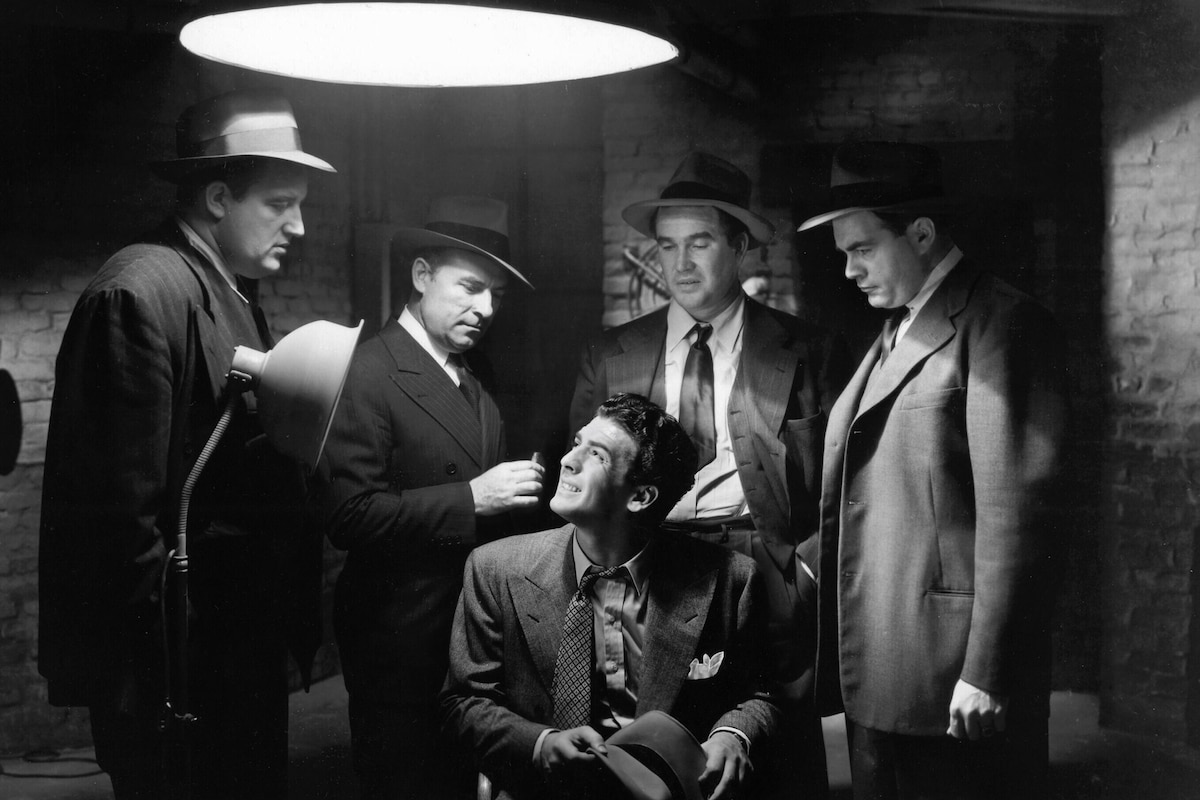
the opening police interrogation sequence this movie shows it's doing something special, with
stunning frames composed around shadows as much as actors. Flashbacks from more than one character
start to piece events together for us - a storytelling device that would soon be as common as
double-crossing dames. The plot resolves itself in a way that looks ahead to Fallen Angel
(1945), another Fox noir.
The director (H. Bruce Humberstone), cinematographer (Edward Cronjager) and much of the crew of
I Wake Up Screaming had just completed Sun Valley Serenade (1941), a film which
couldn't be more different. It's a testament to their skill as craftsmen that they did such an
outstanding technical job on this one. Grable is effectively cast aginst type and does a very good
job. She and Landis are convincing as sisters here, and in fact they also played sisters in their
previous film, Moon Over Miami (1941). In a sign that Fox honcho Darryl Zanuck was worried
about not giving the fans a song from Miss Grable, the DVD includes a deleted musical number, in
which Grable sings Harold Arlen's "Daddy" in a record shop. It's a good thing it was cut because
it would have been totally out of place in the finished movie, but it is delightful and it's nice
to have a chance to see it.
The film's title was changed to the less-harsh Hot Spot before production began, only to be
changed back at the last minute after the cast lobbied Zanuck to do so. Another reason for the
change was that Photoplay was planning a serialization of the novel timed to the movie's
release, using the original title. Fox Home Entertainment has provided poster art and even a
filmed opening credit sequence which uses the alternate title.
Technically, the DVD is outstanding, with Cronjager's cinematography breathtakingly crisp. Extras
include Eddie Muller's commentary, the Hot Spot material, Grable's deleted song, poster art
and still galleries, and the theatrical trailer (which is surprisingly unappealing). Eddie Muller
has done many of these film noir commentaries now, and this may be his best yet. It's just crammed
with fascinating information and engaging observations. He's especially good on the often highly
entertaining backstories of the bit players, and he's well-spoken about Betty Grable. He
attributes her massive popularity to being "sexually appealing without being sexually provocative"
and argues that this is not Grable's first dramatic role (as it's usually described), but rather
her first dramatic film. It's a good distinction to mull over.
It's nice to see Betty Grable getting some much-deserved attention in the DVD world. Pin-Up
Girl (1944) was issued last spring and four more of her musicals are now in release from Fox as
"The Betty Grable Collection." As the number one box office star of the 1940s (and the country's
highest-paid woman of the time), it's important that her cultural impact be remembered.
Look for bit character actor Charles Lane as a florist. To call him a "veteran" would be an
understatement. Mr. Lane has over 300 film and TV appearances dating back to 1931 (including the
rent collector at the end of It's a Wonderful Life) and as of 2006, he is alive and well and
101 years old.
For more information about I Wake Up Screaming, visit Fox Home Entertainment. To order I Wake Up
Screaming, go to
TCM Shopping.
by Jeremy Arnold
I Wake Up Screaming - Betty Grable in a Film Noir? I WAKE UP SCREAMING on DVD
by Jeremy Arnold | June 20, 2006
SIGN UP FOR OUR NEWSLETTERS

CONNECT WITH TCM