"This happened in Brooklyn, the city of churches. The time was the mid-thirties."
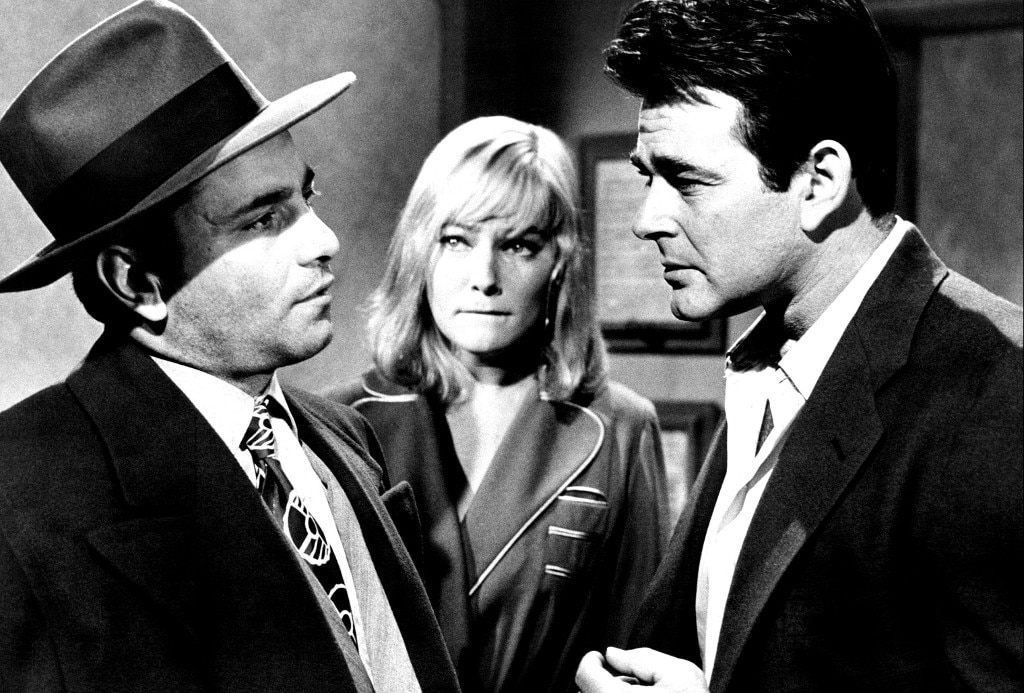
So begins Murder, Inc. (1960), the story of the notorious mob hit squad that was based in Brooklyn but served the organized crime syndicate across the entire United States in the 1930s. Based on the non-fiction book of the same name by Burton Turkus, the Brooklyn assistant district attorney who went after the gang, and Sid Feder, it was one of the more factually grounded gangster dramas of the late 1950s and early 1960s, which was a particularly fertile era for low-budget mob pictures. And Murder, Inc. is decidedly low budget, shot in black and white on location in New York and featuring a cast of second-tier studio players and Off-Broadway actors hired in the city. One of those local actors was Peter Falk.
Though fourth billed in the credits, Falk dominates the film as hitman Abe Reles, the real-life Brooklyn mobster whose knack for the business of murder makes him a key part of the new mob division. It was the big break for the young, unknown actor whose only previous big screen credit was a small role in Wind Across the Everglades (1958). Falk called the role "a miracle" in his autobiography. He threw himself into preparations, searching secondhand stores for the right hat and topcoat and rewriting the script to capture the voice and attitude of the wise guys he heard in the pool halls while growing up in Ossining, New York. Director Stuart Rosenberg, a TV veteran making his big screen debut, let him go with it. "He was a top-notch director who reacted to how the movie played," Falk wrote. "What he liked he would leave alone--and he liked the bulk of what I did." The performance launched his career, earning him an Oscar nomination for his performance and bringing him to the attention of Frank Capra, who cast him in Pocketful of Miracles (1961).
Stuart Whitman, a contract player and rising star at 20th Century Fox, takes the lead as Joey Collins, an unemployed singer whose unpaid debt to the mob forces him into becoming a reluctant member of the assassination enterprise. Whitman thought he was getting the role of Abe Reles and only learned that Falk was cast as Reles when he got to the set. "As soon as I got to see the guy in action, I knew he was right for the role," recalled Whitman in 2013. His long-suffering wife is played by Swedish actress May Britt, who had co-starred in The Young Lions (1958) and played Lola-Lola in the 1959 remake of The Blue Angel.
Turkus, who makes his entrance at the halfway mark, is played by Henry Morgan (not to be confused with the prolific character actor Harry Morgan, who was originally billed as Henry Morgan in his big screen appearances), and Simon Oakland--arguably the most well-known actor in the cast--is the New York police detective that Turkus drafts to help him roust the mobsters. Comedian Morey Amsterdam has a small role and the credits proclaim "introducing Sarah Vaughan" for her brief appearance as a nightclub singer. A number of supporting players in small roles went on to major careers, namely Vincent Gardenia (who plays the mob lawyer), Joseph Campanella (a gangster hiding out from the mob), and Sylvia Miles (who made her screen debut in the role of Sadie).
Midway through the production, the Actors Guild called a strike and Rosenberg was ordered to speed up shooting to finish before the strike deadline would shut down all production in a couple of weeks. "The next day he went 30 percent faster," recalled Falk in his memoir. "He was fired that night. I couldn't believe it." Burt Balaban, the film's producer and a director with a couple of B movies to his credit, took over behind the camera but largely stayed out of the way of the production team, according to Falk. They shot up until midnight on the final day, improvising the final scene to get it in the can before the strike. As time ran out, a murder scene slated to play out in the Catskills Mountains was relocated to a city street, grabbed on the fly, and completed just in time before the strike shut everything down. You'd never even know it was supposed to take place in the woods. Rosenberg and Balaban share directing credit on the finished film but it was Rosenberg whose career took off when he directed Paul Newman in Cool Hand Luke (1967) just a few years later.
Sources:
Crime Movies, Carlos Clemens. Da Capo Press, 1997.
Just One More Thing, Peter Falk. Carroll & Graf Publishers, 2006.
Talk with Falk, Arthur Marx. Cigar Aficionado, Nov/Dec, 1997.
The Mafia Encyclopedia, Carl Sifakis. Checkmark Books, second edition 1999.
Interview with Stuart Whitman, recorded at Arthur Lyons Film Noir Festival in Palm Springs, 2013.
By Sean Axmaker
Murder, Inc
by Sean Axmaker | January 04, 2018
SIGN UP FOR OUR NEWSLETTERS

CONNECT WITH TCM