It's a good bet that no one involved in the making of Powder Town (1942) would ever have imagined that the film would still be enjoyed by thousands of viewers, thanks to TCM, more than 75 years later. The picture drew absolutely scathing reviews. "Exceedingly dull," said The New York Times. "An entertainment dud," proclaimed The Hollywood Reporter. "It misfires so completely that no one specifically can be blamed... The audience at preview talked back to it and laughed in the wrong places."
Variety declared: "This is a picture that should never have been made... It lacks story, action, direction, production or meaning... There is an explosion...at the end that will wake up any patrons who might be left in the theatre." The review added wryly that "J. R. McDonough, no longer with RKO, launched this production before he left the studio."
Powder Town had some prominent names involved. Beyond the cast of Victor McLaglen and Edmond O'Brien, there was the veteran director Rowland V. Lee (The Count of Monte Cristo [1934], Tower of London [1939]), and three credited writers who all were--or would soon be--famous for other works.
Vicki Baum, credited with the story idea, had written the classic Grand Hotel (1932).
Max Brand, credited with the novel, was a prolific writer in many mediums, with film work dating back to 1917. Over the years, he had created the characters of Dr. Kildare, the basis for a long-running film series, and Destry, played by James Stewart in Destry Rides Again (1939). Brand's real name was Frederick Faust, but he published under twenty different names throughout his career while turning out an estimated thirty million words of fiction. Two years after the release of Powder Town, he was killed in combat in Italy, at the age of 51, while working as a war correspondent.
The third writer on Powder Town was David Boehm, credited with the screenplay itself. He would be Oscar-nominated a year later for his next film, A Guy Named Joe (1943).
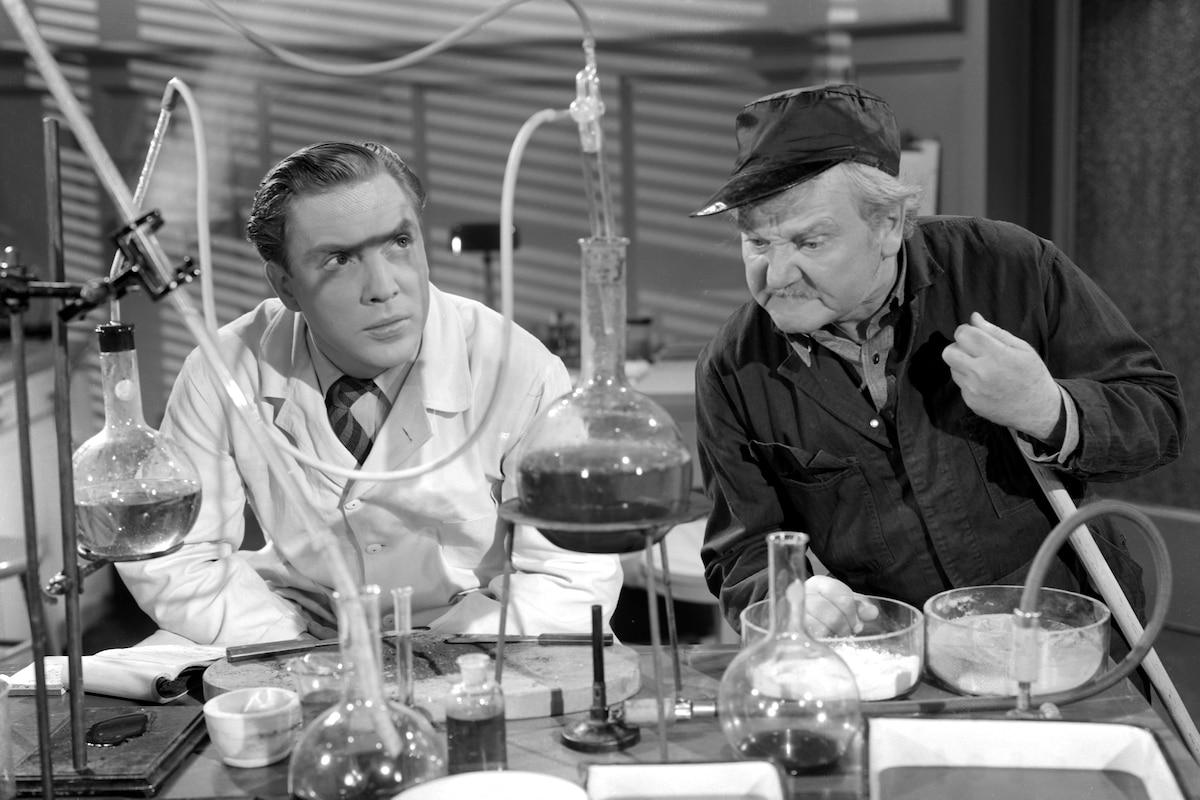
Powder Town is an oddball film, a propagandistic war-themed farce with Edmond O'Brien playing a befuddled scientist named J. Quincy Pennant. He takes a job at a "powder plant" to develop a secret new explosive that can "jump" over long distances- meaning that when it is put in one place to explode, it somehow detonates in two places at once. Victor McLaglen plays bodyguard and nursemaid to O'Brien while enemy agents, espionage and dancing girls abound. The girls share O'Brien's boarding house, and one of them is played by June Havoc in one of her earliest features. In the role of the boarding housekeeper is character actress Mary Gordon, best-remembered for a similar recurring role as housekeeper Mrs. Hudson in the Sherlock Holmes films of the era.
The movie was filmed in November and December 1941, just after the Pearl Harbor attack. Trade reports indicate that filming was delayed due to script issues, but according to critics at least, it wasn't delayed enough.
By Jeremy Arnold
Powder Town
by Jeremy Arnold | January 04, 2018
SIGN UP FOR OUR NEWSLETTERS

CONNECT WITH TCM