Gregory Nava and Anna Thomas felt very strongly that their story of indigenous youths who flee Guatemala and make their way to the U.S. should make it to the screen without corporate tampering. In seeking funding for their project, they avoided Hollywood studios, certain that executives would demand changes in their script and/or casting. It took them two years, but they finally secured about half of the financial backing they needed for this low-budget project through PBS's American Playhouse. The remainder came from pre-sales, including a deal with the United Kingdom's Channel 4.
Their efforts to preserve the concept and characters were justified by an Academy Award nomination for Best Screenplay, the first American independent film to be so recognized. They were also recognized with a nomination by the Writers Guild of America and a Best Film win at the Montreal World Film Festival. In 1995, the film was selected for preservation in the Library of Congress National Film Registry as being "culturally, historically, or aesthetically significant." El Norte was first presented at the Telluride Film Festival, screened in the Un Certain Regard section of the Cannes Film Festival in 1984, and is still regularly shown in high school Spanish and geography classes as well as college multiculturalism programs.
The film's origins can be traced back to Nava's experiences in San Diego, California, where he grew up. The child of a Mexican and Basque family, he had relatives who lived just across the border in Tijuana. He often crossed the border in his youth, struck by the stark contrast between the prosperous American city to the north ("el norte") and the cardboard shacks on the other side.
Nava and Thomas met at UCLA, where he directed a short film based on the life of Garcia Lorca, The Journal of Diego Rodriguez Silva, which won the Best Dramatic Film award at the National Student Film Festival. The two married in 1975 and collaborated on two projects: as co-writers (and he as director) on The Confessions of Amans (1976) and as two of several writers on The End of August (1982), but their attention was also focused on research about the plight of indigenous Guatemalans, conducted among those who had taken refuge in Southern California.
"There are hundreds of thousands of refugees from Central America in Los Angeles alone," Nava told the New York Times at the time of the film's release. "Nobody knows the exact number, but a recent television inquiry estimated 300,000-400,000. In our own research, we came across a community of Mayans from Guatemala--5,000 from one village--now in Los Angeles. The original village, which is now dead, had 15,000."
The film was shot in San Diego and Los Angeles and in Chiapas and Tijuana in Mexico. But some scenes of a Mexican village had to be recreated in California after cast and crew were forced out of Mexico.
"We were filming in Mexico during the end of the López Portillo presidency, one of the last of the old-fashioned caciques to rule Mexico," Nava said in an interview with Soledad Santiago in the Santa Fe New Mexican. "One day, men with machine guns took over the set. I had guns pointed at my head. We were forced to shut down production, bribe our way out of the country, fight to get our costumes back, and start shooting again in California. Ironically, in the United States our extras were real Mayan refugees. They were the people the movie was about."
According to a 1996 story about Thomas and Nava by Roger Ebert in the Chicago Sun-Times, "Mexican police kidnapped their accountant and held him for ransom, while, at the same time, his parents had to pose as tourists in order to smuggle exposed film out of the country in their suitcases."
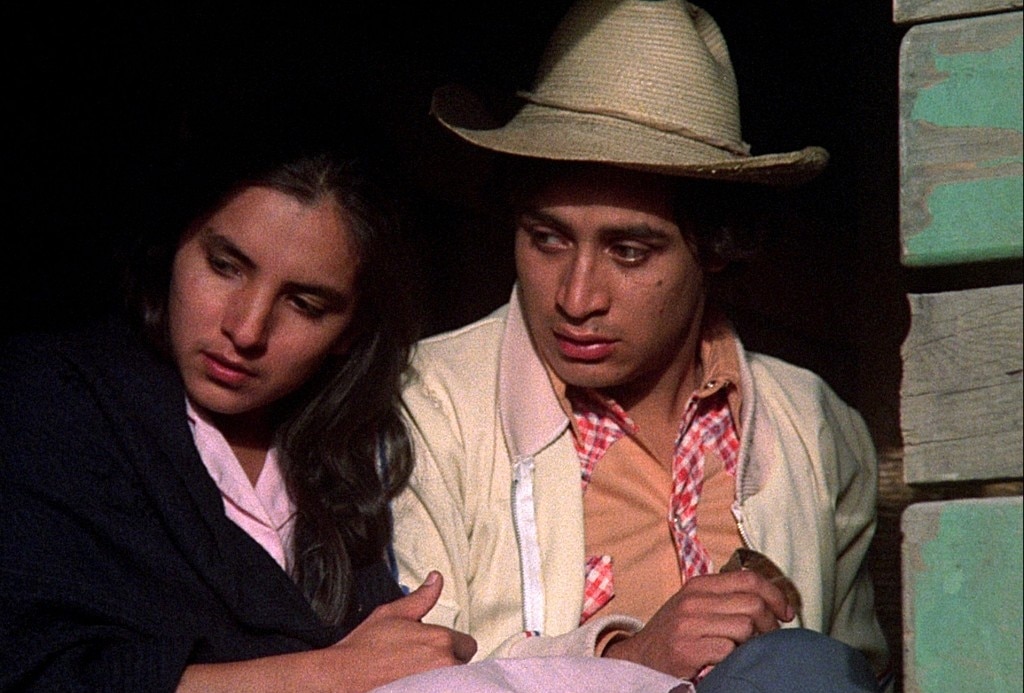
The film received rave reviews upon its release. Although he criticized the tragic ending as "arbitrary," Vincent Canby in The New York Times noted: "Mr. Nava does not patronize his 'little people.' This has something to do with the straight, unactorly quality of the performances, especially by Zaide Silvia Gutierrez as Rosa and David Villalpando as Enrique, two splendid Mexican actors."
Ebert had no such reservations about the ending, comparing the film to a classic of times past, "with astonishing visual beauty, with unashamed melodrama, with anger leavened by hope. It is a Grapes of Wrath for our time."
The picture was particularly praised for the way it wove into its realistic story the kind of magic realism usually seen only in literature, particularly novels from South America. The Washington Post reviewer Ann Hornaday, taking a look back at the film after more than 20 years, called El Norte "seminal, both for its graceful blend of classical narrative and magic realism, and the power with which it brought an otherwise invisible world to life."
Nava and Thomas had truly found a singular voice and vision, one which clearly provided the immigrant point of view in a tragic-poetic framework, something that likely would never have been allowed in a major studio-backed production.
Director: Gregory Nava
Producers: Anna Thomas, Trevor Black, Bertha Navarro
Screenplay: Gregory Nava and Anna Thomas
Cinematography: James Glennon
Editing: Betsy Blankett
Music: Los Folkloristas
Cast: Ernesto Gomez Cruz (Arturo), David Villalpando (Enrique), Zaide Silvia Guttierez (Rosa), Alicia del Lago (Lupe), Mike Gomez (Informer)
By Rob Nixon
El Norte
by Rob Nixon | January 03, 2018
SIGN UP FOR OUR NEWSLETTERS

CONNECT WITH TCM