The idea of doing a sequel with a "II" or "2" after the title was still a fairly novel idea in 1977, with only a handful of high-profile films like The Godfather: Part II (1974) and French Connection II (1975) being bold enough to start adding numerals onto the names of Oscar-winning prestige films. The latter film, a follow-up to William Friedkin's 1971 Best Picture winner, was at least a subliminal suggestion for Warner Bros. to go ahead with a direct sequel to the film he directed afterwards, The Exorcist (1973). A massive worldwide successor that spawned several years' worth of imitators, the film had broken several cinematic taboos and proven that horror (preferably based on a bestselling novel) was indeed big business in Hollywood.
However, the idea of how to continue the story of Regan MacNeil (Linda Blair) and her ongoing tangling with demonic forces proved to be difficult. Both Friedkin and William Peter Blatty, the screenwriter and author of the source novel, felt that making such a film would be impossible, though Blatty would go on to pen a successor of sorts with his 1983 novel, Legion, filmed under problematic circumstances by Blatty himself as The Exorcist III (1990). Like the original novel, it's filled with ruminations on Christian theology and man's relationship with the forces of good and evil.
On the other hand, Exorcist II: The Heretic (1977) almost entirely dispenses with the heavy Catholicism of the two novels and the first film. Director John Boorman, who had helmed a hugely successful adaptation of James Dickey's Deliverance (1972) for Warner Bros., had been offered the original The Exorcist but instead chose to make his own science fiction pet project, Zardoz (1974), for Fox. The latter's hallucinatory and absurdist tone would carry over into Exorcist II, much to the chagrin of many paying audience members and the studio itself, with Boorman and frequent writing collaborator Rospo Pallenberg delivering a metaphysical depiction of spirituality far outside of normal Christian parameters. The original screenplay was actually the handiwork of playwright William Goodhart, though it was rewritten so extensively by Boorman and Pallenberg that, according to multiple sources including Blair on numerous occasions, the version that was shot turned out completely different. The end result is often classified as a horror film but barely qualifies as such; more of a spiritual fantasy, it was even expected to get a PG rating at the time but still received an R, presumably for a fleeting but graphic shot of a spike piercing a foot.
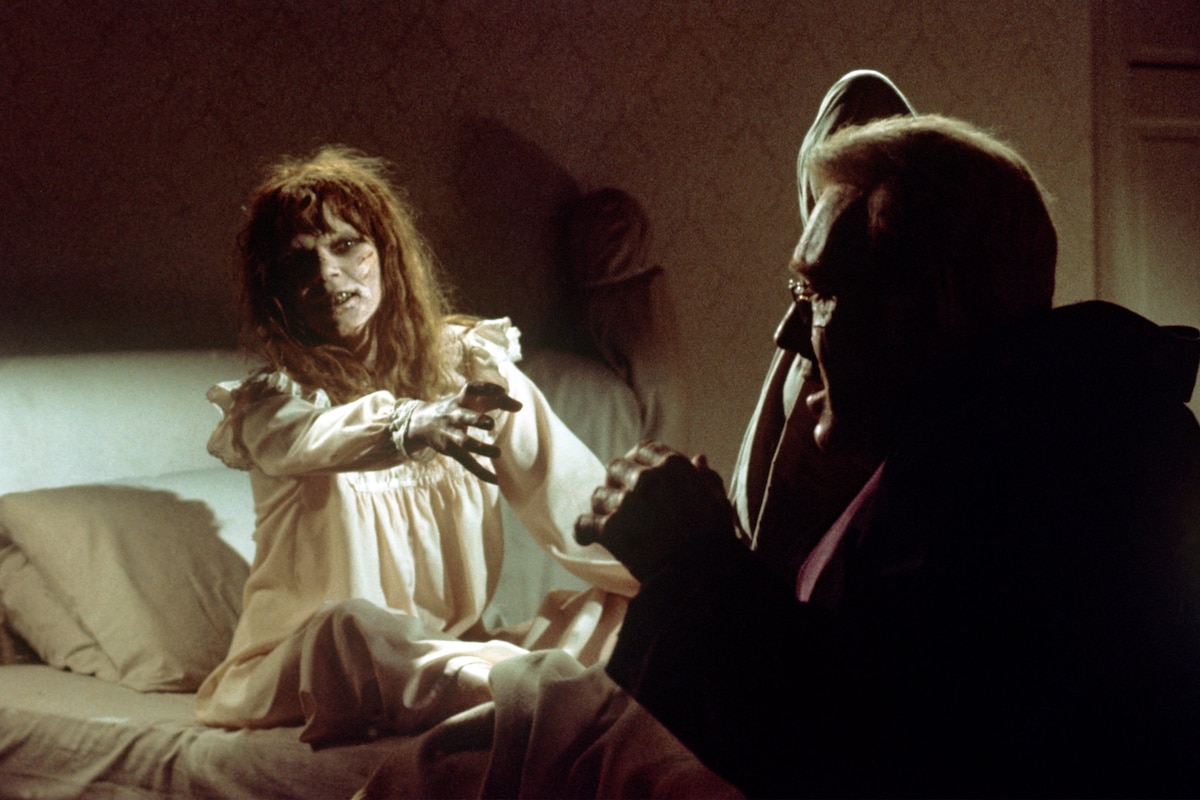
Several factors prevented this film from recapturing the flavor of the original in addition to the script issues. Blair refused to wear any demonic makeup again (a very unconvincing double is used for the sparing flashback scenes involving the synchronizer), though she did consent to contact lenses for the finale. The original Georgetown locations were no longer permissible for shooting, so the house and surrounding areas had to be recreated on a set. Most confusingly, since Ellen Burstyn refused to return as Chris MacNeil (the mother of Blair's character), several options were explored that ended up with Louise Fletcher, originally cast as a replacement Chris based on the initial script, playing Dr. Gene Tuskin and Kitty Winn reprising her role as Sharon from the original film. Two of Boorman's Deliverance actors were also approached; Jon Voight initially accepted the role of Father Lamont, ultimately played by Richard Burton as a much older man, while Ned Beatty appeared in what ultimately end up as a very brief role as a helicopter guide in Africa.
Plagued by illnesses that afflicted both Boorman and multiple cast members (not to mention hundreds of locusts that perished after being transported to the shoot), the film ballooned to a then-excessive budget of $12 million but was expected to be a top performer at the box office. Boorman's initial rough cut clocked in at a reported three hours, which he whittled down to 117 minutes for the film's initial theatrical dates. Audience and critical response was so intensely negative that all prints were withdrawn within a week, and a revised edition running 100 minutes took its place with no positive effect. The recut added a new explanatory prologue, deleted several sequences (including Blair's initial rehearsal tap dance performance), and revised the ending to kill off Burton's character. However, this version also adds a bloody shot during the finale of a cab driver impaled on a wrought-iron fence, more than enough to finally justify that R rating. The shorter cut was the only one available on home video and viewable on television for many years, though a VHS and eventual DVD and Blu-ray release of the longer 118-minute cut finally surfaced and has now become the norm.
Though still often cited on lists of "bad" Hollywood films, Exorcist II has enjoyed its fair share of high-profile admirers over the years including Pauline Kael and Martin Scorsese. One aspect consistently singled out for praise is its daring and haunting score by Ennio Morricone, highlighted by the dazzling rock-flavored tribal track "Magic and Ecstasy" (heard in the shorter cut's closing credits and over the film's exceptional theatrical trailer) and the lyrical "Regan's Theme," a version of which can be heard in Quentin Tarantino's The Hateful Eight (2015). Though it feels out of step with the prior film, this one has since been embraced as part of what would turn out to be a series, followed by the Blatty film and a far more troubled fourth sequel that ended up being shot twice as two different features, Renny Harlin's Exorcist: The Beginning (2004) and Paul Schrader's Dominion: Prequel to the Exorcist (2005). The story of Regan's supernatural siege has since transferred to other media as well including a somber stage production and an acclaimed television series for Fox.
By Nathaniel Thompson
Exorcist II: The Heretic
by Nathaniel Thompson | December 27, 2017
SIGN UP FOR OUR NEWSLETTERS

CONNECT WITH TCM